
In this review
For as long as I’ve been fly fishing I told myself bamboo was a thing you bought once the kids were through college and the truck was paid off. Wall money. Collector money. A bamboo rod was a pocket watch — beautiful, and not actually for telling time. Then I started actually pricing the new stuff this year and found a hand-planed Tonkin cane rod, on a real Payne taper, for less than I’ve spent on graphite I no longer fish. That broke something loose in my head.
Because here’s what’s actually happening: a new generation of makers figured out how to build cane without the four-figure heritage markup, a lot of us graphite lifers are remembering what a slow, deep-loading rod does to a close-in dry, and a category everyone wrote off as “museum stuff” is suddenly full of rods people fish. Not own. Fish.
So this is an honest roundup of the best bamboo fly rods you can buy new in 2026 — not a tour of vintage grails behind glass (those come at the end), but rods you can order today, sorted from “cheaper than a mid-range graphite stick” to “leave it to your kids.” Full disclosure on where I’m standing: I’m a graphite-and-glass guy who got talked into his first cane rod and is now mildly obsessed, so read this as the case for bamboo from someone still early in the learning — not a guy who’ll tell you he’s been planing penta tapers in a leather apron since the Carter administration. My everyday rods are still a Scott Centric, a Diamondback euro 3-weight and a glass 3-weight, and between them they cover most of my days. Cane is the addition, not the replacement.
How I picked these
Four things, in this order.
- Does it fish? Taper and action first. A gorgeous rod that casts like a curtain rod is a wall hanger, and I already have enough things on my walls. (If action is still a fuzzy word, start with fly rod action explained.)
- Build quality and warranty. Cane is hand work, and a real guarantee is what separates a serious maker from a guy with a planing form and a dream. Anybody can glue six sticks together once. Doing it the same way a thousand times is the trick.
- Value. What you pay against what you get. Bamboo’s price spread across this list is better than 11x — $500 at one end, $5,760 at the other, for two objects that a stranger at the boat ramp could not tell apart at ten feet — so value matters more here than in any other gear category.
- Who it’s actually for. A first cane rod, a legend-built keeper, and an engraved heirloom are three completely different purchases. Ranking them head to head is like asking whether a daily driver or a wedding ring is the better buy.
One thing I did not do: quote a price from memory. Every number here came off the maker’s own live page while I was writing, and where a shop lists variants I read the variant table instead of the headline price — because the “from” price is always the cheapest thing in the building, and that is not an accident. Half the bamboo roundups on the internet quote a maker’s entry model and describe their flagship. I did that once in a draft of this very post, caught myself, and have been insufferable about it since.

Everything below you can buy new today. The vintage Paynes and Leonards are their own beautiful, dangerous world — I get to them at the bottom.
Quick look
Every number below is the maker’s own current asking price, pulled off their own page, not a remembered figure or a “from” teaser. Where a maker runs two lines at very different money, I’ve said so rather than quoting the cheap one and letting you find out later.
| Rod / maker | Best for | Price (from the maker’s page) |
|---|---|---|
| Headwaters Bamboo | Lowest entry price into hand-planed cane | $500 (Favorite) / $600 (Deluxe); $750 top of range |
| Sweetgrass Rods | Best legend-built | $1,450 Mantra 2-pc · $2,200 Sweetgrass 2-pc |
| PJ’s Fine Bamboo | Best custom / build-your-own | $1,595 (Novice) – $2,895 (Freshwater Master’s) |
| R.L. Winston | Best overall performance | $3,500 (2-pc) – $4,000 (3-pc) |
| Orvis | Best classic production | $3,498 Penn’s Creek · $4,498 for the 1856 at dealers |
| Oyster Bamboo | Best artistry / heirloom | $3,920 Maker’s Choice · $5,760 Master Series |
| Thomas & Thomas | Best traditional taper | from $4,995 |
1. Headwaters Bamboo — the cheapest way into real cane
This is the one blowing the category wide open. Headwaters Bamboo is an Idaho outfit — founder David Rogers, writing from Sandpoint — that has been at this since 2002. The rods are hand-planed Tonkin built by artisan workshops in China that Rogers says he has worked with for over two decades, and sold direct-to-consumer only. No dealers, no middlemen, no retail markup. Into Fly Fishing named the Headwaters Deluxe series its Best Affordable Bamboo Fly Rod of 2026 — a series award, not a single-rod one, which is worth saying out loud because half the internet quotes it as though one specific rod won something. After digging through the lineup I’m not inclined to argue with the call — “affordable” and “bamboo” usually go together about as often as “quick” and “DMV.”

The lineup and what it costs. Eight models you can actually order today, all on named historical tapers — Payne, Dickerson, Granger, Paul H. Young, Phillipson — running from a Grande Ronde 6’6” 3-weight for creeks you can step across up to a McKenzie 8’6” 5-weight for water nobody would call small. Five more are on the site marked coming soon, including a 6’ 2-weight Neversink and an 8’6” 7-weight John Day; “coming soon” and “in stock” are different products as far as your August is concerned, and a roundup that blurs them is wasting your afternoon. The centerpiece is the Gallatin 7’6” 4-weight on the Payne 100, which Headwaters lists as a medium action and describes as loading “a half-step quicker than the 98” — the 98 being the Beaverhead, the technical-water specialist next to it on the shelf.
There are two series, not three, and the difference is what’s in the tube:
- Favorite — $500. One tip ($650 if the model is a three-piece).
- Deluxe — $600. Two tips ($750 on a three-piece). Buy that second tip later on its own and it’s $150, so it’s a hundred dollars now or a hundred and fifty in hindsight.
That really is the whole difference. Same cane, same taper, same fittings on both — red agate stripping guide, hard chrome guides, deep burgundy thread wraps, stabilized burled-maple insert — whichever series you buy. If you turn up a comparison chart claiming the Favorite drops to a plain chrome stripping guide while the Deluxe adds nickel-silver ferrules and hand-wrapped silk, ignore it. Every Headwaters model page lists one fittings spec for the rod and describes the Favorite as “Same rod, same fittings, same hand-planed cane.” The spare tip is the only line item that moves, which is a refreshingly boring answer to a question most makers would happily charge you to be confused about.
The matched Clark Fork 2.5 reel can be added with the rod at half price — $137.50 instead of $275.
Nothing in the current range tops $750 (the three-piece McKenzie and Madison in Deluxe trim). Both series carry a lifetime warranty for the original owner on workmanship plus a 30-day, fish-it-anywhere return with return shipping covered — which is a more generous return policy than I get on a pair of wading boots, for an object built one shaving at a time by hand. It’s the same craft that makes bamboo so expensive everywhere else, minus the heritage tax.
Honest con: these aren’t US-built. Hand-planed Tonkin, yes — planed in artisan workshops in China and shipped from a Utah warehouse. Headwaters doesn’t pretend otherwise; Rogers’ own About page walks you up the Sui River valley in 2009, to the hillsides where the cane grows, and the overseas build is exactly why the number is $500 and not $3,500. (The same supply-chain math is why flies cost more than they used to, just running the other direction.) The rest of the con is what the price actually buys: this is a catalog rod, not a commission. You pick from eight tapers, you don’t specify one. Nobody puts your name on the butt cap, there’s no bench in Montana with your rod on it, and there’s no maker to phone about the way it loads. The lifetime warranty covers workmanship, not the tip section you close a car door on — which is the honest argument for the Deluxe, and it’s a hundred dollars, not a philosophy. If made-in-USA is a dealbreaker, scroll down; the heritage makers are your people.
My take
This is where I point anyone curious about cane, full stop. I have a Gallatin and I’ve since put real days on it at Deckers — the full review is here, cons and all, because telling you how a rod casts off three afternoons is how a gear writer gets his credibility quietly mailed back to him. What belongs in a roundup is the value math, and the value math is ridiculous: a genuine Payne-taper rod, hand-planed, for the price of a mid-tier graphite stick you’d forget you owned. It’s the rod that lets you find out whether you love bamboo without spending heirloom money to ask the question.
Who it’s for: Anyone buying their first cane rod — and, honestly, plenty of people buying their fifth.
2. Sweetgrass Rods — best legend-built
Sweetgrass is Glenn Brackett, building in Butte, Montana. If the name doesn’t land: Brackett learned under Lew Stoner, Doug Merrick, Gary Howells and Tom Morgan, and it was Morgan and Brackett who moved R.L. Winston from San Francisco to Twin Bridges in the mid-seventies. Their own site puts him at 45 years at the rod bench. Buying a Sweetgrass isn’t really buying a rod. It’s buying provenance.
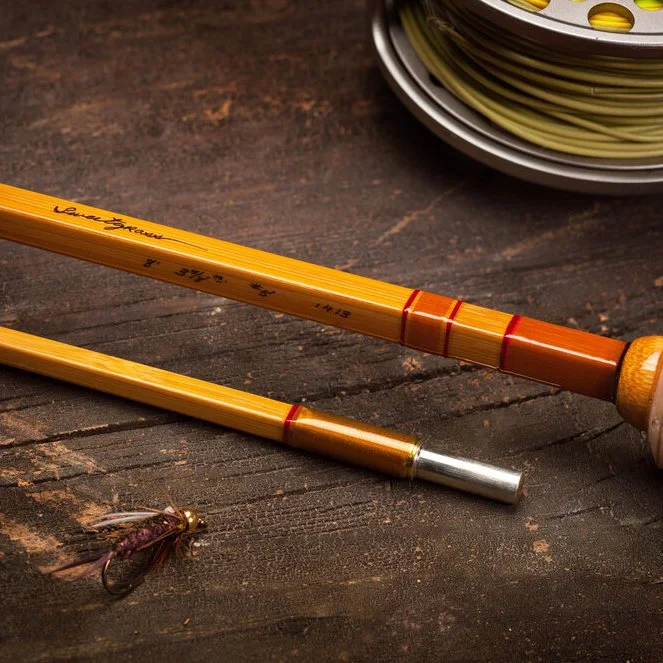
The shop is known for penta (five-strip) construction — a flat strip rides up top, directly under the line, and devotees swear it tracks and dampens beautifully — alongside traditional hex and even quad builds. The cane comes from the Cai family in the village of Aozi, in Guangdong, a relationship Brackett has run for decades, and every rod is described as the product of about 3,000 unique processes.
Read the price list carefully, because there are two lines and they are not close. The Mantra series is $1,450 two-piece / $1,750 three-piece — no upgrades offered, ti-chrome stripping guide, Bellinger hardware, shop’s-choice wood. The flagship Sweetgrass series is $2,200 two-piece / $2,700 three-piece. Plenty of write-ups quote “$1,450 for a Brackett rod” and stop there; that’s the Mantra, and it’s a genuinely great buy, but it isn’t the top of the shop, and finding that out at checkout is a bad afternoon. The catch on both is patience — they’re built one at a time on no clock anyone’s watching. Which is exactly the point. Nobody rushing a Brackett rod has understood the assignment.
Honest con: the wait is real and unscheduled, and you’re buying a name as much as a taper. If what you want is the best-casting rod per dollar, that’s two entries down and it isn’t this.
Who it’s for: The angler who wants real provenance without going to five figures.
3. PJ’s Fine Bamboo — best custom / build-your-own
If you want bespoke, this is the Colorado shop, which means I’m a little biased toward it. Paul Dufour (“PJ”) builds made-to-order cane at 456 Pagosa Street in Pagosa Springs, Colorado, and the Collector Series is listed in four tiers you can price today: Novice $1,595–$2,145 · Premium $2,195–$2,695 · Revered $2,395–$2,795 · Freshwater Master’s $2,895 — every one of them made to your taper, length, and hardware. The shop’s stated wait on a custom is five months, which in cane terms is practically same-day delivery.
Sit with that Novice number for a second, because it reorders this whole list: $1,595 is the cheapest made-to-order American cane on this page, it’s a hundred and forty-five dollars over a stock Sweetgrass Mantra, and it’s built in Colorado by a guy whose phone number is on his own website. Most roundups quote PJ’s off his top tier and leave you thinking bespoke starts at $2,400. It doesn’t.
Honest con: made-to-order means you’re choosing a taper you’ve never cast. That’s a great problem to have if you already know what you like in a rod, and a genuinely bad one if you don’t. Fish somebody else’s cane first.
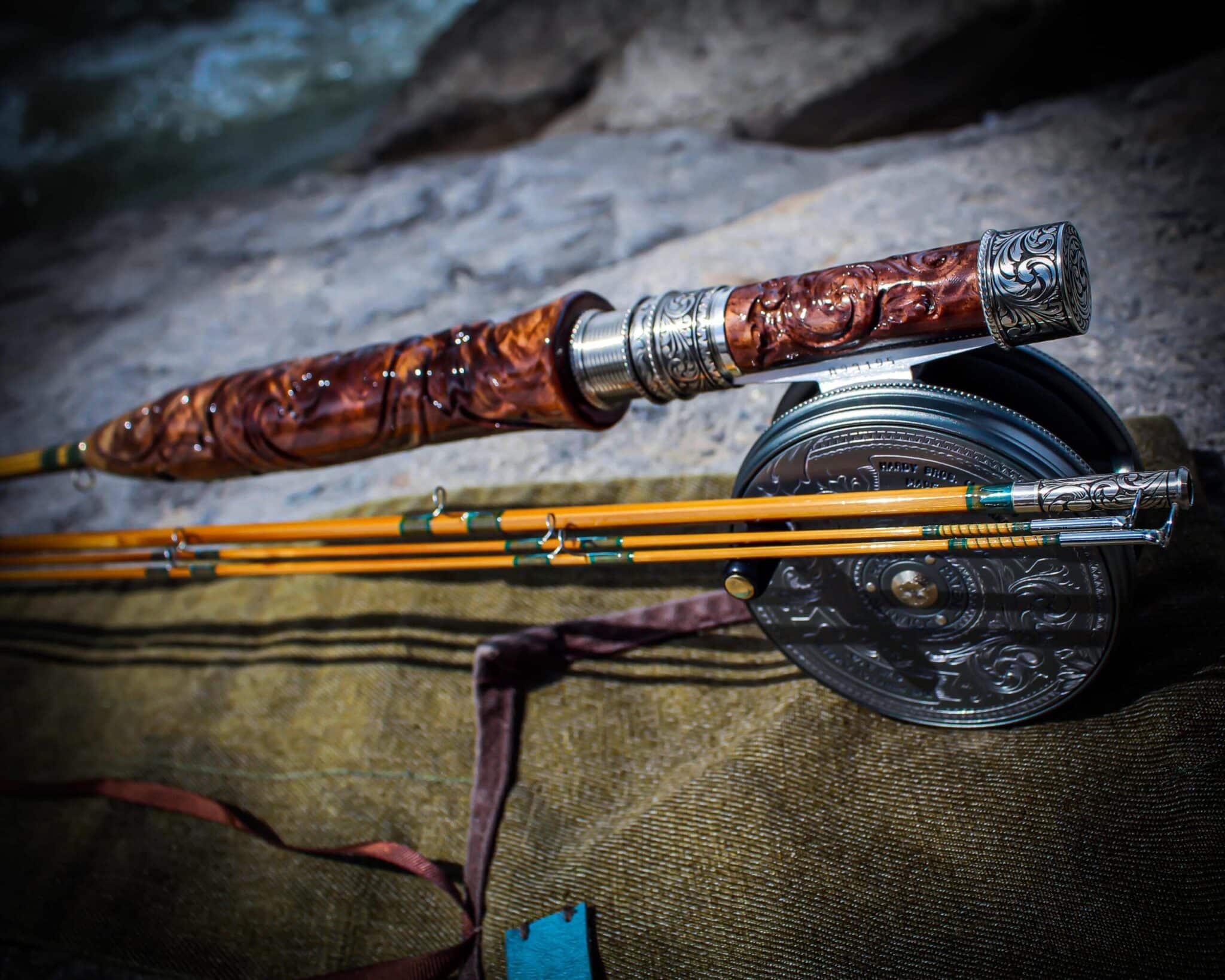
PJ also does something almost nobody else offers: six-day rod-building classes where you plane and wrap your own bamboo rod alongside him, plus in-person demos if you’re rolling through town. Six days of planing strips to thousandths of an inch is either a dream vacation or a nervous breakdown depending on your relationship with patience — I’m honestly not sure which camp I’d land in. It’s the rare maker where you can either commission the rod or become the builder. And for a Front Range guy, there’s something to cane built by someone who knows the same Colorado water you do — a rod that’s already met the rivers it’s going to fish.
Who it’s for: The angler who wants a rod built to exact spec — or who wants the experience of building it himself.
4. Orvis — best classic production
The oldest name in American fly fishing has been building cane in Manchester, Vermont since Charles Orvis opened the shop in 1856, and it still does. What’s on the site right now, though, is worth getting straight, because a lot of roundups get this wrong.
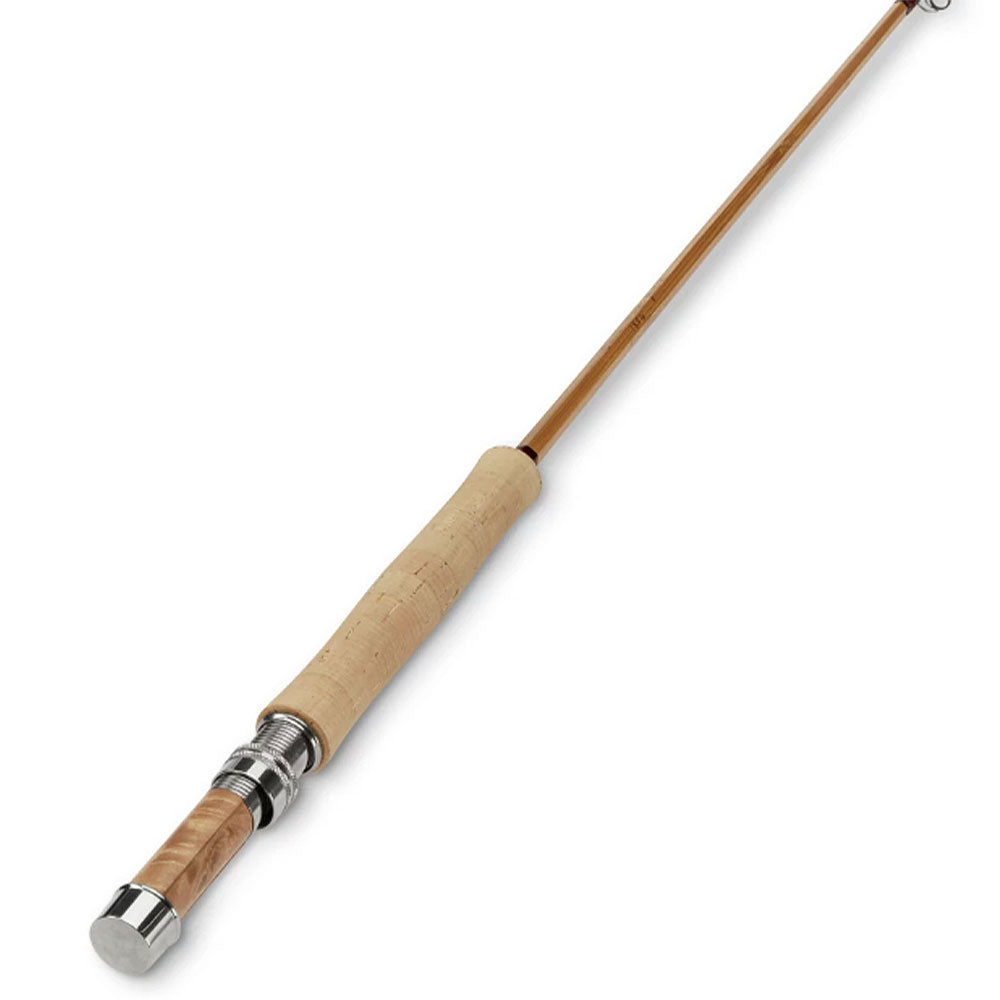
Orvis’s own bamboo page today lists one rod: the Penn’s Creek Full-Flex, a 7-foot 2-piece 4-weight at $3,498, made in the USA, shipped with two tip sections and backed by the Orvis guarantee — “we guarantee your rod to be free from defects for as long as you own it.” That’s the classic production cane rod you can actually put in a cart.
The famous 1856 — 8-foot, 3-piece, 5-weight, hollow-built for light weight and quick rebound, downlocking nickel-silver seat with a Vermont maple-burl insert, 6.5-inch full-wells grip, and a progressive flex you can under-line for a faster feel or over-line for a deeper load — no longer has a live product page on orvis.com; that URL now bounces you to the general rod listing. It’s still sitting on authorized dealer shelves at around $4,498.
Honest con: a rod that has quietly slid off its own maker’s website is a strange thing to spend $4,498 on. The warranty is Orvis’s and it’s excellent, so this isn’t a risk warning — it’s a supply warning. If you want an 1856, buy it while dealers still have them. That’s the whole nature of the production-cane tier: it exists until a spreadsheet decides it doesn’t.
Who it’s for: The collector-leaning angler who wants a blue-chip heritage rod from the oldest name in the sport.
5. R.L. Winston — best-casting cane money can buy?
If money’s no object and you want the performance benchmark, Winston is the name everyone else gets measured against. The company started in San Francisco in 1929, when Robert Winther and Lew Stoner began working the material and eventually patented the hollow-fluting process Winston says it still uses today. The rods are built in Twin Bridges, Montana.
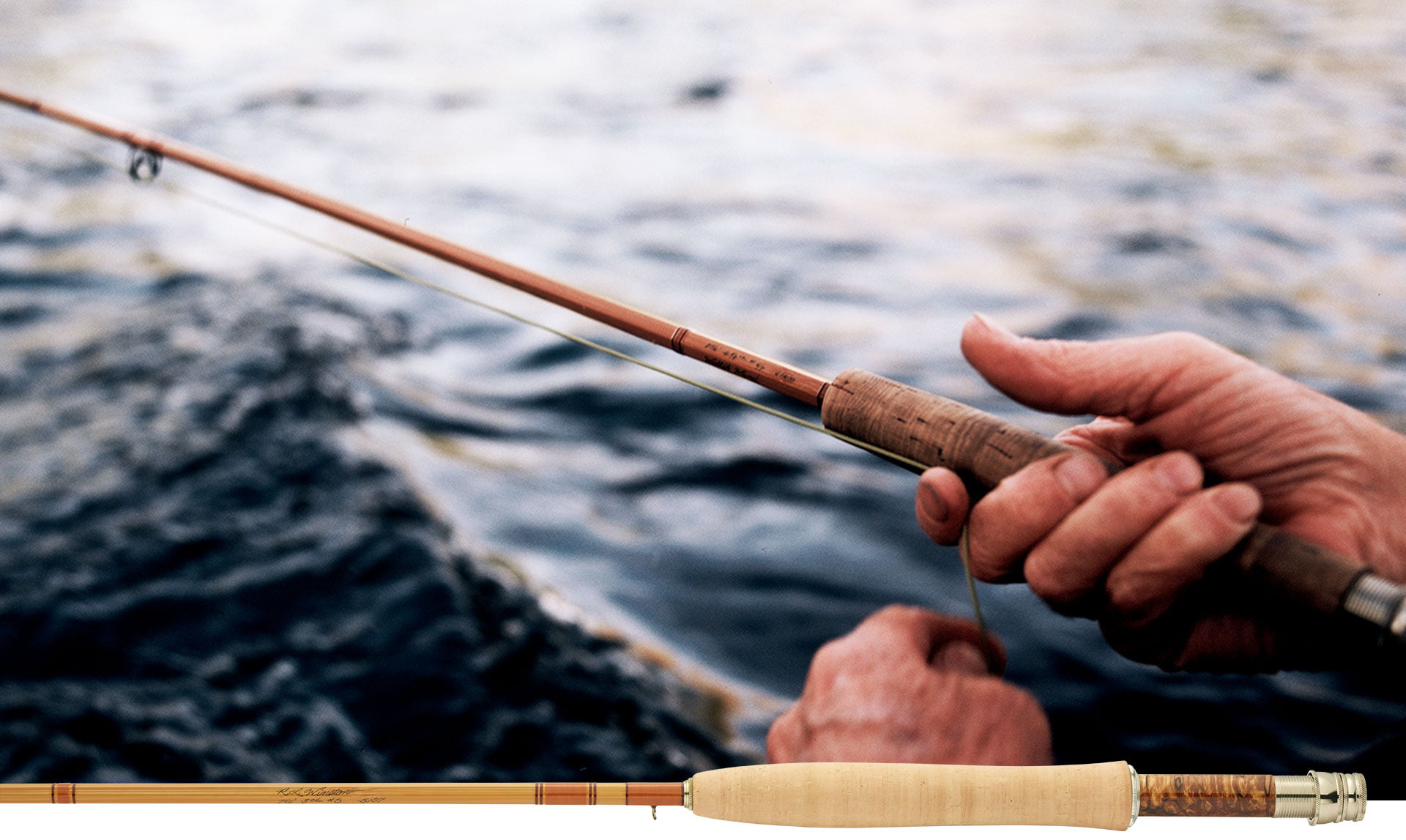
The spec sheet is unusually plain for a rod at this price: six hexagonal strips, slow action, agate stripping guide, titanium-plated snakes, nickel silver seat with a burled Box Elder or Spalted Alder insert. You choose 2-piece at $3,500 or 3-piece at $4,000 (one outlier, the 8’6” 5-weight three-piece, lists at $3,750), in 3- through 6-weight from 6 feet all the way to a 9-foot 6-weight — which, yes, exists, and no, you do not want to swing it all day. Winston asks you to call them or a dealer for current availability, which tells you what you need to know about how these get made.
By every account I trust, a Winston cane rod does everything a great graphite rod does — just slower, smoother, with more soul running through the cast. These don’t come off a rack any more than a good steak comes out of a vending machine. You’re not buying value here. You’re buying the rod the rest of this list is quietly trying to be.
Honest con: for a first cane rod this is absurd overkill, and the $500 you’d spend upgrading to the three-piece is, to the dollar, an entire Headwaters Favorite. Come here second.
Who it’s for: The angler who wants the best-casting cane made and isn’t flinching at the number.
6. Oyster Bamboo — best artistry / heirloom
Bill Oyster in Blue Ridge, Georgia, builds what are honestly as much engraved art objects as fishing rods. The hand-engraved nickel-silver hardware — done by Oyster himself, who’s as renowned for the engraving as for the rod-building — is the kind of work that ends up in glass cases and gets handed down. I look at one of these the way I’d look at a hand-tied salmon fly the size of my thumb: I admire it, and some quiet voice in the back of my head whispers don’t you dare lose it in a tree.
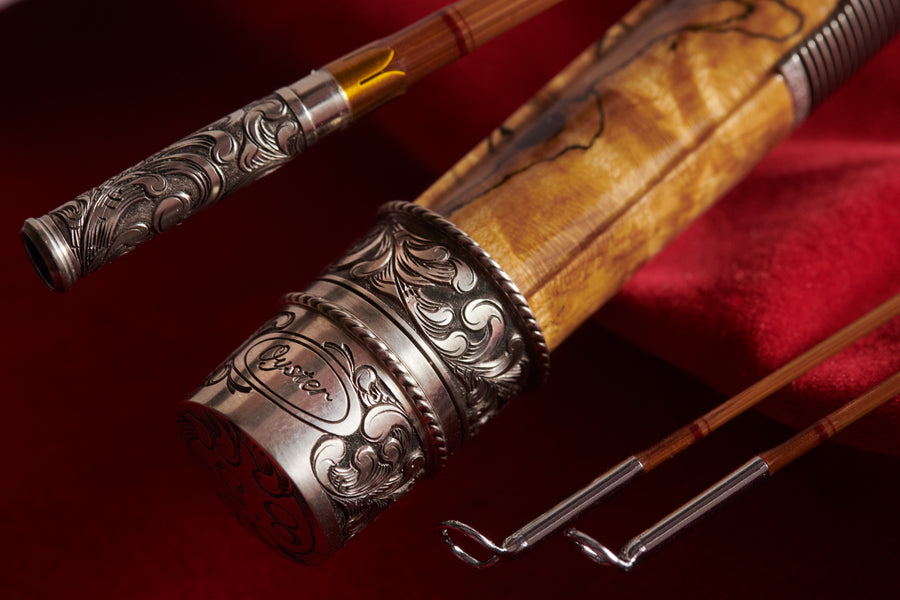
The trout rods are the Master Series at $5,760 — the 3-, 4- and 5-weights listed on the site all carry that same number, whatever the taper. The way in is the Maker’s Choice, a 7’9” 4-weight at $3,920, where Oyster picks the appointments instead of you. Above that sits the Flo Series at $8,985, at which point we’ve left the category of “fishing purchase” entirely. Oyster also runs the most sought-after rod-building and engraving classes in the country. Let’s be honest about what this tier is: you don’t buy an Oyster to save money, or even, really, to have a fishing tool. You buy it to leave it to someone.
Honest con: the engraving is the product. Nobody buying a $5,760 rod is doing it on casting numbers, and if you take it where you’d take a $500 rod, you will not enjoy the walk back through the willows.
Who it’s for: The heirloom buyer who wants a rod that’s also a piece of art.
7. Thomas & Thomas — best traditional taper
Thomas & Thomas was founded in 1969 by Tom Dorsey and Tom Maxwell and built its whole reputation on bamboo long before it was ever a graphite house. The cane is still hand-built in Greenfield, Massachusetts, and it’s some of the most respected traditional-taper work in the world.

If your taste runs to a crisp, proven dry-fly taper rather than a soft full-flex, T&T is the heritage name to know. The action is a touch more defined and presentation-oriented — the kind of thing traditionalists love for delicate dry work, and the kind of thing they’ll happily tell you about at length if you stand still long enough. It’s also the priciest entry point on this list: the current bamboo collection is the Sans Pareil 7’6” #4 at $5,500, the Individualist from $4,995, and the saltwater Sextant from $4,995. There is no starter T&T cane rod. That’s a position, not an oversight — the cheapest way into this shop is roughly ten Headwaters Favorites, and I want to be clear that I have considered that trade at length.
Honest con: there’s no way to sample this shop cheaply, and two of its three current cane listings are a saltwater rod and a flagship — a trout buyer is really choosing between two rods, neither under $4,995. If you’re not already sure you want a crisp dry-fly taper, you’re paying T&T money to find out.
Who it’s for: The traditionalist who wants a recognized heritage name and a proven dry-fly action.
What about the vintage grails?
Buy them with your eyes open, because no bamboo conversation is honest without the old masters — Payne, Leonard, Garrison, Dickerson, Young. These are the names every rod above is quoting; four of the seven makers here build on their tapers by name, which is its own small lesson in how much of this sport is inherited. You don’t buy these new; you hunt them on the used and auction market, and prices run from a few hundred bucks for a tired production rod to five figures for a clean Garrison. It’s beautiful, fishable history. It’s also a market where condition is everything and fakes absolutely exist, so know what you’re looking at or bring someone who does — this is not the corner of the hobby where you want to learn by getting burned. For a rod you’ll actually fish hard, the makers above are the safer money.
There are also a few small custom builders worth a look beyond PJ’s — High Sierra Rod Co. (pentagonal cane) and Spinoza among them — if you want something built to your spec instead of off a list.
Why is bamboo so expensive?
Because it’s the better part of a hundred hours of hand labor on a single-source natural material — there’s no shortcut and no factory mandrel. Tonkin cane only grows in one small region of China; every strip gets split, planed to thousandths of an inch, glued, wrapped, and finished by a person. Sweetgrass counts it as roughly 3,000 discrete processes per rod. Graphite, by comparison, gets baked in an oven like a very expensive croissant. The full breakdown lives in why bamboo fly rods are so expensive, and it’s exactly why Headwaters can sell real cane so cheaply: that hand work happens in their overseas workshops and the rods ship direct, so there’s no US-shop labor premium and no dealer markup stacked on top. (More on the raw material in what is Tonkin cane, and the whole build in how a bamboo fly rod is made.)
Hex, penta, or quad — does it matter?
Not for your first rod, no. Here’s the whole debate in three lines:
- Hexagonal (six strips) — the standard, and what most of these rods are. Winston’s spec sheet says it plainly: six hexagonal strips. Proven, balanced, traditional. Buy this.
- Pentagonal (five strips) — Sweetgrass’s signature; a flat strip rides up top under the line, and fans say it tracks beautifully.
- Quad (four strips) — rarer, a slightly different feel and faster recovery. Sweetgrass builds those too, if you ask.
For a first cane rod, don’t overthink it. Buy hex. The geometry rabbit hole is a problem for your second bamboo rod, and trust me, there will be a second one. Ask me how many rods I own sometime, then don’t.
What length and weight should you buy?
Short and light. Bamboo rewards a specific kind of fishing — close, deliberate, dry-fly and small-water work — so for trout you want a 7’ to 8’ rod in a 3- to 5-weight. A 7’6” 4-weight (the Gallatin’s spec) is about the perfect do-everything cane trout rod, for the same reasons a 4-weight earns its keep on a tailwater in any material. Go shorter for genuinely tight blue-line water; go longer and heavier only for big water, because cane gets heavy in the hand fast above a 6-weight.

What you should not do is buy one to euro-nymph with. Roughly half my days are on the tight-line rig and the other half on a regular line, and cane has no place on either end of the first half: tight-lining wants a 10-to-11-foot rod for reach and line control, and bamboo trout rods are short by design — that’s the whole euro rod vs. indicator rod split, and cane doesn’t sit on either side of it. Wrong tool, wrong job. Cane is a dry-fly and dry-dropper instrument — think a PMD or Trico morning on flat water — and that’s a feature, not a limitation. For how glass, graphite, and cane actually feel different in the hand, I broke it down in fiberglass vs graphite vs bamboo; for choosing any rod for this water, how to choose a fly rod for a tailwater.
Caring for cane
A bamboo rod isn’t fragile, but it isn’t graphite either, so treat it like the hand-built thing it is. Never store it wet or leave it in a hot car — heat and trapped moisture are what kill the glue and varnish, and a cane rod cooking on the back dash all afternoon is a slow-motion mistake you only make once. Break it down by pulling straight (don’t twist the ferrules), give the ferrules an occasional wipe, and store it tube-up so it hangs straight.

Every rod on this list ships in a hard tube and a sock; use them, including on the drive. If your rods currently live loose behind the seat — mine did for years, and I have the tip sections to prove it — a roof-mounted rod vault or even an honest truck kit is a cheaper fix than a repair. None of it’s hard. It asks a little more attention than graphite, the way a leather boot asks more than a sneaker. Do that much and a good cane rod outlives you, which is sort of the entire pitch of the heirloom tier.
Frequently asked questions
What’s the best affordable bamboo fly rod? Headwaters Bamboo — $500 for the single-tip Favorite, $600 for the two-tip Deluxe, direct-to-consumer, and Into Fly Fishing named the Deluxe series the best affordable bamboo rod of 2026. The direct model plus China-workshop construction is what puts real hand-planed Tonkin cane at that price, and they’re upfront it isn’t US-built.
What’s the cheapest US-built bamboo fly rod on this list? Sweetgrass’s Mantra at $1,450 (two-piece), out of Glenn Brackett’s shop in Butte, Montana — with PJ’s Novice Collection at $1,595, made to order in Pagosa Springs, right behind it. Those two are the floor for new American cane, and the fact that a bespoke build sits within $145 of a stock one is the most interesting number in this post. There is no $700 American cane rod, though, and anyone telling you otherwise is quoting a blank, not a rod.
Is a bamboo fly rod worth it? For close, deliberate dry-fly and small-stream fishing, genuinely yes — the slow, deep load does something graphite can’t, and a good one lasts generations. For distance casting, big water, or euro nymphing, no. Use graphite. See fly fishing essentials for beginners if this would be your first rod of any kind — it shouldn’t be.
What’s the best bamboo rod for someone new to cane? The Headwaters Gallatin 7’6” 4-weight. It’s cheap enough to experiment with and a forgiving medium action that teaches you what cane wants instead of fighting you.
How long will I wait for a bamboo rod? It depends entirely on which tier you buy, and it’s the spec nobody puts in the table. Headwaters builds to stock and ships in days. PJ’s quotes five months on a custom. Sweetgrass is built one at a time with no published queue — you order and you wait, and the shop will tell you as much. Winston asks you to call for availability, which is its own answer. If there’s a date attached to why you want the rod, ask before you order, not after.
What weight and length bamboo rod should I get for trout? A 7’ to 8’ rod in a 3- to 5-weight. A 7’6” 4-weight is the do-everything pick.
Can you fish bamboo on a tailwater? Yes — for dries, dry-dropper, and close technical work it’s a joy. It’s not the tool for deep nymph rigs, and it’s not the tool for a windy afternoon on the Deckers flat. On pressured tailwater fish, though, a soft tip and a leader that lands like nothing is exactly the argument for cane. See how cane stacks up against glass and graphite.
New or vintage? New, for a working rod you’ll actually fish — you get a warranty and known condition. Vintage (Payne, Leonard, Garrison) is for collectors who know the market and accept the risk.
Why are Winston and Orvis bamboo rods so expensive? Heritage-shop hand labor, small batches, the brand, and US construction. Winston is $3,500 two-piece and $4,000 three-piece; Orvis’s current Penn’s Creek is $3,498. They’re superb — you’re paying the full traditional markup the direct-to-consumer makers skip.
Why is Headwaters so much cheaper than everyone else? Two reasons: they sell direct-to-consumer (no dealer markup), and the rods are built by artisan workshops in China rather than in a US shop. The cane, the historical tapers, and the hand-planing are the real thing — they cut the cost, not the craft — but the overseas build is a big part of why they undercut the US-built makers, and Headwaters says so plainly on its own About page.
Does a Headwaters rod come with a reel? Not included, but discounted: Headwaters offers the Clark Fork as a rod-purchase add-on at $137.50, half its standalone $275. If you’re pricing a whole outfit, the $137.50 you save on the reel is worth more than the entire $100 that separates the Favorite from the Deluxe — so the reel, not the series, is where the real money moves. (For what a good reel costs on its own terms, see best fly reels under $500.)
Which bamboo maker is in Colorado? PJ’s Fine Bamboo, in Pagosa Springs — Paul Dufour builds custom cane and runs six-day build-your-own classes. (High Sierra and a few other small builders are out West too.)
How do I care for a bamboo rod? Store it dry and cool, never in a hot car, pull ferrules straight (don’t twist), and store it tube-up. Reasonable care equals a multi-generation rod.

Bamboo, honestly — the pros and cons
Each rod above has its own honest con; that’s the section-by-section stuff. This is the category-level question — should you be buying cane at all? The straight pros and cons, before you spend a dollar.
Pros
- The load is real, and it’s the whole point. A slow, deep-flexing cane rod does something to a close-in dry-fly cast that graphite simply doesn’t — you feel the rod work all the way into the grip. On the right water it’s the most tactile cast in fly fishing.
- It slows you down, and that’s a feature. Cane rewards deliberate, close, one-good-cast fishing. If your favorite days are the quiet technical ones, this is your material.
- It genuinely lasts generations. Reasonable care and a good cane rod outlives its owner. Almost nothing else you buy for this sport is an heirloom on purpose.
- The floor has dropped. Hand-planed Tonkin now starts at $500. Cane stopped being wall money the year Headwaters undercut the heritage tier.
Cons
- It’s a specialist, not a quiver-killer. Wrong tool for distance, wind, big water, streamers, and — emphatically — euro nymphing. If you own one rod, this isn’t it.
- It asks for more care than graphite. No hot cars, no wet storage, pull the ferrules straight. Not hard, but not “toss it behind the seat,” which, for the record, is how I lost a tip once.
- Above the entry tier, you pay for the name and you wait for the rod. A bench-built heritage rod is four figures and an unscheduled wait measured in seasons. Worth it, but go in clear-eyed.
- It’s heavier in the hand up top. Cane gets tiring above a 6-weight, which is exactly why every pick here tops out in trout weights.
The honest summary: bamboo is the best second rod almost nobody needs and plenty of us buy anyway. Know which it is for you before the box shows up.
Bottom line
Bamboo has never been this accessible, and that’s the whole story of 2026. If you’ve been curious but scared off by the price — same, for most of the time I’ve been doing this — start with the Headwaters Gallatin at $500, or $600 if you want the second tip. It’s the rod that proves hand-planed cane doesn’t have to cost what a used truck does, and on paper it’s my pick for the best value in the category, period. If you’ve got the budget and want the performance benchmark, go Winston at $3,500; if you want art, Oyster; if you want a piece of cane history without five figures, a Sweetgrass Mantra at $1,450; if you want it built to you — or by you — PJ’s. But the headline is simple: the best bamboo rod for most people is finally one most people can actually buy.
Next: see why cane costs what it costs, then how a bamboo rod is actually built — and where a cane rod would sit in my own South Platte quiver.