
In this guide
The South Platte gets most of my attention. But every season there are days I just need to disappear — no crowds, no pressure, no fish that have already been caught seventeen times and seen every fly in my box. Those days I go looking for blue lines: the little unnamed creeks that don’t show up on any report. And for those creeks, I reach for the Scott F Series — a rod I had absolutely no practical need for and bought anyway. You see where this is going.

The short answer
The Scott F Series 7’2” 3wt is a slow-action, five-piece E-glass rod built for one job: 15-foot presentations on tight, overgrown blue-line creeks, where fiberglass loads off the tip in casts a graphite 3wt shrugs off. Scott asks for 94–106 grains on this model — a true-to-weight 3, and a DT3 is my pick inside that window. It packs into an 18-inch tube for hiking in, and it runs out of energy past 30 feet — so it’s a specialist, not a do-everything rod. Price: $695.
No, you don’t need one. Neither did I. That’s not the point.
What E-Glass Actually Means
E-glass is fiberglass — elastic glass, Scott calls it. It’s not a nostalgia play. It’s a fundamentally different material than graphite that does specific things better at specific distances.
Under 20 feet, where small-creek casting actually happens, fiberglass loads when graphite barely feels the line. The F Series will load off the tip in a 15-foot cast that a graphite 3wt just shrugs off. That translates to more accurate presentations at the distances that matter on tight water, and more forgiveness when the timing is off.
The action is slow. Genuinely slow — not “moderate-fast” by marketing-language standards. Actually slow. You slow your stroke way down, you feel the rod load through the entire blank, and you wait for it. If you’re the impatient type — and on a good day I am — it’ll teach you patience whether you signed up for the lesson or not. That feel is the point.
The Five-Piece Design
Scott builds the F Series 7’2” as a five-piece rod with internal ferrules. Four ferrules in a 7’2” rod is an engineering challenge — ferrule connections are where glass rods usually lose feel. Scott’s internal ferrule system solves this well enough that the rod feels seamless, not segmented. Reviewers have called it one of the most impressive ferrule solutions in fiberglass.
The practical benefit: the rod packs into an 18-inch tube. It goes in a carry-on, a daypack, a jacket pocket. When I’m hiking to a creek that nobody else bothered to hike to, the rod is already there with me.
On the Water
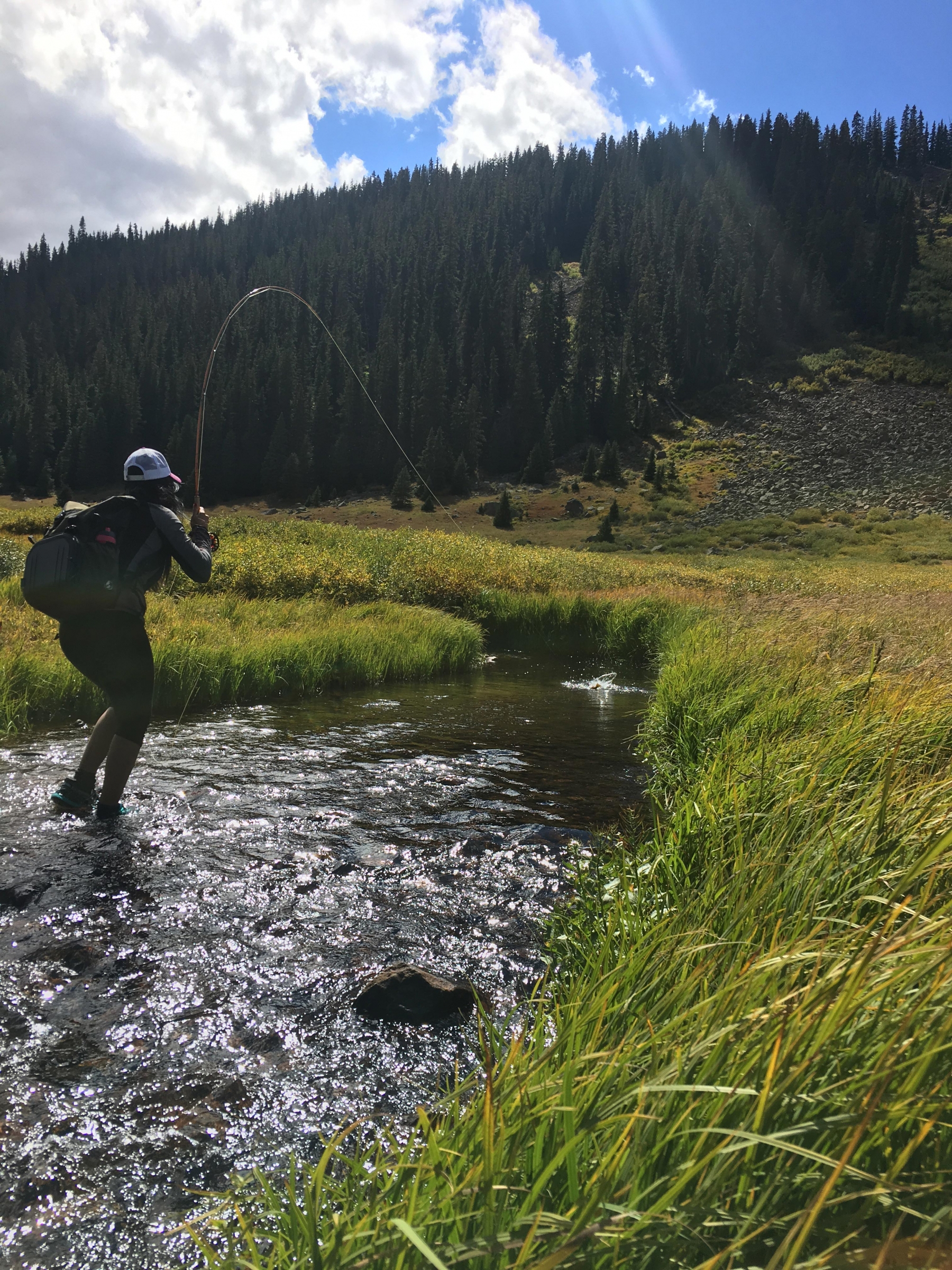
A 10-inch brown trout on 6X on a 3wt glass rod fights like something twice its size. The slow action absorbs the surge and amplifies the feel. These aren’t South Platte fish with miles of runs behind them — they’re wild, fast, and unaware that anything has changed. Landing one on the F Series is its own kind of satisfaction.
The 7’2” is the right length for the short game. Long enough to reach through brush without struggling, short enough to stay out of the overhanging limbs that will destroy a cast on a creek that’s 15 feet wide.
Scott doesn’t recommend a taper for this one — they publish a grain window. The FS 7235 asks for 94–106 grains, which is a true-to-weight 3 and nothing heavier. I fish a DT3 in that window because the long belly suits a rod I’m loading at 15 feet, but that part’s my preference, not Scott’s instruction. A DT3 and a patient stroke is the whole recipe.

My take
Full disclosure on the verdict: I cannot build you a rational case for this rod, and I’ve stopped trying. I own faster rods, more versatile rods, rods that do ten things instead of one. But the days the F Series comes out are the days I’m not trying to accomplish anything — no crowds, no pressured fish, just a tight little creek and a casting stroke that refuses to be rushed. Some gear makes you a more efficient angler. This one makes me a happier one, and that turns out to be a category I’m willing to pay for.
Limitations
This is not a 40-foot rod. At distance, the slow action runs out of energy and the accuracy suffers. Don’t fish it on open water expecting anything from it past 30 feet. It’s built for one thing. But that one thing — 15-foot presentations in tight, overgrown, beautiful water — it does better than anything I’ve ever fished.
So no, you don’t need a five-piece glass 3wt. Neither did I. But the days it earns its keep, hiking into water nobody else bothered with and bending double on a wild 10-incher, I forget the price tag entirely. Buy once, cry once — then go disappear for an afternoon.
Price: $695 | scottflyrod.com
Part of my six-rod South Platte quiver.