
In this review
I once spent more than I’ll admit on a rod because the catalog said “lightning-fast” and the guy at the shop nodded like that was obviously what I wanted. I took it to Deckers, fished dries at 25 feet, and spent the morning wondering why my casts were piling up in a sad little heap. The rod was fine. I was fine. The action was completely wrong for what I was doing. That rod and I were never going to be happy together, and it took me an embarrassingly long time to figure out why.
So let me save you the tuition. Action is the single thing that most determines how a rod feels and whether it fits the way you actually fish — more than the brand, more than the length, more than the price or the color of the blank. Get it right and the rod disappears in your hand. Get it wrong and you’ll fight the thing every day and quietly blame yourself.
The short answer
Fly rod action is where a rod bends under load and how fast it springs back: fast (tip-flex) rods throw the most line speed and distance for big water, streamers, and wind but punish sloppy timing; slow (full-flex) rods bend deep, land a fly softly, and protect light tippet but run out of gas past 30–40 feet; medium/medium-fast (mid-flex) sits in between and is the most forgiving all-arounder. For most trout fishing — and for any beginner — a medium-fast 9-foot 5-weight is the answer, which is exactly why it’s the most popular trout rod alive. Fast isn’t an upgrade; it’s a specialty. Match the action to your water and your stroke; everything below is the why.
What does fly rod action mean?
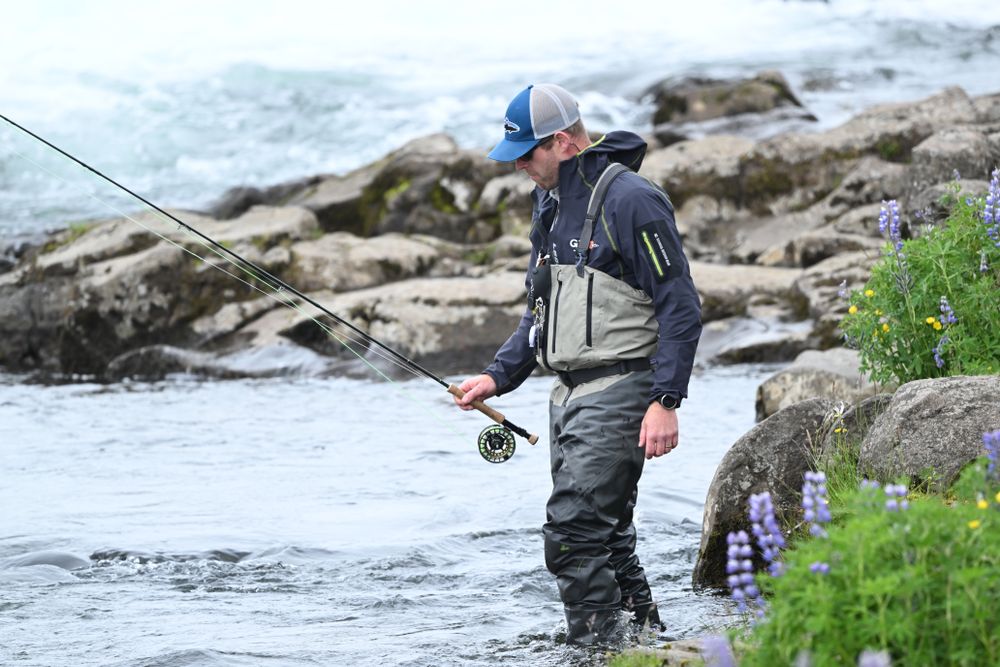
Fly rod action means two things: where the rod bends under load, and how fast it springs back to straight. A “fast” rod bends mostly up near the tip and recovers in a blink. A “slow” rod bends deep down toward the cork and comes back gently. Everything else is shades in between. That’s the whole concept — the rest is marketing wearing a fishing vest.
It helps to split that into two ideas, because the industry mashes them together and confuses everybody:
- Flex = where it bends — tip, middle, or all the way down. Set mostly by the taper (how fast the blank’s diameter changes from butt to tip).
- Recovery = how fast it stops bending and returns to straight after your stroke. Set mostly by the blank’s stiffness and material.
Why split them? Because the rods you actually fall in love with bend deep and recover fast — what casters call “fast but full.” That combo is why a great rod feels powerful and smooth at the same time: it loads deep enough that you feel it work, then snaps back clean enough to throw a tight loop. A cheap rod bends fine but recovers like a wet noodle — the tip keeps wobbling after you stop, and that wobble runs down your line as waves that wreck your accuracy. When somebody says a pricey rod feels “crisp” and a budget one feels “mushy,” recovery is what they’re feeling.
Where action actually comes from
You don’t need an engineering degree, but knowing the levers lets you read a rod honestly instead of trusting the sticker:
- Taper is the main lever for where it bends — the real source of action. Two rods of the same weight and length can feel like totally different animals purely because of how their tapers are cut.
- Modulus (the stiffness of the carbon fiber in a graphite rod) mostly sets recovery and weight — higher-modulus blanks snap back faster and weigh less, which is why flagships feel quick and feathery. It’s not free, though: the highest-modulus rods are also more brittle and less forgiving, so “most expensive” isn’t automatically “best for you.”
- Wall thickness fine-tunes the local bend and the swing weight.
Translation: “action” isn’t one dial you turn. It’s taper plus material plus build, which is exactly why a $250 rod and a $1,000 rod both stamped “fast 5-weight” can feel nothing alike.
The three actions, in plain terms
Fast action (tip-flex)
Stiff through the lower two-thirds, bends mainly in the tip. It generates serious line speed and tight loops, throws distance, and slices wind. Lift a sunk nymph rig off the water, set the hook at 50 feet through a belly of line, punch a streamer into a headwind — fast rods eat that up.
The trade is real, and it’s why “fast” isn’t a synonym for “good”: a fast rod demands timing and a crisp stroke. Load it too lightly — not enough line out, too soft a stroke — and it just won’t bend, and your casts collapse at short range (ask me how I know). Rush the stroke and it spanks you with tailing loops. It also hides the load from your hand, so it feels more like a precision instrument than an extension of your arm. Best for: big water, distance, wind, streamers, heavy nymph rigs, and casters with a dialed stroke. Think: the Sage Igniter at the extreme, and most modern “fast” flagships.
Medium / moderate action (mid-flex)
Bends into the middle third. This is the all-around compromise — enough tip to reach out and turn over a leader, enough flex to forgive your timing and lay a fly down with some grace. It loads at the distances where trout actually get caught (25–40 feet), protects tippet better than a fast rod, and is just plain easier to cast well across more situations.
It’s the most versatile action and the most forgiving, which is precisely why a medium-fast 9-foot 5-weight is the most popular trout rod on the planet. Think: a Winston Pure 2 (leans medium) or a Scott Centric / Orvis Recon (medium-fast).
Slow / full action (full-flex)
Bends deep — “down into the cork.” It loads at spitting distance with almost no line out, lands a fly like a snowflake, and acts as a built-in shock absorber that protects light tippet on the hookset and the fight. It’s also just fun — there’s a reason people fall back in love with fly fishing the first time they bend a slow rod fully on a 10-inch brookie.
The trade is distance and wind: a slow rod runs out of gas past 30–40 feet and gets shoved around in a breeze. Not a flaw — a focus. This is the home of small streams, delicate dries, and most fiberglass and bamboo. Think: a Scott F Series or Epic glass rod, and essentially all cane.
Action at a glance
| Fast (tip-flex) | Medium (mid-flex) | Slow (full-flex) | |
|---|---|---|---|
| Bends | In the tip | Into the middle | Deep into the butt |
| Line speed / distance | Highest | Moderate | Lowest |
| Wind | Best | OK | Poor |
| Forgiveness / feel | Least forgiving | Forgiving + crisp | Most forgiving, most “feel” |
| Tippet protection | Least | Good | Best |
| Short-range delicacy | Poor | Good | Best |
| Best for | Big water, streamers, wind | All-around, one-rod quiver | Small streams, delicate dries, fun |
The same rod feels different on a different line
Here’s a thing that quietly drives people nuts: the same rod feels faster or slower depending on the line you hang on it. The rod’s built to load with a certain amount of line mass, so:
- Underlining (a 4-weight line on a 5-weight rod) makes it feel faster and stiffer — keeps loops tight at distance.
- Overlining (a 6-weight line on a 5-weight rod) makes it feel slower and softer, loading deep at short range — a great trick to wake up a too-stiff fast rod.
So before you decide you hate a rod, make sure the line actually matches it — and know that a lot of modern lines run a half-size to a full size heavy of what’s printed on the box. Half the “this rod feels dead” complaints I hear are really a line problem in a trench coat.
How can you tell a rod’s action when you cast it?
Cast it with real line out and watch two things: where it bends, and what the tip does when you stop. Wiggling it in the shop tells you nothing — that’s the fly-shop equivalent of kicking a truck’s tires.
- Bends only near the tip and snaps back instantly → fast.
- Flexes into the middle and recovers smoothly → medium.
- Whole rod loads deep and settles slowly → slow.
- Tip keeps wobbling after you stop → poor recovery (a cheap blank, whatever the label claims).
And cast it at the distance you actually fish, not just a hero cast across the parking lot. A rod that feels electric at 60 feet can be a total chore at the 25 feet where you’ll spend your real day.
What action is best for a beginner?
Medium or medium-fast — don’t overthink it. A new caster needs forgiveness: a rod that loads visibly and gives you a beat of slack in your timing. A medium rod does that and lets you feel the load, which is how you learn to time a cast in the first place. A fast rod hides what it’s doing and punishes a rushed stroke, so it makes a hard thing harder. Skip the broomstick “tournament” rods until your stroke’s dialed — they teach bad habits and bruise your confidence, and confidence catches more fish than stiffness ever will.
Is a fast or slow rod better for trout?
Neither — it depends on the water. On big, windy rivers, throwing streamers, or fishing indicators at distance, fast wins: you want the line speed and reach. On small creeks and spring-creek flats, fishing dries to spooky fish, slow-to-medium wins: you want soft presentation and tippet protection. For one rod that does the most trout fishing acceptably, a medium-fast 9-foot 5-weight is the answer, and it’s no accident it’s the most popular trout rod alive.
On my home tailwater I lean medium-fast for the everyday stuff — my quiver is built around it, and you can see how I match rod to the water there — but the second I’m casting dries to wary risers, I want something softer that drops the fly without a splash. Same angler, same river, different action for the job.
The myth that costs people money: fast = better
If you take one thing from all this, take this: fast action is not an upgrade. It’s a specialty. Somewhere the industry trained us to read “fast” as “high-performance” and “premium,” and it has sold a whole lot of stiff rods to people who’d cast better, and have a lot more fun, on something medium. Fast rods are the right tool for distance, wind, and big flies — and the wrong tool for a beginner learning to cast or anyone fishing dries at 25 feet. (See: me, one expensive morning at Deckers.) Buy the action that matches your water and your stroke, not the one that sounds most aggressive in the catalog.
My take
Action is the heart of how a rod feels, and it’s the spec most worth getting right — way more than chasing the lightest or priciest blank on the wall. Figure out the water you fish most and the stroke you actually have, and match the action to that: medium-fast for the all-around trout angler, softer for small water and dries, faster for big water and big flies. Do that and the rod gets out of the way and lets you fish. Don’t, and you’ll spend a lot of money learning what I learned the hard way at Deckers.
Next up: if you’re trying to actually choose a rod, start with how to pick a fly rod for tailwater, then see how it all fits together in my six-rod quiver.