
In this review
My wife once asked me, in the genuinely curious tone of a person who does not understand fly fishing, why I needed six rods when I only have two hands and can fish one river at a time. I said something about “different tools for different jobs,” which is true, and also exactly what I’d say if I were trying to justify a seventh. She let it go. I have not let it go, because the honest answer is more interesting than the dodge: I needed three rods. The other three are a story about how it gets out of hand.
So let me give you the version I wish someone had given me before I started buying. Here’s what one rod gets you, what the second one actually adds, what the third one fills in — and then, as a public service and a confession, my own six-rod quiver as the cautionary tale of what happens when you keep going. The goal isn’t a wall of rods. It’s the right few for the water you actually fish.
I’ll frame all of it around my fishing — Colorado tailwater plus small high-country water, splitting my season about evenly between euro nymphing and a standard line — because that’s a common setup and it makes the logic concrete. Swap in your home water and the same reasoning holds.
If you’re not here for my financial confessions, here’s the whole answer in five bullets:
- One rod: a 9’ 5-weight, medium-fast — or a 10’ 3-weight euro rod if your fishing is nymph-heavy. Buy it, go fishing, stop reading.
- Two rods: add the 10’ 3-weight euro rod (or the 5wt, whichever you skipped). Now you cover ~90% of trout fishing.
- Three rods: add the specialist that fills your biggest gap — a short 3-weight for creeks, or a 9’/10’ 6-weight for streamers.
- Four and up: you’re buying joy, not capability. Totally fine. Just call it joy.
- The one test that matters: does the new rod do a job your current rods do badly — not differently, badly? If not, it’s a want, not a need. I flunk this test regularly.
What’s the one fly rod everyone should start with?
A 9-foot 5-weight, medium-fast action — and it’s not close. If you buy one rod and never read another word about gear, buy that, go fishing, and you’ll be fine.
It’s the most versatile single tool in the sport. A 5-weight line turns over a dry, a small streamer, or a weighted nymph rig. Nine feet is long enough to mend and reach but short enough to stay accurate all day single-handed. Medium-fast action gives you forgiveness and enough backbone to punch through wind. Every rod brand on earth benchmarks its flagship on the “905” — the 9-foot 5-weight — because it’s the rod a beginner gets handed and the rod a thirty-year veteran grabs when they don’t know what the day holds. If you want the deeper logic on matching a blank to your water, I laid it out in how to choose a fly rod for tailwater.
The honest weakness of the 9’ 5wt is that it’s a B+ at everything and an A+ at nothing. It’s a touch stiff for delicate spring-creek dries, a little light for serious streamers, and too long for tight brushy creeks. But “good at everything” is the entire point of a first rod. You don’t yet know what you love. The 905 buys you time to find out.
The one wrinkle on the “one rod” answer
Here’s where I’ll argue with the textbook. If your fishing is nymph-dominated — and a huge amount of tailwater fishing is — your single best rod might not be the 905 at all. It might be a 10-foot 3-weight euro rod, because it owns the technique you’ll actually use most, and it can still dredge a small dry-dropper in a pinch. A lot of Front Range anglers I know have quietly made the 10’ 3wt their only serious rod.
And if you fish a ton of summer hopper-dropper, a 10’ 5-weight leans right into that — the extra length buys real mending reach without giving up much accuracy. The rule isn’t “always buy the 905.” The rule is: pick the one rod that matches the technique you use most, not the default off the shelf.
If you can own two rods, what’s the best pairing?
A 9’ 5-weight plus a 10’ 3-weight euro rod. This is the highest-leverage two-rod quiver in trout fishing, and for most people it’s where the smart money stops.
These two barely overlap, which is exactly why they’re a great pair. They cover something like 90% of trout fishing between them:
- The 5-weight handles dries, dry-dropper, light streamers, indicator rigs, wind, and big-fly days. It’s your “stuff is happening on top, or I need to cover water” rod.
- The 10’ 3-weight owns tight-line nymphing — clear, technical tailwater where a drag-free contact drift on light tippet is the whole game. It does a thing the 5-weight physically cannot do well, which is the only good reason to own a second rod.
That’s the test for rod number two, by the way, and it’s the test most people fail: does it do a job the first rod is genuinely bad at? If your “second rod” is another 9-foot 5-weight in a prettier color, you don’t have a two-rod quiver. You have one rod and a backup. (Backups are fine. Just call it what it is.)
If you fish euro at all — and on a Colorado tailwater you should at least try it — this pairing is the move. You’ll reach for one or the other on nearly every trip and rarely feel under-gunned. I dug into why these two setups are built so differently in euro rod vs indicator-nymph rod, because “long soft nymph rod” and “stiff bobber rod” are not the same animal, and assuming they are is how people waste money.
What should the third fly rod be?
The specialist that fills your biggest remaining gap — and which one depends on your “other” fishing. This is the rod where you stop buying “coverage” and start buying character. Two flavors, depending on what kind of trout angler you actually are:
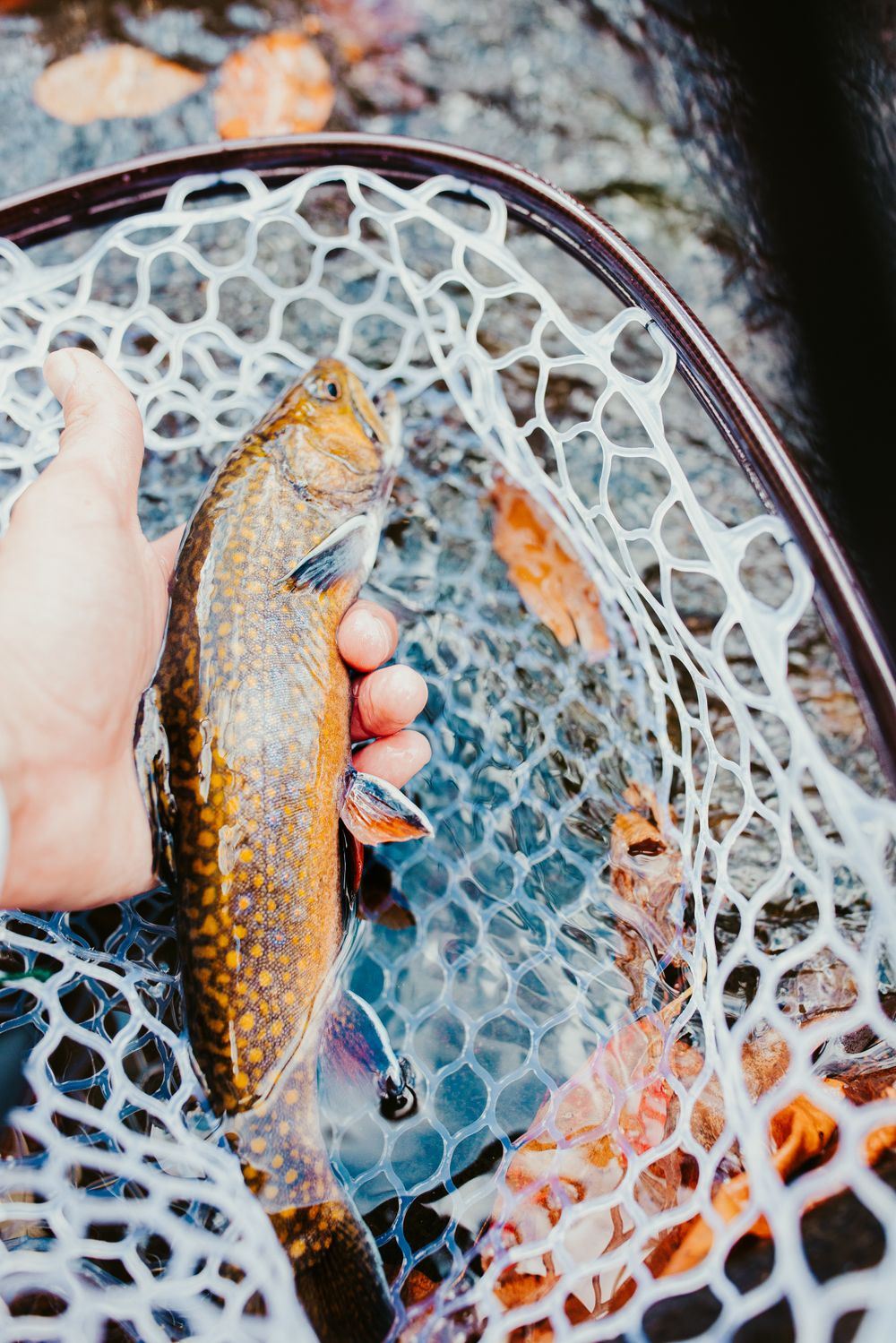
- Fish small creeks and blue lines? Add a short 6’–7’6” 3-weight. Fiberglass for fun and forgiveness, or a crisp graphite if your creeks have casting room. A short rod lets you roll cast, bow-and-arrow, and sidearm-flip a fly into pockets a 9-footer can’t reach without snagging the entire forest. It turns a nine-inch wild brookie into an actual event.
- Chase big browns on streamers? Add a 9-foot 6-weight (or a 7 for big articulated flies and sink-tips). It throws what the 5-weight chokes on — “it takes mass to move mass” — and it has the backbone to fight a bigger fish.
For most tailwater-plus-creek anglers, the small-stream 3-weight is the more natural third rod, because most of us fish more skinny water than we fish six-inch streamers. My own quiver is built on exactly this skeleton — an all-around graphite, a dedicated euro stick, and a short rod for the headwaters — each doing a job the others can’t. That’s three rods covering more water than someone else’s pile of eight covers, because the three were chosen on purpose.
The quiver at a glance
Here’s the whole framework in one place. Find the technique you do most, buy that rod first, and let your actual fishing tell you what comes next.
| If you can own… | Buy this | What it adds |
|---|---|---|
| One rod | 9’ 5wt (or 10’ 3wt euro if you’re nymph-heavy) | Does everything acceptably — the do-it-all |
| Two rods | + 10’ 3wt euro (or + 9’ 5wt) | Tight-line nymphing the 5wt can’t touch |
| Three rods | + short 3wt creek rod or 9’ 6wt streamer rod | Fills your biggest remaining gap |
| Four+ | dry-fly rod, glass rod, cane rod… | Joy and refinement, not coverage |
Do you really need more than three fly rods?
Honestly? For most people, no. Past three rods, you’re almost always buying refinement and pleasure, not capability. A dedicated dry-fly rod for the most delicate risers. A fiberglass rod purely for the feel. A bamboo rod for the soul of the thing.
Those are wonderful, and I am the last person who’s going to talk you out of one. But be honest with yourself about the line you’re crossing: rods one through three fill real gaps in what you can do. Rods four and beyond fill gaps in how it feels to do it. Both are legitimate reasons to buy a rod. Just know which one you’re doing, because “I need this for the fishing” and “I want this because it’s beautiful” are different sentences, and only one of them holds up at the dinner table.
And here’s how it gets out of hand — my six-rod quiver
Right. So I just told you three rods is plenty. I own six, with two more on the way. Let me walk you through them in the order I bought them, with the actual justification I used at the time, so you can watch the rationalization happen in real time and maybe catch yourself doing it.
1. Scott Centric 9’ 5wt ($995), paired with a Ross LTX. The textbook first rod, and a genuinely great one. This was my do-everything stick for years — dries, dry-dropper, indicator, hatch days. Completely defensible. Justification: “It’s the one rod that does it all.” (True!)
2. Diamondback Gen IV 10’7” 3-weight, my euro rod. This is the one that actually changed my fishing. Once I committed to tight-line nymphing on the South Platte, the Centric couldn’t do it — wrong tool, full stop — and the Diamondback took over about half my season. It didn’t replace the Centric; it took the water the Centric was never going to fish well. Justification: “It does a job the Centric physically can’t.” (Also true — this is rod number two doing its job exactly as designed. I reviewed it in detail in the Diamondback Gen IV write-up.)
3. Scott F Series 7’2” 3-weight, with a click-pawl Ross Colorado. The small-stream rod. When I started chasing blue lines in the high country, the 9-footer was a liability in the brush, and a short rod made tiny wild trout the whole point of the trip. Justification: “I needed something for the creeks.” (Fine. This is a legitimate rod number three.)
So far, so reasonable. Three rods, three real jobs, textbook quiver. This is where I should have stopped. I did not stop.
4. Winston Pure 2 9’ 5wt ($995), on a Ross San Miguel. Now, technically I already had a 9’ 5-weight. The Centric. So what does a second 5-weight do? It’s a softer, more progressive dry-fly action — it lands a #20 on 6X like a snowflake when fish are up and leader-shy on the Dream Stream flats. Justification: “It’s a presentation rod, it’s totally different from the Centric.” It is different. It is also, undeniably, a second 9’ 5-weight, which is the exact thing I told you not to buy. Do as I say, friends.
5. Redington Vice 9’6” 7-weight, paired with a Lamson Liquid S. The streamer rod, for chucking bigger flies at bigger browns in the fall. This one I’ll actually defend — it does a job nothing else in the quiver does, and it earns its keep maybe ten days a year. Justification: “It’s the streamer rod.” (Honestly true — but ten days a year is the tell. That’s a “want,” dressed up as a “need,” and I knew it when I bought it.)
6. Headwaters Gallatin 7’6” 4-weight, split cane. The one that isn’t about need at all. Cane is slower, heavier and worse at almost everything a graphite rod does — and none of that is the point. It changes how an afternoon feels, which is a real thing to want even if it’s an impossible thing to justify on a spreadsheet. I wrote up what it’s actually like to fish. Justification: “everyone should fish cane once.” (There is no version of this that is a need. I’m at peace with it.)
So: three rods of pure capability, one rod of “presentation refinement” that’s really just gear love wearing a trench coat, and one specialist that earns a couple weeks a year. That’s the anatomy of a quiver that grew past what the fishing required. Not a tragedy — I love every one of them. But if I’m honest, a guy with rods one, two, and three fishes the same water I do and goes home with the same fish.

How do you know when you actually need another rod?
Ask whether the new rod does a job your current rods do badly — not differently, badly. That one word is the whole filter, and it’s the one I personally keep flunking.
A 9’ 5wt does technical euro nymphing badly: it can’t hold line off the water or protect 6X on a contact drift. So the euro rod is a real need. A 9’ 5wt does small-creek pocket fishing badly: it’s too long for the brush. So the creek rod is a real need. But a 9’ 5wt does dry-fly presentation just differently than a softer 5-weight — both work, one’s a little nicer. That’s a want.
Run every “should I buy this rod?” through that test honestly and you’ll build a tight, deadly quiver instead of a closet. Or you’ll do what I did, recognize the want clearly, and buy it anyway — which is allowed, as long as you’re not lying to yourself (or your spouse) about which column it’s in.
What’s the best fly rod quiver for a Colorado tailwater angler?
For South Platte–style tailwater plus small high-country creeks, the cleanest three-rod quiver is: a 10’ 3-weight euro rod, a 9’ 5-weight all-arounder, and a short 3-weight for the blue lines. That order, for a nymph-dominated angler.
Notice the euro rod comes first in that list, not the 5-weight — because on technical Colorado tailwater, tight-line nymphing is the highest-percentage game, and a lot of us treat the long 3-weight as the true do-it-all now. The 9’ 5-weight covers your dry-dropper, your hatch days, and your wind. The short 3-weight covers the creeks. Three rods, three jobs, zero overlap, and you’ll out-fish the wall-of-rods guy on the water you both share.
My take
Don’t build a quiver by accident, one impulse buy at a time — that’s how you end up with six rods, two more inbound, and a spouse who’s seen through your tool metaphor. Buy the right first rod for the technique you actually fish most, add the second rod only when it does a job the first one can’t, and let your real fishing tell you what the third should be. Three intentional rods beat eight accidental ones every time.
After that, buy for joy. Just call it joy. The fish can’t tell the difference between a $250 rod and a $995 one, and neither, on most days, can you — but the want is real, and there’s no shame in it as long as you’re honest about which column it lives in. I’ve got two rods in the “joy” column and I’d buy them again. I just won’t pretend the trout asked for them.
Next up: if you’re picking that first rod, start with how to choose a fly rod for tailwater, get clear on what fly rod action actually means before you spend a dime, and then see the whole thing assembled in my six-rod quiver.