
In this review
I spent the first stretch of my fly fishing life convinced rods were basically all the same and the rest was marketing. A rod’s a rod. Pick a 5-weight, go fish, let the spec sheet sort out the rest. Then one June I borrowed a buddy’s glass 3-weight on a little creek, made one cast, and stood there grinning like an idiot at how different it felt. Same job. Completely different relationship. Like I’d driven the same car for years and somebody tossed me the keys to something with a clutch pedal — and then had to remember which one of us forgot how to drive stick.
Here’s the thing nobody prints on the box. The biggest driver of how a rod feels in your hand isn’t the weight, the length, or the price tag. It’s what the thing is made of. Graphite, fiberglass, and bamboo are three different personalities, and once you’ve cast all three you quit asking “which is best” and start asking the only question that’s ever mattered: best for what.
My own quiver is mostly graphite, with a glass 3-weight I grab when the point is fun, and — lately — a pull toward cane I’m not entirely proud of. Two of them, in fact, which is two more than I owned at the start of the year: a Headwaters Gallatin that landed this summer, and a hand-built Sweetgrass off Glenn Brackett’s bench in Butte that’s still coming this fall. More on both below, once I’ve stopped petting them. These aren’t three flavors of the same rod. They’re three different tools that happen to share a shape. Here’s how each gets built, how it actually feels, and where it earns the spot in the truck.
What these rods actually are under the finish
The material basically is the action, so the feel doesn’t make sense until you know what’s under the wraps. I ignored this for years and bought rods the way I buy groceries when I’m hungry — by the label and the price. Three different recipes:
- Graphite is a hollow tube of carbon fiber set in epoxy, rolled thin over a tapered steel mandrel and baked. Stiff, light, hollow — the recipe for power without weight.
- Fiberglass swaps glass fiber for the carbon. Heavier and softer for its weight, but tougher and far more forgiving. Still a hollow tube.
- Bamboo (split cane) isn’t a tube at all. It’s a solid beam — six strips of bamboo planed to exact wedges and glued into a hexagon, the plant’s hard outer fibers facing out. Solid wood fiber where the others have air, and that one fact changes everything about how it loads.
Keep the picture in your head as we go: hollow-and-stiff, hollow-and-soft, solid-and-dense. Everything else follows from it. Two rods stamped the same weight but built from different stuff will feel like different animals — and if you want the full physics of why, I went down that hole in fly rod action explained.
Graphite: fast, light, and crisp
Graphite — carbon fiber — is what almost every rod on the wall is built from, and for good reason. It has the best stiffness-for-its-weight of the three by a mile. That’s the whole trick: a graphite rod gets to be genuinely light in your hand and genuinely powerful at the same time. The other two don’t let you have both.
The defining trait is recovery speed — how fast the tip stops bending and snaps back straight after your stroke. Graphite recovers almost instantly, and that clean fast stop is what buys you line speed, tight loops, distance, and the muscle to drive a fly into a wind that’d laugh at a softer rod. Point it where you want the fly and the fly goes there. It’s the rod that does the most — the kitchen appliance that also tells the time and connects to the internet. Whether you need all of that is a separate question.
What does “modulus” actually mean on the price tag?
It’s the stiffness of the carbon fiber — and it’s a tradeoff, not a straight upgrade. You’ll see graphite sold on modulus with numbers that sound like robots: IM6, IM8, “high-modulus,” “nano.” All that word means is how stiff the raw fiber is (Young’s modulus, technically — resistance to bending, not strength, and not the finished rod’s overall stiffness). A stiffer fiber lets a builder hit the same target with less material, so climbing the ladder gets you lighter, crisper, faster, more sensitive. And more expensive. Funny how that works.
Here’s the part the catalog says quietly. The highest-modulus blanks are also more brittle and less forgiving. They punish a sloppy stroke, and they’re the ones that detonate when a tip finds a truck door. (I have not done this. I think about it every single time I set a rod down behind the truck, which is its own kind of tax.) A mid-modulus rod is usually more fishable for more people than the priciest stick on the wall, which is an awkward thing for a shop to say out loud and a very easy thing for me to say out loud. And most good rods are a blend anyway: a high-mod tip for recovery and feel over a tougher standard-modulus butt for lifting power. The number on the label is just the headline act.
So what does graphite give up?
Feel. A fast graphite rod does so much of the work that you don’t always sense it loading — it can read a little like a tool and a little less like an extension of your arm. That’s a fair trade for the versatility, and on most of my Colorado tailwater days it’s the right one. But it’s also why a lot of anglers, a few years in, go quietly looking for something with more soul. The rod that does everything well sometimes doesn’t make you feel much, and feeling something is half the reason any of us are standing in the river to begin with.
Fish it when: you need reach, you’re fighting wind, you’re chucking streamers or indicator rigs, or you just want one rod that does most things acceptably well. It’s the right call on big water and the correct first rod for basically everyone alive. Examples run from budget workhorses like the Echo Carbon XL or Redington Vice up to flagships like the Scott Centric, Sage R8 Core, and Orvis Helios. My own everyday stick — a Scott Centric 5-weight — is graphite, and it covers the bulk of what I do.
Fiberglass: deep, slow, and a whole lot of fun
Fiberglass flexes deep into the blank and recovers slower than graphite, so you feel the rod load and unload through the whole stroke. Glass isn’t trying to be efficient. It’s trying to be fun — and it pulls it off so completely that grown adults giggle out loud on small creeks. I have been one of them.
Is old glass the same as the new stuff? Not even close.
No — “fiberglass” covers two eras that barely belong to the same family, and the difference is not simply which letter of glass got used. The rods of the ’60s and ’70s were heavy, slow, noodly things: cross-woven fiber that drank resin and piled on weight without adding much useful stiffness, which is exactly why graphite buried them the moment it showed up. If your only memory of glass is a dusty rod in your grandfather’s garage that cast like a wet bootlace, your memory is correct.
Modern glass is a different creature, and it comes two ways. Some builders went to S-glass — a stronger, stiffer structural grade — which is what Epic’s FastGlass rods are built from. Others stayed with E-glass and simply got dramatically better at using it: Scott’s F Series is E-glass, and Scott’s own description is “new slimmer tapers with E-glass and our redesigned hollow internal ferrule” — resin systems, wall thickness, and taper doing the work the raw fiber used to be blamed for. My own F Series 3-weight is E-glass, which I mention because I spent a while assuming “E-glass” was a polite way of saying “old.” It isn’t. Cast either one next to grandpa’s rod and you’ll swear they’re different materials. Functionally, they nearly are.
What is glass actually good at — and what’s the catch?
It’s a short-range fun machine, and the catch is distance. Glass loads at 15 to 25 feet, which is exactly where small-stream and technical fishing happens anyway. It shrugs off the rocks and willows that eat graphite tips for breakfast. And that soft, deep bend protects light tippet beautifully while turning a modest fish into a genuine event — a glass rod folds over on a 10-inch trout in a way no fast graphite rod ever will. A little brookie doing its best tarpon impression is one of the purest joys in the sport, and glass hands it to you for free.
What it gives up is distance and wind. Glass runs out of gas past 30 or 40 feet and gets shoved around in a breeze like a grocery bag in a parking lot. That’s not a flaw — it’s a focus. Trying to make a glass rod do a big-water graphite job is how people decide they hate glass, when really they just asked it to do a job it was never built for.
Fish it when: you’re on a small creek or tight brushy water, throwing short delicate casts, or you just want the day to be more fun than productive. My Scott F Series 3-weight lives for blue-line water for exactly that reason — it’s what I grab when the point is enjoyment, not yardage, and it has never once let me down on that promise. Examples worth knowing: the Scott F Series at the premium end, Epic’s S-glass FastGlass rods, the very affordable Echo River Glass, and the Orvis Superfine Glass.

Bamboo: slowest, deepest, and full of soul
Bamboo (split cane) is a solid wood-fiber beam, not a hollow tube, so it’s the heaviest of the three and it loads the slowest and deepest of all. The word cane people always reach for is dampening: after the stroke the tip settles fast and smooth instead of buzzing, and the energy rolls out in a slow pulse you can feel all the way down into the cork. It’s the most alive of the three to fish, and I say that as a lifelong graphite guy who now owns a cane rod he can’t leave in the truck: my Gallatin sets a dry down inside 35 feet like it’s placing it on a shelf, and by the end of the first afternoon I fished it at Deckers I’d quietly stopped arguing with everything I’d assumed. It’s the kind of cast that gets an involuntary noise out of a grown man — and yes, it got one out of me.
Why are bamboo rods always so short?
Because cane is dense and heavy, and the math stops being your friend fast. Big cane exists — Winston will happily sell you a 9-foot 6-weight in bamboo, and their cane runs $3,500 to $4,000, so you get to hold a used motorcycle in your casting hand for eight hours. Scale a rod up and the weight and swing weight (the felt heft of mass way out at the tip) pile on quick, cooking your forearm and blunting the action. So most fishable cane lives where its weight doesn’t cost you anything: short casts, delicate presentations, small and technical water. It’s a presentation tool first, a distance tool a distant second. The sweet spot most makers actually stock runs roughly 6-and-a-half to 8 feet, 3- to 5-weight — Headwaters’ whole current lineup sits inside that window — and that’s not a limitation builders apologize for. It’s the rod’s natural home.
Why does cane load the way it does?
Because dense solid fiber stores and releases energy slowly — and the why is genuinely cool. A graphite rod is a hollow carbon tube: light, stiff, quick to snap back. Cane is a solid stack of dense wood fiber, so it loads slow and lets go slow, in that smooth rolling pulse. You feel the load actually happen, which makes the timing easier to learn and the whole thing more tactile. That soft, dampened tip is also a built-in shock absorber, which is why cane protects 6X and 7X so well and drops a leader with almost no disturbance — exactly the recipe for drag-free dries to spooky fish on a tailwater. The material isn’t being romantic for the sake of it. The fishing reasons are real.
There’s more going on than performance
A cane rod also carries something the other two flat-out don’t: craft and heritage. It’s a hundred-plus hours of hand work, built from a bamboo that grows in essentially one river valley in China, often on a taper drawn by a name anglers have revered for a century. People fish 70-year-old cane rods and hand them down to their kids — try that with a high-modulus flagship. That’s a different relationship with the tool, and I only really understood it once one was in my own hand.
Which is the moment to say the unromantic part out loud, because nobody selling cane will. It is the heaviest of the three and you feel that by hour six. It is short, so distance and wind are simply not on the menu. It is the only one of the three that genuinely cares whether you left it wet in a hot truck. And the entry price is $500 for a rod that will only ever do one job well. Buy cane because you want that job, not because you want a better rod — it isn’t one, and it was never trying to be. (I went deep on how cane is built, where the bamboo comes from, and why it costs what it does across the rest of this series. Fair warning: the more you learn, the more you want one. Ask me how I ended up with two.)
Fish it when: you’re fishing dries on technical or small water, you want the most tactile cast in fly fishing, and you care about the experience as much as the catch. Examples span an unusually wide range for one material: value cane like the Headwaters Bamboo Gallatin, a 7’6” 4-weight on the classic Payne 100 taper for $500 to $600 and the rod I came into cane on; bench-built makers like Sweetgrass in Butte, Montana, from roughly $2,000; and Winston’s Twin Bridges cane at $3,500 to $4,000. Same six strips of grass, a tenfold spread in price. I broke down exactly where that money goes in why bamboo costs what it costs.

Three feels, at a glance
| Graphite | Fiberglass | Bamboo | |
|---|---|---|---|
| Build | Hollow carbon-fiber tube | Hollow glass-fiber tube | Solid split-cane hexagon |
| Feel | Fast, crisp, efficient | Deep, slow, lively | Slowest, smooth, “alive” |
| Recovery | Fastest | Medium | Slowest |
| Best range | Short to long, incl. distance | ~15–40 ft | Short, ~10–35 ft |
| Weight | Lightest | Medium | Heaviest |
| Toughness | Good (brittle at high modulus) | Toughest | Durable but needs care |
| Shines at | Versatility, wind, streamers, reach | Small water, fun, tippet protection | Delicate dries, presentation, heritage |
| Weak at | Pure feel | Distance, wind | Distance, big flies, weight |
Which fly rod material is best for trout?
There’s no single best — they’re three tools for three jobs. Graphite is the most versatile and the right default if you own exactly one rod: distance, wind, streamers, all-day water. Fiberglass wins on small streams, short delicate presentation, durability, and pure fun. Bamboo is the presentation-and-soul pick for technical dry-fly fishing and anglers who love feeling a rod actually work in their hand. Most people who fish all three end up keeping all three, because each one does something the other two genuinely can’t. That’s not gear-acquisition disorder talking. (Okay — it’s a little bit gear-acquisition disorder talking. But it’s also true.)
Is fiberglass a good rod for a beginner?
It can be a great teacher, with one caveat. Glass’s slow, deep flex makes the timing of a cast easy to feel — you sense the rod load and you know when to come forward, which is a lot harder on a fast graphite rod that hides what it’s doing. It’s also tough enough to live through the learning curve, including the part where the rod meets a streamside boulder at speed. The one limit: a brand-new angler on big, windy water is going to want graphite’s reach and line speed, and glass won’t hand it over. But for small water and for learning the actual stroke, a short glass rod is a genuinely good first rod — arguably better than the stiff “fast” rod most beginners get talked into at the counter.
Can you fish bamboo on big rivers?
You can, but it’s usually the wrong tool, and that’s fine. Cane’s weight makes long rods tiring over a full day, and it won’t make the line speed to fight wind or sling heavy flies at distance. On a wide, windy tailwater you’ll just be happier with graphite — there’s no medal for suffering. Bamboo earns its keep on the close, technical, delicate end of things, which, conveniently, is a huge amount of trout fishing: spring creeks and low, clear tailwaters where the fish have PhDs and the cast is 25 feet.
How do you choose — and why might you end up with all three?
If you’re building a quiver, the order is honestly pretty simple:
- Start with graphite. A medium-fast 9-foot 5-weight covers more water than anything else made and should be the first rod almost everyone owns. Full stop. If you only ever buy one, buy this.
- Add fiberglass when you want a small-stream rod that turns every fish into a good time. A short glass 3-weight is the perfect counterpart to a graphite tailwater setup — different job, different mood, almost no overlap.
- Come to bamboo when you’re ready to slow down and fall for the feel: delicate dries on technical water, and the simple pleasure of fishing something a person built by hand.
That progression is exactly how a lot of us end up with one of each — not because we’re hoarding wall art, but because each material does something the other two can’t, and the water tells you which one to string up before you’ve even shut the truck door.
My take
Don’t file these under better and worse. File them under different. Graphite is the rod that does the most. Glass is the rod that’s the most fun. Bamboo is the rod with the most soul. I came up a graphite guy, dead certain the other two were obsolete or precious, and I was wrong twice — glass made me grin like a kid, and cane talked me into one before I’d even cast it. Fish enough days and you’ll want a piece of each, and you’ll know by the water and the wind exactly which to pull from the quiver.
Next: if this hooked you, read how a bamboo rod is actually built, then why cane costs what it costs — and you’ll never look at that “museum piece” the same way again.
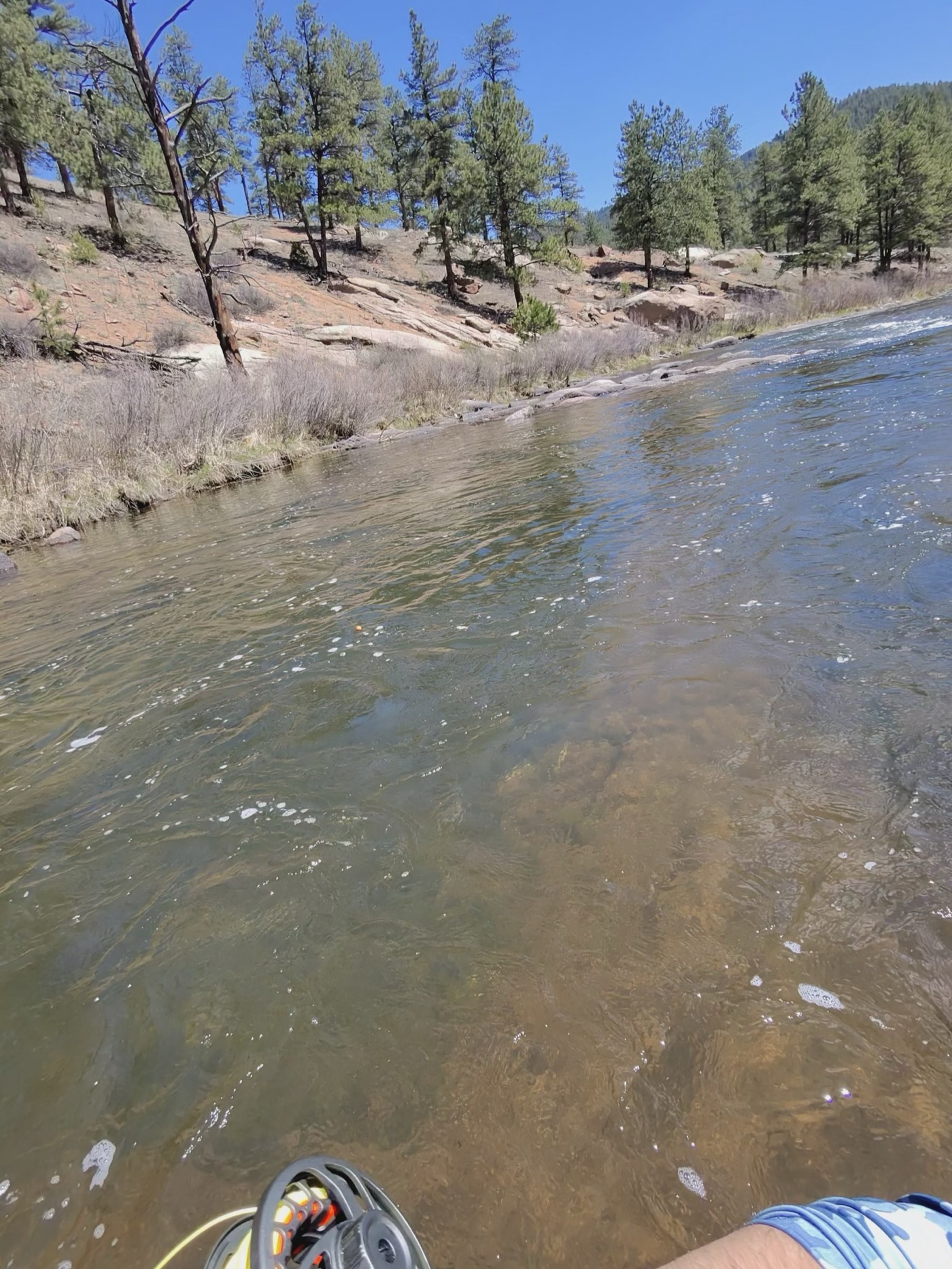
Rod photos — the cast on the water and the reel over the run — are mine. The cane sections on the bench are Headwaters Bamboo’s; the fiberglass rod with its roll and tube is a maker’s product shot.