
In this guide
For nine months of the year, the South Platte makes you earn it. Size 22 midges. Tippet so fine you knot it on by feel and hope for the best. A drift so technical you start questioning your life choices around noon. Then summer shows up, the bank grass gets tall and buggy, and the whole river relaxes — including the trout.
That’s terrestrial season. Late June into September, when the fish stop staring at the bottom waiting for emergers and start watching the banks. Ants fall off the streamside brush. Beetles lose their grip and plop in. Hoppers get blown off the grass and land in the current like a clumsy first date. And the trout — who have spent all spring inhaling specks the size of a comma — will move two feet to crush a foam bug they can actually see.
It is, hands down, the most fun dry-fly fishing this river offers. You see the eat. You see the fish commit. And for a few glorious weeks, you get to throw flies you can actually tie on without reading glasses. Here’s how to fish it.
At a glance — terrestrials on the South Platte
| Bug | Season | South Platte size | Where to fish it |
|---|---|---|---|
| Hopper | Early July–September, peaking August | #12–16 | Grassy banks, open meadow runs |
| Beetle | July–September | #14–16 (#12 when they’re on it, #18 low and clear) | Bank water, under overhanging grass/brush |
| Ant | Late June–September | #14–20 | Flat tailouts, seams, bank edges |
| Foam attractor (Chubby Chernobyl) | July–September | #12–14 | Anywhere — searching pattern + indicator |
Two notes before you raise an eyebrow at that column.
The first: these run bigger than the flies that own this river the rest of the year. Terrestrials are a mouthful, and you fish them like a mouthful — not the #18–22 micro-stuff you’re hauling in January. If your hopper box looks like your midge box, you bought the wrong hoppers.
The second, which is the one that costs people fish: they run smaller than the hoppers in every magazine photo. The western standard is a #6 or #8, and on a pressured South Platte tailwater that is simply too much fly. These are the same trout that were on #22 Tricos four hours earlier. They’ll move for a big meal, but they’ll also study it. I settled on #12–14 for foam years ago; the full argument is in my Chubby Chernobyl guide.
This post is the overview. Each of the three bugs has its own deep-dive, and where they disagree with the summary below, the deep-dive wins: hoppers, beetles, and cinnamon ants.
Hoppers — the big-fish bug
Hoppers are the headline act. They’re large, they suggest a real meal, and the biggest fish in the run will leave a perfectly good feeding lane to come eat one.
The window runs early July into September and peaks through August — earlier down at Deckers around 6,400 feet, later up in South Park at about 8,700, because the bugs mature on the calendar the elevation gives them. Any stretch with grass growing to the water’s edge is hopper water:
- Deckers — the open meadow sections with grass banks above and below the road.
- Dream Stream — the Spinney stretch, open rangeland on both sides, wind that does half your hopper delivery for you.
- Eleven Mile Canyon — a real window in the lower canyon, where the road-side banks are grassy and the water slows enough to give a fish time to commit.
And one that isn’t the South Platte at all but belongs in the same conversation: the Arkansas at Pueblo, wide channels with grass to the bank. It’s where the sizing changes — bigger, less-scrutinized water, and the one place around here I’ll throw the #8–10 foam that gets refused on the Platte.
Cheesman Canyon isn’t on that list, and the reason is the hike in and my own calendar, not the water. It’s technical water — long leaders, small flies, fish that get a very long look — which makes it a harder place to fish big foam. That’s a statement about the tactic, not the canyon.
On the Platte itself, fish them #12–16. A Chubby Chernobyl in #12–14 is my searching pattern — floats like a cork, visible from across the river, doubles as a strike indicator. A Morrish Hopper or Dave’s Hopper in #12–14 covers meadow water when I want a lower-riding, more realistic profile. Worth knowing that Charlie Craven’s Charlie Boy Hopper was developed while he was guiding on Tarryall Creek, a South Park stream that joins the Platte below Lake George, above Cheesman Reservoir — it was built for this water rather than imported to it. Umpqua sells it in 08, 10 and 12; the #12 is the one you want.
Lean to the small end early. Colorado’s hoppers are immature instars in July and don’t reach full size until late August, and the fish have been watching the real ones all summer.
And don’t present it gently. A real hopper doesn’t tiptoe onto the surface; it crash-lands like it owes the water money. Drop the fly tight to the bank with a little splat. The commotion is the trigger — it took me a long time to stop laying a hopper down like I was setting a wine glass on a table, and the careful version was costing me eats the whole time. If the dead drift doesn’t move anything, give it a short twitch — a three-inch strip every few seconds — and hang on.
My take
If I had to fish one terrestrial all summer it’s a tan #12 Chubby, and the size matters more than the pattern. It catches fish, it floats a dropper, and I can still see it at last light. Two sizes down from what the catalogs sell you is not a compromise on this river; it’s the whole reason the fly gets eaten. Buy the #12s, leave the #6s for the Madison, and spend the money you save on tippet you’ll lose in the willows.
Beetles
Beetles get overlooked, and that’s a mistake, because pound for pound they produce the most violent surface takes on this river.
The catch is location. A beetle isn’t a search-the-whole-river fly — it works because it imitates something specific fish actually see fall in. So you fish it where beetles come from: tight to undercut banks, under overhanging grass and brush, near any fallen timber touching the water. Get it within six inches of the bank if you can reach it. That’s the whole game.
It’s also why beetle fishing costs more than the flies suggest. Six inches from the bank means four inches from the bank is a willow, and the willows keep everything they catch. If you come home from an afternoon of good beetle fishing with the same number of beetles you left with, you weren’t fishing close enough.
Sizes, and the beetle guide has the full breakdown: #14–16 is the workhorse on Cheesman and Deckers, #12 when they’re eating them confidently, and #16–18 in low clear water. Black foam body, rubber legs, a little high-vis post if your eyes need the help. A Hippie Stomper in #14 is a beetle/ant attractor that splits the difference and stays on my leader most of the summer.
Ants — the one that’s always working
Ants are the terrestrial that works every single day. They’re in the water from late June through September, tailing off with the first hard freeze, and trout eat them when nothing else is visibly hatching.
Ants are the one terrestrial where you do dial the size down — but not to midge territory. #14–20 covers the season, and the two sizes that do the work on this river are #16 and #18. Flying-ant patterns run to #18–20 during a fall flight. Fish them dead-drift in the flat tailouts and along seams, on 5X or 6X with enough leader to keep your fly line out of the feeding lane. A black or cinnamon foam ant with a thread waist and a hi-viz post is all you need; the cinnamon ant guide goes deeper on the pattern.
Worth knowing why the ant works so far above its size: it sits in the film rather than on it, and it doesn’t float away the way a hopper does — it’s stuck, half-drowned, going nowhere. That’s a low-risk meal from the trout’s side of the equation, which is why ants draw unhurried, deliberate eats rather than the slashing take a beetle gets. It’s also why a sunk ant catches more than people expect. If yours goes under, don’t pick it up — a half-drowned ant is exactly what a lot of them look like anyway.
The trout at Deckers and the Dream Stream will refuse a dragging ant instantly. Get the drag-free drift and they reward you.
The hopper-dropper
If you take one rig from this post, take this one. A buoyant foam hopper on top, a nymph hung off the bend, and you’ve covered both the fish looking up and the fish that won’t quite commit.
The hopper is your indicator and a legitimate fly — fish eat it. The dropper mops up everyone else. My go-to trailer is an Olsen’s Blowtorch (orange tag in stained water, green in clear) or a Perdigon when I want it to drop fast. Eighteen to twenty-four inches of 4X–5X off the hopper’s bend covers most of the bank game; in deeper runs I’ll go out to 30 or 36 inches, which is about where a #12 Chubby stops holding a tungsten bead up and starts getting dragged under. That’s the real ceiling on the rig: the flotation gives out long before the fish do. A hopper riding low means the dropper’s too heavy or too deep, and you’ve quietly turned a dry-dropper into a bad indicator rig. Longer version in my dry-dropper guide.
The hopper rides the meadow seam, the nymph ticks along below, and you’re fishing two columns of water with one cast.

What time of day is best for terrestrial fishing?
On the South Platte, terrestrials fish best on warm afternoons — roughly 11 a.m. through mid-afternoon, sun high and a breeze up. Heat and wind make ants, beetles, and hoppers active and careless, which is the exact inverse of the low-light midge and BWO bite.
So flip your whole routine. Sleep in, which is not advice I get to give often. Let the morning midge sippers do their thing while you drink your coffee. Then walk down around 11 a.m. when the meadow grass is warm and the hoppers are stupid, and fish hard through the heat of the day. I’ve had my best hopper afternoons on the kind of bright, windy, high-summer day that would make a nymph angler curse — because that wind is doing half my job, knocking bugs off the grass and onto the water for me.
A few timing truths worth knowing:
- Wind is your friend. A steady breeze blows hoppers and beetles off the bank and puts them in the drift. Glassy, dead-calm conditions are actually harder terrestrial fishing.
- Warm beats cool. The hotter the afternoon, the more active the bugs. A cold front or a gray, raw day will shut the terrestrial bite down fast — that’s when you go back to the nymph.
- Later in the summer, bigger and later in the day. Early in the season (late June) lean on ants. By August the hoppers are closer to full-size and the best fishing often runs right into evening.
Does the afternoon schedule conflict with warm-water ethics?
Sometimes, and when it does, the water wins. This is a summer schedule, not a hot-water permission slip. Terrestrials peak on exactly the afternoons when a lowland tailwater is at its warmest, and a trout caught at 2 p.m. in 66-degree water is already in the stress zone before you ever touch it. Deckers and the Dream Stream hold up better than most Colorado water because they’re dam-fed and the cold release buys them hours — but a tailwater is only cold near the dam, and “better than most” is not a pass. Carry a thermometer. Check it when you arrive and again at the hottest part of the day. When it touches 65, I’m done for the day, full stop — regardless of how good the wind looks. Seventy is not a second chance; it is well past the line. CPW’s voluntary closures trigger on any one of four criteria — a daily maximum above 71°F, flows at or below half of average, visible stress or fungus on fish, or dissolved oxygen under 6 ppm — but a river is in trouble well before an agency says so. I go through the numbers and where I draw my own line in the summer water-temp piece; the version where I drive past the warm water and go up instead is in the dog-days piece.
Read the bank, not the river
Everything about terrestrials comes back to one idea: fish where the food comes from. A terrestrial gets into the water by falling, blowing, or jumping off a bank. The trout that eat them have learned exactly where to watch — so should you.
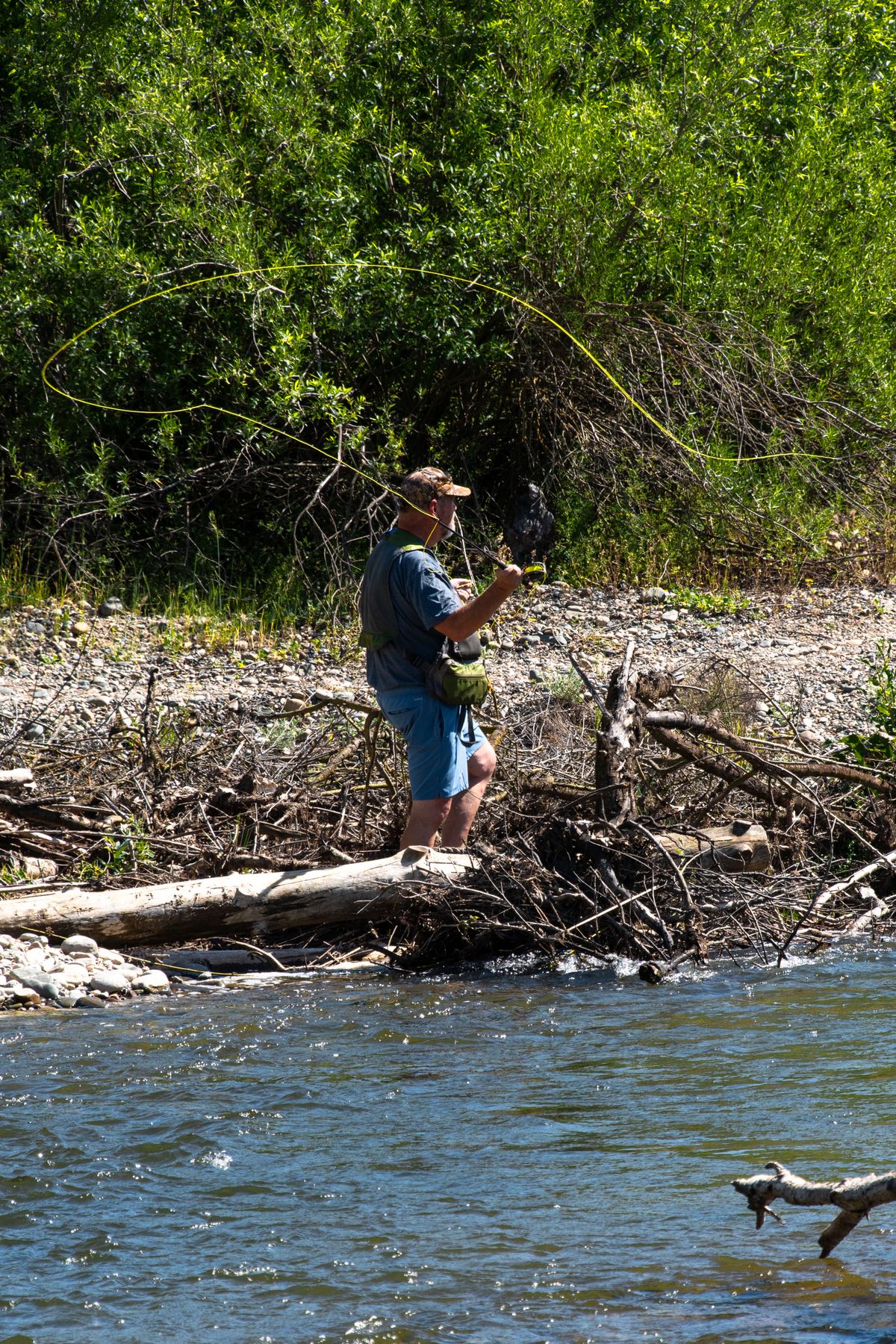
The money zone is the 12–18 inches closest to the bank, especially:
- Under overhanging grass or brush
- Where a fallen log or branch touches the water
- The seam where slow bank water meets the moving current
- Just downstream of rocks a bug can tumble off
Midstream, hero-cast presentations don’t do much for ants and beetles. Work the edges.
This is genuinely hard to make yourself do — the long cast across the current feels like fishing in a way that flicking twelve feet of line at a grass clump does not. I fish the first thirty yards of a run before I ever wade into it now, on the theory that whatever I’d have spooked getting out there was the thing I came for.
Rigging
Keep it simple — terrestrial season is a vacation from your tippet anxiety.
- Ants & beetles: 9–12 ft leader, 5X to start, 6X if fish refuse in low clear water. Clinch knot. Done.
- Hoppers: 9 ft leader, 3X or 4X — the fly’s big enough to turn over on heavier tippet, and you’ll want the backbone when a meadow brown tries to take your fly to Kansas.
- Hopper-dropper: add 18–24 inches of 4X–5X off the hopper’s bend to the nymph.
For the soft, accurate stuff in the flats — picky ant and beetle eaters — I reach for the Headwaters Madison, my 8-foot cane rod; the medium, progressive bamboo action lays an ant down without slapping it. For chucking a hopper-dropper into a meadow wind, the stiffer Scott Centric turns the rig over and keeps it from collapsing into a bird’s nest at your feet. Those are two of the six rods I own, pointed at what is arguably one job; the full accounting is in my South Platte rod quiver.
Frequently asked questions
Do trout eat terrestrials when nothing is hatching? Yes — that’s the whole point. Once terrestrials are in play, South Platte trout watch the banks even with no mayfly or midge showing. Ants especially get eaten with confidence during dead-air afternoons.
Can I fish terrestrials from a drift boat? This is where the bank game gets easier and harder at once. You get an unlimited number of first casts at fresh grass, which is the single biggest advantage in this fishing — but you get about a second and a half of good drift before the boat drags the fly. Cast downstream-and-in at forty-five degrees rather than straight at the bank, and feed line the moment it lands.
Do I need a dedicated terrestrial box, or can I fold them into the dry box? Fold them in, with one exception: foam takes up four times the space of a comparable mayfly dry and it crushes if you jam it. One row of a standard box for foam, everything else where it already lives.
What do I do when a fish refuses the hopper? Go smaller before you go bigger. The instinct is to reach for something louder; it doesn’t work on this river. Drop a size, then drop another, and if that fails put a #16 ant in front of it. A trout that refuses a hopper will frequently eat an ant on the very next cast.
Is a windy forecast a reason to cancel? It’s a reason to go. Wind is what puts terrestrials in the water in the first place, and a gusty afternoon after several calm hot days is the best terrestrial fishing there is. Dead-calm bluebird days are the hard ones.
Bottom line
Terrestrial season is the South Platte loosening its tie. The fish that made you crazy with #22 midges all spring will chase a foam hopper across a meadow seam in July. Stock the ant and beetle boxes by late June, start carrying a row of hoppers (#12–16) and a few tan #12 Chubbys by early July, and fish the banks hard through September — checking the thermometer on the hot afternoons, because the best terrestrial weather and the worst water temperatures are the same weather.
Next: pick your bug and go deeper — hoppers, beetles, cinnamon ants — or start with the dry-dropper setup if you’re rigging tonight.