
In this guide
The Blowtorch is my favorite fly. If you opened any box I carry you’d find a whole row of them — tag colors and body variations I’ve drifted into over years on this river, because apparently I can’t leave a good thing alone. Orange tags, green tags, with CDC, without CDC, body colors across the spectrum — they all catch fish. Some flies need a sales pitch. The Blowtorch does not. You put it in the water on a tight line and fish eat it.
It was developed by Devin Olsen — Team USA fly fisher and multiple national champion — at the 2014 World Fly Fishing Championship in the Czech Republic, where Czech competitor Michael Adamcik put him onto a local “tag nymph” on the Vltava River. Olsen took the idea home and built his own version: two hot spots — a tag at the tail and a collar — over a durable Ice Dub body with a flashy rib, on a jig hook with a tungsten bead. He’s called it one of his top flies for trout anywhere in the world. After enough seasons fishing it on the South Platte, I’m not about to argue with the guy who won. It’s the fly I tie on when I want a take, not a maybe.
The short answer
My favorite fly is Olsen’s Blowtorch — a 60-degree jig nymph on a 3mm copper tungsten bead, built around two orange hot spots (a short floss tag and an orange underbody glowing through an opalescent rib) that I fish as the heaviest point fly on a tight-line euro rig, no indicator. I run the standard orange tag when the river’s carrying color and swap to a green tag when it’s low and clear, mostly sizes 16–18 on Deckers, the Dream Stream, and Cheesman. When I need a take and not a maybe, this is the one my hand reaches for.
Is the Blowtorch a euro nymphing fly?
Yes. It’s a 60-degree jig hook with a tungsten bead, built to ride point-up and get to the bottom fast on a tight line. I fish it as the point fly — the heaviest fly in the rig — no indicator, French leader, colored sighter.
The Recipe
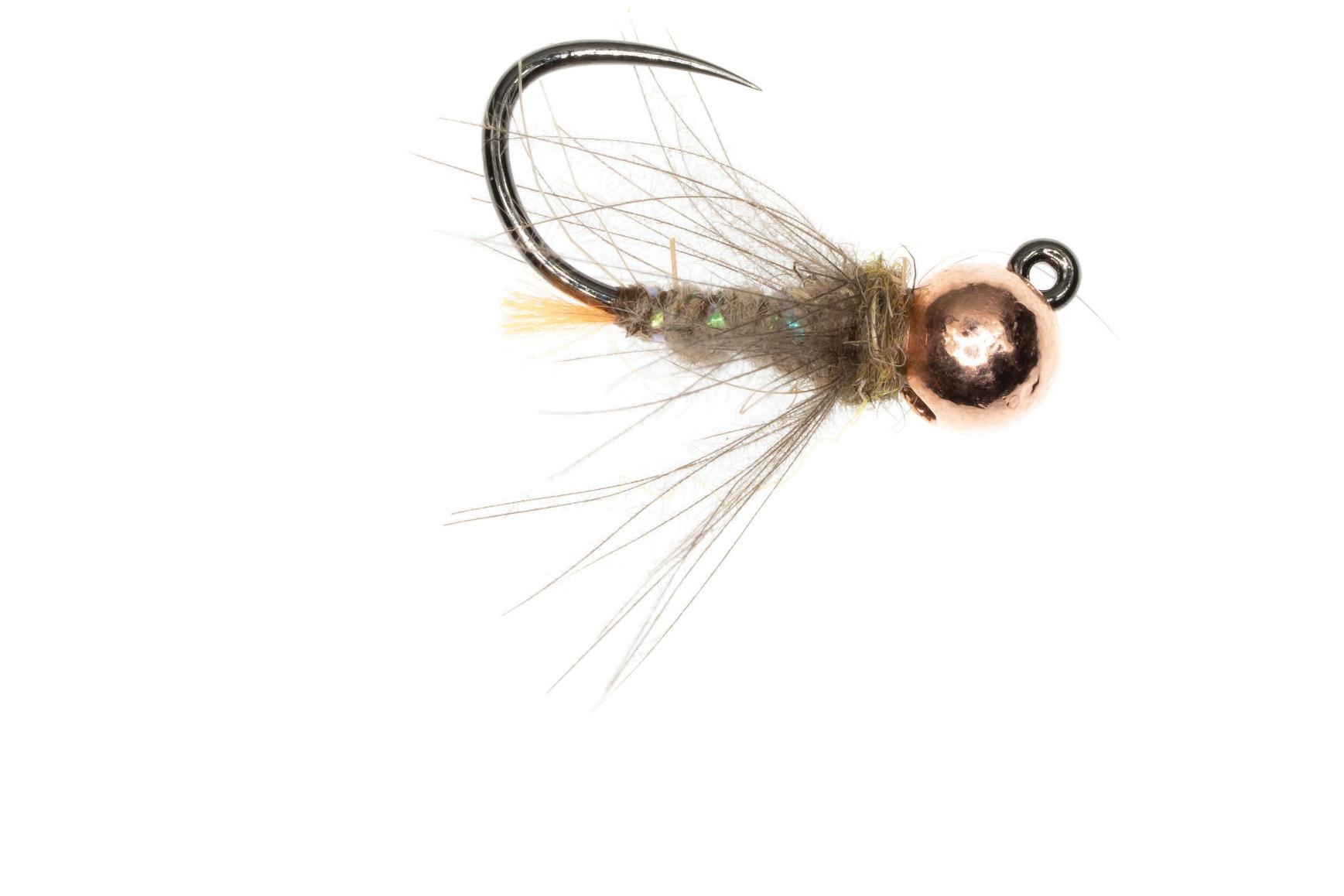
The pattern’s identity is its dual hot spot: a short orange floss tag at the bend and an orange thread underbody showing through the opalescent rib. Everything else is almost incidental — the fly is about those two triggers. The recipe below is the standard. I tie variations off this base — covered in the next section.
Hook: 60-degree jig hook — Umpqua C-400, Hanak 400BL, or Umpqua XT500 BN, sizes #10–16 (South Platte: #16–18)
Bead: Slotted copper tungsten, 3mm
Thread: Veevus 14/0, hot orange
Tag: Glo-Brite Floss, Fire Orange #5 — 3 strands only, short, just past the bend
Rib: Mirage Flashabou, single strand opalescent
Counter-rib: 5X tippet material, crossed over rib for durability
Body: Black peacock Ice Dub, slim and tapered
Collar: Natural dun CDC, one stripped side
Olsen is explicit: three strands of floss for the tag, not a clump. Overdressing it kills the action. The body should be slim enough that the thread underbody reads through. The CDC collar does the micro-movement work — it doesn’t need to be heavy.
Want to fish it before you commit a winter to tying it? Olsen sells his own tied Blowtorch — peacock, hare’s ear, and purple — straight through his shop, Tactical Fly Fisher.
The Variations I Tie
I almost never fish the Blowtorch exactly as Olsen ties it. Over years of testing on this river, I’ve drifted into a handful of variations that out-produce the standard pattern in specific conditions. The two triggers — the tag and the rib — stay the same. Everything else flexes.
Green tag (Glo-Brite Floss Chartreuse #11 or Fluorescent Green #12): A green tag instead of orange shifts the trigger from attractor toward imitation. Fish that have inspected and rejected orange tags in the same drift will eat a green-tagged Blowtorch. I run green during summer caddis activity and any time the river feels suspicious — pressured fish, low water, clear conditions.
No CDC, slim peacock body: A stripped-down version with no CDC collar and a tighter peacock body fishes well in low flows and clear water. The slimmer profile drops the inspection threshold. Sizes 16 and 18, mostly for late-summer Deckers when flows are under 100 cfs.
Olive body, orange tag: Swap the black peacock for olive Ice Dub and you have a baetis nymph silhouette with the standard tag trigger. Spring and fall BWO windows are when this version earns its keep. Size 16, fished as the point fly through the same water as the standard pattern.
Dark brown body, copper rib: For fall and winter on the Dream Stream and Cheesman when fish are keying on darker midges and small mayflies. I swap the opalescent rib for fine copper wire — less flash, more imitation. Same orange tag, slimmer body, size 16.
The point is the Blowtorch is a platform. Keep the two triggers consistent, vary the inputs based on conditions, fish the result. I’ve tied a lot of variations that didn’t work — a graveyard of clever ideas the fish ignored — and a few that did. The ones above are the ones I now tie in bulk.
My take
Let me put the conviction on the record: this is my number one, and it isn’t close. The on-water decision is the shortest one I make all day — orange tag when the river’s carrying color, green when it’s low and clear and the fish are acting suspicious — then the heaviest version goes on point and I fish. Years of tinkering have changed the body colors and the collars, but never the answer. When I genuinely need a take — not a maybe, a take — the Blowtorch is what my hand reaches for before my brain has finished weighing in.
When It Matters on the South Platte
Deckers is where I fish the Blowtorch most. Flies & Lies includes it in their house combo packs and mentions it specifically in winter and early spring reports. It fishes year-round but earns its reputation from November through April, when flows drop and fish get inspection-close to every nymph. Orange tag, standard pattern, sizes 16–18 in most conditions; the slim no-CDC variation in size 20 when flows drop below 100 cfs.
Dream Stream produces on it in the slower, deeper seams — sizes 16–18 in fall and winter when fish push into deeper structure. It’s a strong lead fly for euro nymphing the corridor water between the weedy flats. The olive-body variation works particularly well here during BWO windows in March, April, and October.
Cheesman Canyon suits the standard pattern well in the faster runs and pocket water above the slower canyon pools. The jig bead cuts current fast enough to reach depth in the heads of pools before the fly sweeps past the holding fish. The jig hook rides point-up through the canyon’s rocky substrate — fewer snags, more drift time. The dark-brown variation works here in deep winter when fish key on smaller, darker food.
How to Fish It
This is a euro nymph. No indicator, tight-line contact, French leader with a colored sighter. It belongs as the point fly — the heaviest fly in the rig — with a smaller dropper 18–22 inches above it. A WD-40 in olive, an RS2, or a small Juju Baetis works well in the dropper position.
Tippet: 5X–6X fluorocarbon. Below 150 cfs at Deckers, go 6X. The fly needs to get to the bottom fast — don’t let the tippet thickness slow that down.
Watch the sighter for hesitation or any speed change. Fish don’t always slam this — they eat it and hold. The take can look like the fly momentarily stopped drifting. Set on anything that doesn’t look like a natural drift.
If you held me to one fly for a full year on the South Platte, no swaps, this is the one I’d hand you — and I’d sleep fine about it. Tag color and body would change with conditions. The Blowtorch stays.