
In this guide
There’s a fish I think about more than any I’ve landed. I didn’t land it. I watched it tip belly-up in the shallows on a July afternoon a few years back, after what I thought was a clean release. The water was warmer than I’d admitted to myself. I’d caught it, fought it a touch long, held it up for a photo I didn’t need, and let it go. It didn’t go.
That fish is the reason I carry a thermometer now. Not because I turned into a saint — I just got tired of being the guy who tells himself the water’s “probably fine.”
Summer fishing is the part of this sport nobody likes to talk about honestly. We’ll argue about tippet diameter for an hour and skip right past the thing that actually decides whether the trout we release lives or dies. In summer, the most ethical cast is sometimes the one you don’t make.
Why Warm Water Is a Death Sentence in Slow Motion
Cold water holds a lot of dissolved oxygen. Warm water holds less. That’s just physics — the warmer the water, the less oxygen it can carry.
Here’s the part that makes summer brutal: a warm trout also needs more oxygen, not less. Its metabolism climbs with the water temperature — cold-blooded animals run at the speed of the water they’re sitting in, and a trout that goes from the low 50s to the high 60s is burning oxygen at roughly double the rate. So you’ve got a fish that needs more air in water that holds less of it. Less supply, more demand. That’s the squeeze.
Now add a fight. You hook that fish, it burns through its oxygen reserves sprinting around the run, and you land an animal that’s already gasping in water that can’t refill its tank. It might swim off looking fine. “Looking fine” and “surviving the next 24 hours” are two different things. A lot of summer mortality is delayed — the fish kicks out of your hand, drifts into a current seam, and never recovers. You drive home thinking you did everything right.
My take
I’d rather catch zero fish than catch one I’m going to quietly kill an hour after I leave. That’s not me being precious. It’s just math I’ve decided to respect. The belly-up fish from that July afternoon didn’t teach me anything I hadn’t already read — I knew the numbers then. What it taught me is that knowing them and acting on them are different skills, and only one of them keeps trout alive. So now the thermometer makes the call instead of my mood, because my mood has a documented history of being wrong about this.
At What Water Temperature Should You Stop Fishing for Trout?
Around 65°F trout start showing real thermal stress, and by the upper 60s released fish are dying at much higher rates. The exact cutoff varies by group and by species, and the direction matters more than any single number: brook trout and cutthroat are the least heat-tolerant, rainbows sit close behind, and browns are the most forgiving. Keep Fish Wet flags 61°F for rainbow, brook and cutthroat and 66°F for brown; Colorado agencies and guides more often draw the practical line at 65°F, and 70°F is treated as a hard stop everywhere. My personal rule: 65 is my line.
A stream thermometer costs less than a box of flies and weighs nothing. I clip mine to my pack and I actually use it — that second part matters.
The numbers worth knowing, framed as “around” because biology isn’t a light switch:
- Around 65°F, trout start getting stressed. The fight costs them more, recovery takes longer. This is the conservative shoulder where released-trout mortality begins climbing.
- Around 70°F and up, post-release mortality climbs fast — trout caught in low-70s water die after release at dramatically higher rates than fish handled in water below the mid-60s.
- Brook trout and cutthroat are the first to suffer, not the last. They’re the coldest-water species we have, they stress earlier than rainbows and browns, and they’re exactly what’s living in the high-country creeks everyone escapes to. Don’t carry a brown-trout number up there.
I don’t treat those as a hard wall — I treat them as the zone where I start paying attention. Low 60s and I’m already watching the clock. When the thermometer touches 65, I’m done for the day, full stop. No “one more spot.” The fish don’t get to make that call, so I make it for them.
It’s worth knowing where the official line sits, because it is not where most people assume. CPW’s criteria for a voluntary fishing closure aren’t temperature alone — they look at a daily maximum water temperature above 71°F, streamflow at or below half the daily average, visible fish stress or fungus, or dissolved oxygen dropping under 6 ppm. Any one of those can trigger it, and in a drought summer the flow and oxygen criteria often get there before the thermometer does. Two things follow. One, a river can be in genuine trouble at a temperature that hasn’t hit 71 yet, which is why “no closure posted” is not a green light. Two, by the time an agency has posted a closure on a reach, the fish in it have been having a bad month. A voluntary closure is a floor, not a target — it tells you when the state has run out of patience, not when the trout did. Check the CPW fishing conditions page before you drive, then check your own thermometer when you get there.
And don’t trust the air temperature or the calendar. A 9,000-foot canyon can feel like a furnace at 2 p.m. and still hold cold water. A lower, exposed stretch can cook while you’re standing in it. The thermometer is the only honest voice out there. Stick it in the water, wait thirty seconds, believe what it says.
Fish the Dawn, Rest the Afternoon
The simplest fix for summer is also the oldest one: go early.
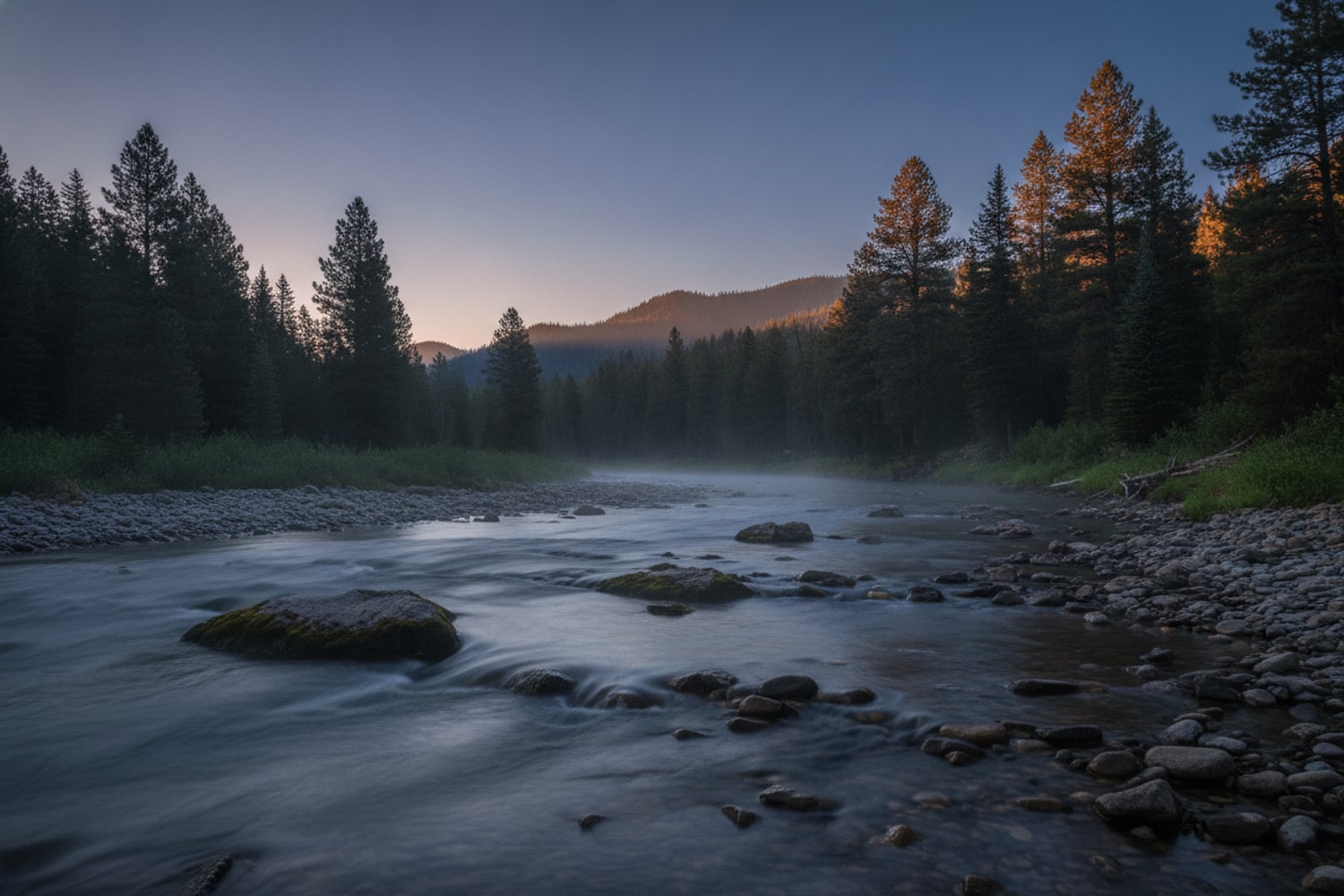
Water is coldest right before and after sunrise. It’s been shedding heat all night, the sun hasn’t hit it yet, and the oxygen’s as high as it’ll get all day. That first hour of light is when I do most of my summer fishing — and honestly it’s the best fishing anyway. Bugs are moving, fish are looking up, and the crowds are still in bed.
Then I quit. By late morning, when the sun’s on the water and the temperature’s climbing, I’m off the river. Coffee, shade, a sandwich, maybe a nap in the truck. The afternoon is the trout’s recovery window, and the worst possible time to add stress is exactly when the water’s hottest and the oxygen’s lowest.
If you’ve only got afternoons, that’s a real constraint — I get it, life doesn’t always hand you dawn. But that’s the day I’d point at a cold high-country creek instead (more on that below) or just call it a hike. There’s no rule that says a day on the water has to involve hooking a fish.
This is also when I switch gears entirely and shoot photos. The light’s better midday for the river itself, and there’s plenty to point a camera at without disturbing a single fish. It also means I come home from a fishless day with four hundred pictures of moving water, which my wife has learned to receive with the enthusiasm you’d expect. If that’s your move too, I wrote up how I approach it in my South Platte photography guide.
The South Platte Advantage (and Its Limits)
Here’s where we Coloradans catch a break. A lot of our best water is tailwater — it pours out of the bottom of a dam, where the water’s been sitting deep and cold.
Deckers is the obvious one. The water releasing from Cheesman Reservoir upstream keeps the Deckers stretch cool well into summer, when the freestone rivers around the state are pushing into the danger zone and shutting down. That’s the whole reason the South Platte fishes through July and August while other water bakes. Same story below the other dams in the system.
But — and this is the part people skip — a tailwater is only cold near the dam. The further the water travels from that cold release, the more it warms up. Sun, shallow riffles, tributaries, distance. By the time you’re miles downstream of the dam, or fishing an unbuffered lower stretch in the afternoon, you can be in genuinely warm water even on a “tailwater.” The dam doesn’t follow you down the canyon.
So the South Platte advantage is real, but it’s not a blanket pass. Carry the thermometer even here. Check it when you arrive, check it again midday, and check it especially on the lower, more open water. The cold release buys you time and miles — it doesn’t repeal physics. If you want the broader picture on how a thin-snowpack year stacks the deck against us, I dug into that in the 2026 low-snowpack piece — less cold runoff means warmer summer flows, and that matters here.
Land Fast, Keep Them Wet, Skip the Photo
When the water’s marginal and you’ve decided to fish anyway — say it’s mid-60s and you’re on it at first light — how you handle the fish matters more than it ever does in cold water.
The rules I actually follow:
- Land it fast. Don’t baby a fish to the net to “enjoy the fight.” A long fight in warm water is the most dangerous thing you can do to a trout. Heavier tippet, more pressure, get it in.
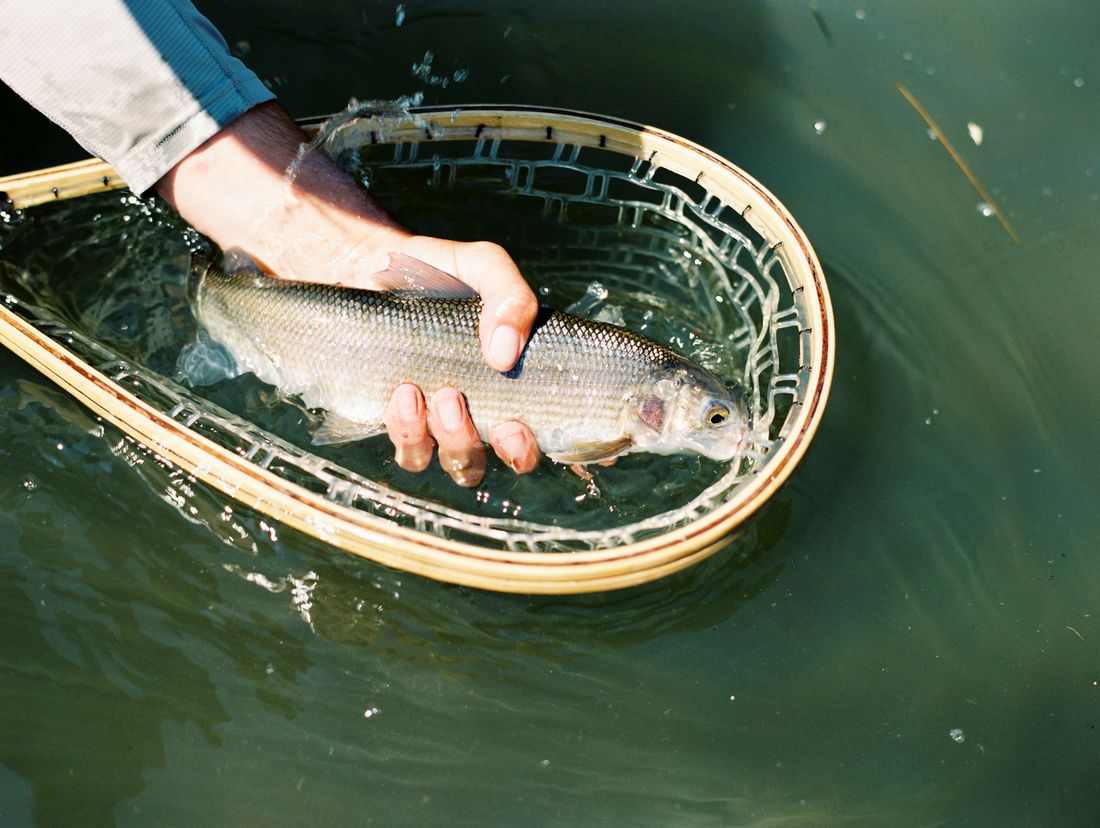
- Keep it wet. Air exposure and warm water stack on each other — the combination is worse than either alone. The research is blunt about it: even a short spell out of the water, combined with warm temps, sharply raises the odds the fish doesn’t make it. Unhook it in the net, in the water.
- Skip the hero shot. I know. The light’s gold, the fish is gorgeous, you want the picture. In warm water, that photo can be the thing that kills it. If you absolutely must, have the camera ready, lift for a literal second or two over the water, and put it back. When it’s hot, I just don’t bother. The fish I let swim off strong is a better souvenir than a photo of one that didn’t.
- Revive it properly. Hold it upright, facing into the current, until it kicks out of your hand on its own. Don’t toss it back and walk away. If it won’t hold itself upright, you’re not done.
None of this is hard. It just requires deciding, before you ever make a cast, that the fish’s survival outranks your photo.
Go Higher, Go Colder
The best summer escape isn’t a handling trick. It’s a road.
When the tailwaters are warming and the freestones are off the table, I go up. Colorado’s high country is full of small, cold creeks running snowmelt and spring water that stays cold all summer because it’s at altitude and shaded and moving. Those little blue lines are the answer to a hot July afternoon — cold water, eager fish, nobody around.
It’s a different game than the technical tailwater stuff. The fish are smaller and a lot less picky. But the water’s cold enough that you’re not playing Russian roulette with every release, and that alone makes it the right call when the lowland water’s hot. I’ve come to genuinely love this fishing — I wrote about why I started chasing blue lines and how to find them on a Colorado map if you want to go down that rabbit hole, and the seasonal version of the same move — what my late-August looks like when I stop driving to the river and start driving past it — is in the dog-days piece.
One caution I’d rather say twice than not at all: going up is not the same as switching the thermometer off. The trout up there are brook trout and cutthroat, the two least heat-tolerant species we have — Keep Fish Wet’s 61°F applies to them, not the 66°F you’d give a brown. A creek that leaves the timber for an open meadow, or drops through a chain of beaver ponds, or runs thin in a dry year, can climb further than the elevation on the map suggests. In practice mine almost never reads high up there. “Almost never” is still a reading, not a guess.
The short version: when the water you usually fish gets too warm, the answer is usually higher and colder, not later and warmer.
I’d Rather Not Fish Than Cook a Fish
I’ll be straight with you. I love fishing about as much as a person can love anything that isn’t a family member. I’ll drive two hours for a few hours on the water. I fish more days a year than I probably should.
And I still pack it in early, all the time, in summer. I check the thermometer, see a number I don’t like, and drive home. It used to feel like losing. Now it feels like the only version of this sport I want to be part of. The trout in our tailwaters are a shared, finite thing. Every one I kill carelessly is one neither I nor the next angler gets to catch.
The fish I didn’t catch don’t cost me anything. The fish I killed by pretending the water was fine — those stick. I’ll take the empty net every time.
Frequently asked questions
Do I really need a stream thermometer, or can I just go by feel? You need one. Water that “feels cool” on your legs while you’re wet wading can still be in the stressful zone, and you can’t feel a two-degree difference that changes everything for a trout. A thermometer is a few dollars and removes the guesswork. Stick it in, give it thirty seconds, and let the number make the decision for you instead of your optimism.
Tailwaters stay cold, so I’m fine fishing the South Platte all summer — right? Mostly, near the dam, in the morning. But cold-water releases warm up as they travel downstream, and a lower or exposed stretch on a hot afternoon can be genuinely warm even on a famous tailwater. The cold release buys you time and distance, not immunity. Check the temp where you’re actually standing, not where the dam is.
What if I only get to fish in the afternoon — am I just out of luck? Sometimes, yeah, on the lowland water. But that’s exactly the day to drive up to a cold high-country creek, which stays fishable when the tailwaters warm. If even that’s not in the cards, a hot afternoon is a fine time to scout, shoot photos, or just sit on the bank. Not every river day has to end with a fish in the net.
Is wet wading a sign the water’s too warm to fish? Not by itself. South Platte tailwater can be cold enough to wade comfortably in shorts and still be perfectly safe to fish at dawn — the cold release keeps it down even in summer. But it’s a good prompt to check the actual number, especially as the day heats up. Comfortable-for-your-legs and safe-for-the-trout aren’t the same threshold.
Carry the thermometer, fish the cool hours, and when the number says walk away — walk away. The river will still be there in October.