
In this review
Every so often a rod comes along that you stop using and start looking forward to. The Headwaters Madison is that rod for me. It’s eight feet of split cane on Jim Payne’s 200L taper — a 4-weight that reaches like a bigger rod and still sets a dry down like a whisper — and from the first afternoon I had it out, it made an easy convert of me.
This was the rod I’d been quietly wanting: real reach on bigger water, without giving up the soul that makes bamboo worth fishing in the first place. Here’s the whole story.
What it is
- Rod: Headwaters Madison — 8’0”, 4-weight, three-piece, medium action, Payne 200L taper. The Deluxe ships a spare tip; you rotate them so neither takes a set.
- Cane: genuine hand-split, hand-planed Tonkin bamboo, blonde (honey-toned) finish.
- Appointments: downlocking double-locking knurled reel seat over a stabilized burled-maple insert, ultra-fine cork grip, red agate stripping guide, hard-chrome guides, deep burgundy wraps with a narrow black tip, Cordura tube and sock.
- Reel (separate bundle): the Clark Fork Classic 2½” click-and-pawl — machined 6061 aluminum, small arbor, no drag. $275 alone, $137.50 with a rod.
- Price: Favorite (1 tip) $650 · Deluxe (2 tips) $750. A spare tip on its own is $150, so the Deluxe is the cheaper route to owning both.
- Policy: 30-day guarantee, lifetime workmanship to the original owner.
Why affordable split-cane can even exist
Here’s the part worth understanding before you fall in love with the price. Bench-built cane from a named maker starts around $1,450 and runs well past $4,000 — the kind of rod you commission now and fish a couple of seasons from now. (Why cane costs what it does is its own rabbit hole — the culm, the waste rate, the hours.) The Madison starts at $650: a catalogue rod you order and fish, not a custom build with a years-long wait.
That gap isn’t magic — it’s the model. Headwaters is an Idaho-based, direct-to-consumer outfit — no dealers, no middlemen — and the rods are built overseas by artisan workshops in China that have made cane for them for over two decades. I’d rather tell you that straight than dress it up in heritage: it’s precisely why a working angler can own real split-cane for the price of a mid-tier graphite rod. That’s not a compromise you settle for. It’s the reason this rod is in my hands at all.
The Payne 200L, and what the taper actually is
A bamboo rod is really just a taper — a table of dimensions at every inch — reassembled in cane. The Madison rides the Payne 200L, and the Payne name has meant smooth, presentation-first trout rods for a century.
Jim Payne is widely held to be among the finest cane makers who ever lived — ferrules machined to tolerances that made other makers wince, invisible glue lines, tapers worked out by casting rather than by arithmetic. He learned the craft from his father, Edward F. Payne, who had cut his teeth on ferrules at Hiram Leonard’s shop and helped build the Kosmic rods before founding the E.F. Payne Rod Company in Highland Mills, New York. Jim ran it for decades and fished his own rods, changing the numbers when the water disagreed with him. Original Paynes trade for thousands.
The 200-series were his longer rods, and the L is generally read as the lighter, more refined build of the 200 — more line speed at distance and a softer tip for delicate presentation, without giving up the authority to mend at range. That’s not marketing to me anymore; that’s something I’ve now felt with a rod in my hand. It’s the taper for the angler who’d outgrown the idea that bamboo is only good at short range on small water.
The craft underneath it
The work in this rod is real, and it’s worth knowing what you’re holding. A single culm of Tonkin bamboo is split into strips, each one hand-planed to tolerances measured in thousandths, and six wedges are glued back into a hexagon so the dense power fibers ride the outside of the blank where the bending stress lives. That’s why cane bends and recovers the way it does — a solid fiber beam, not a hollow carbon tube. (How a bamboo rod is made walks the whole process if you want it.)
Yes, cane is a touch heavier than graphite — that’s physics, not a defect. I braced for it and never once thought about it on the water. The number on a spec sheet and what your arm actually notices are two different animals.
Why I love fishing it
Here’s what makes this rod special, and it’s the whole reason I keep reaching for it.
The 200L taper has genuine range. I can stand off the bank, drop a dry on the far seam, and throw a reach mend to hold the drift — covering water a shorter cane rod would leave me wading into. And the magic is that it gives up nothing up close: at fifteen or twenty feet it shortens right down and fishes soft and accurate, as delicate as anything I own. Close or far, it just does what I ask, which is the rare trick a lot of rods promise and few deliver.
It’s got the deliberate, wait-for-the-load soul of great cane — but crisper, with more line speed on tap. It’s the same conversation, spoken a little faster. On a bad-habits cast you can feel it ask you to slow down and let it load, and when you do, the line goes exactly where you sent it — quiet, no crack, no hiss. That extra speed even earns its keep in a breeze, where lighter cane rods tend to fold. And there’s real backbone in it: enough to lift and turn a good fish when one decides to leave, and enough to feel every head-shake telegraph straight up the blank into your hand.
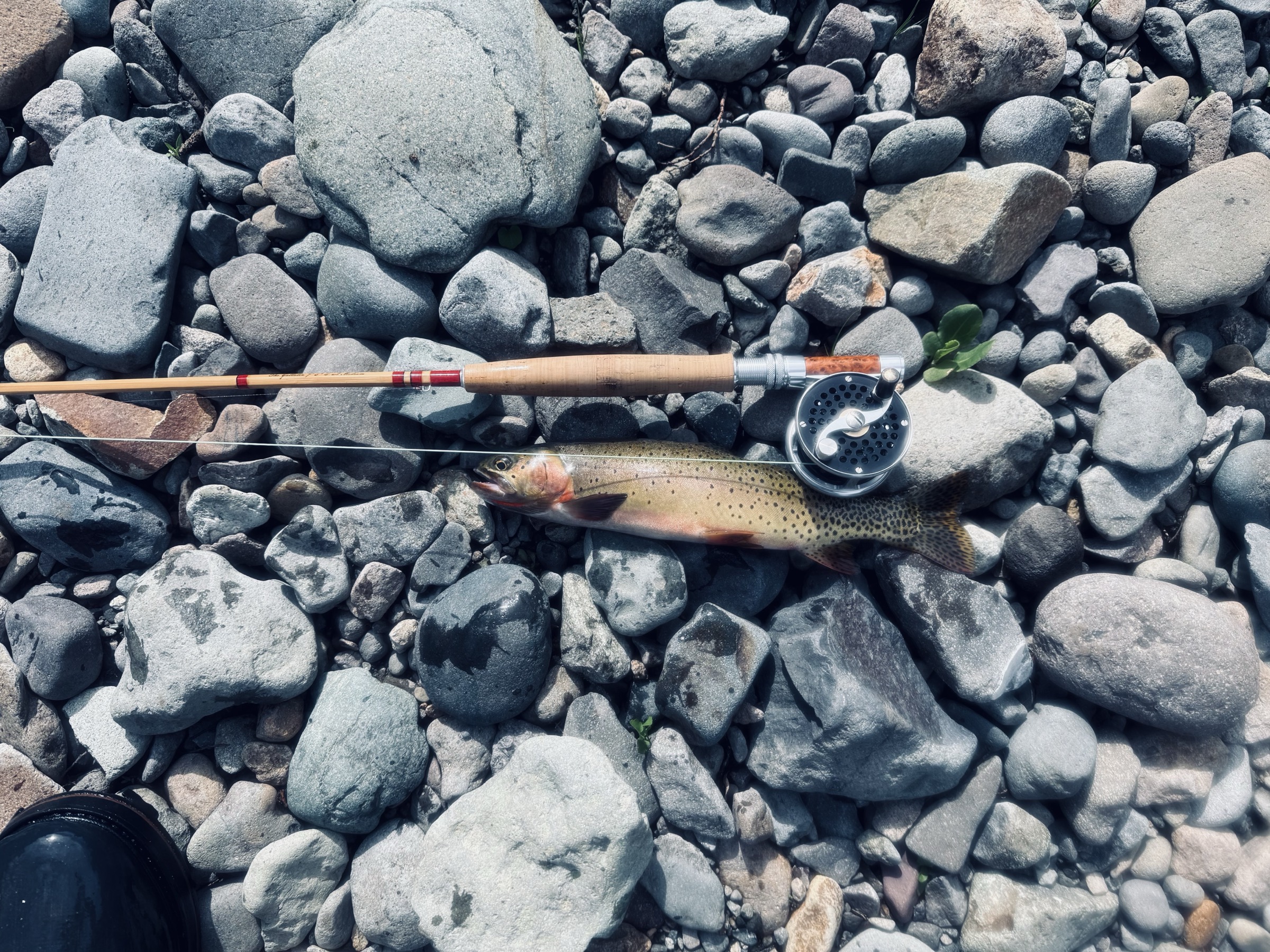
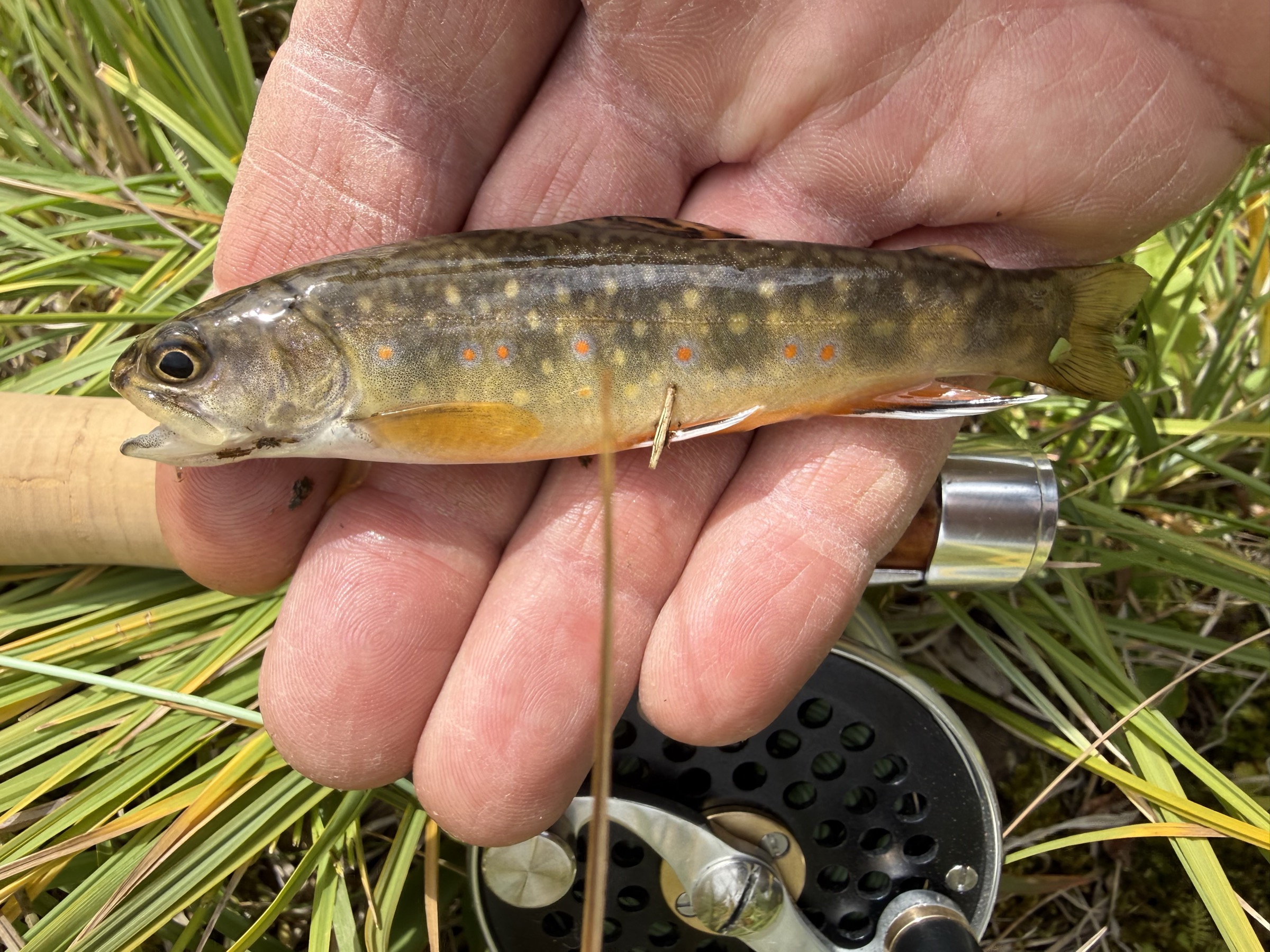
The cutthroat up top and the little brook trout below both came on it, on a bigger backcountry stream I’d hiked into for the day. That’s the thing about this rod — it doesn’t just catch fish, it makes you glad you carried it in.
It’s a stunner, too
No point being coy about it: it’s gorgeous. The stabilized burled-maple insert, the red agate stripping guide, the deep burgundy wraps over blonde cane — it’s the kind of object you catch yourself just looking at between casts. Split cane that fishes this well and looks this good, at this price, still feels a little unfair.
The reel: Clark Fork, and that sound
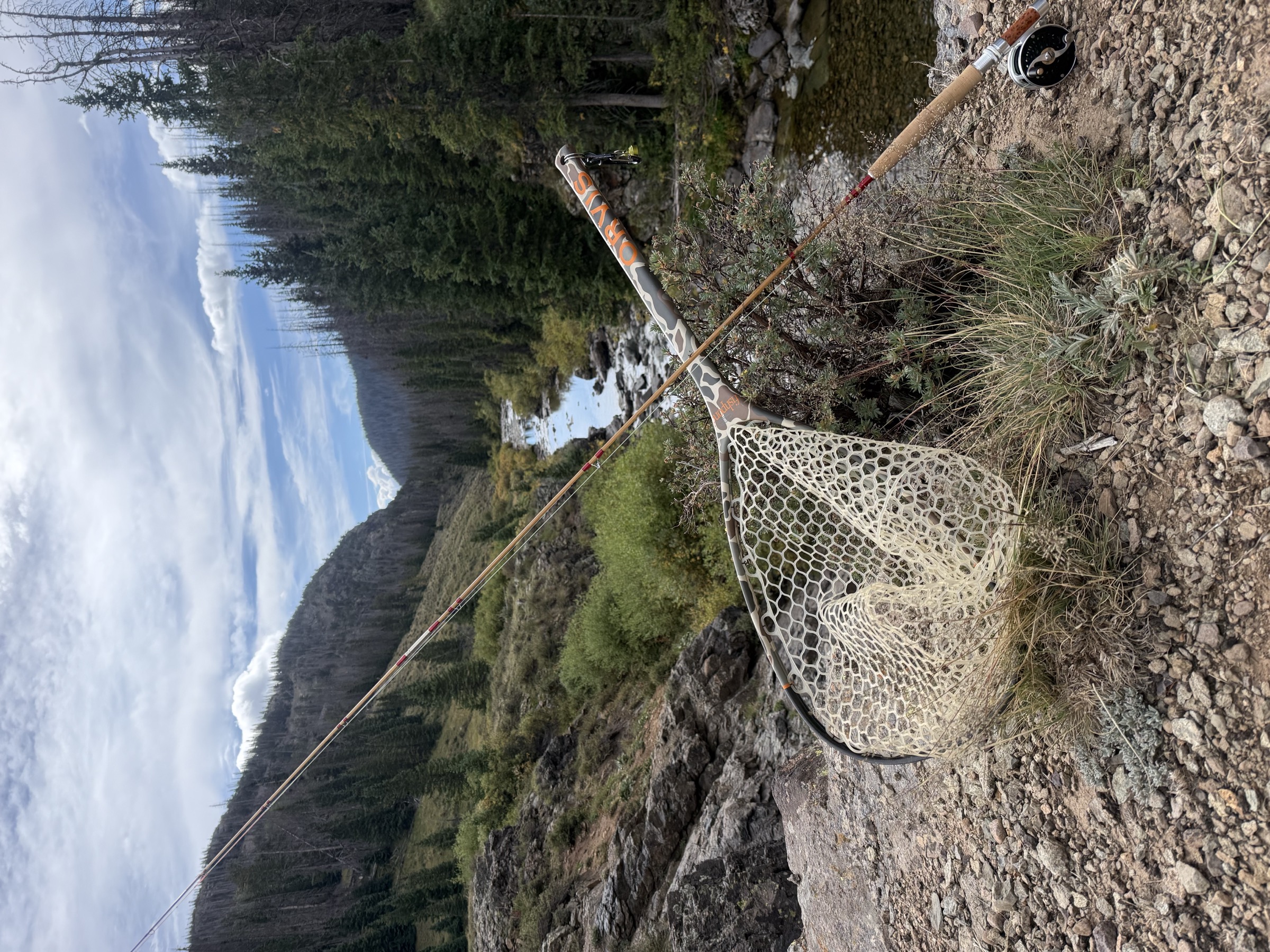
It pairs with the Clark Fork Classic 2½” — a simple click-and-pawl reel, no drag, just a ratchet and a spring, which is exactly right on a 4-weight. A disc drag on a rod this size is cruise control on a golf cart: technically possible, deeply unnecessary. At this weight a reel is line storage, balance, and the noise it makes when a fish runs — you palm the rim for the rare fish that earns the right to run.
And that noise. When a good fish turns and heads downstream, the ratchet lets go and it sounds like a machine gun — flat out, no rhythm to it, a sound you feel in your wrist before you’ve worked out what’s happening. Machined from 6061, 2.8 oz, balances the rod beautifully, nothing to set and nothing to fail. More on why click-pawl belongs on light rods in Click-Pawl vs. Disc Drag.
The three-piece, and why it travels
The Madison breaks down into three pieces, and that’s a feature I’ve come to love: it fits a carry-on, a backpack, or behind a truck seat. Headwaters are straight about the trade — a three-piece is a hair heavier than a two-piece because of the extra ferrule — but on the water it’s a difference I’ve never once felt against what it buys me, which is that this rod goes where I go. A cane rod you’ll actually pack in is a cane rod you’ll actually fish.
Caring for cane
Cane asks for a little care graphite shrugs off, and none of it is hard. Dry the rod before you tube it, keep it out of a hot car, and store it hanging or flat so it never takes a set. Rotate the two tips (that’s what the spare is for) so neither one gets tired sitting in the same bend. It’s a fishing rod with the maintenance schedule of a houseplant — not demanding, but it’ll reward you for paying a little attention.
Who it’s for
If you fish bigger water and you want real bamboo with genuine reach that still presents like a dream, this is the one. It shines on open runs where you need to cover water without slapping fish off the far seam, and it’s every bit as happy shortened down on something intimate. I fish a shorter Gallatin for tight creeks — the Madison is the one I grab the moment there’s room to open up.
Where it costs you is narrow and honest: it’s cane, not a graphite cannon. If your whole day is bombing long lines into a gale or chucking tungsten, that’s a different rod — reach for graphite and don’t look back. For everything else a dry-fly angler actually does — reaching a seam, protecting light tippet, presenting a fly and enjoying the afternoon — I genuinely can’t fault it.
My take
The Madison is the best cane rod I’ve fished, and it isn’t especially close. It reaches, it presents, it’s beautiful, and it turns an ordinary afternoon into one I’m still thinking about later. If you’ve ever wanted real bamboo that actually fishes the water you fish — not a wall-hanging, not a compromise — this is the rod that finally makes that easy.
Where to get one — and 20% off
Here’s the part worth reading twice: buy through my link and you get 20% off, sitewide — no code needed, the discount comes off at checkout. That’s real money on a cane rod: 20% off the Madison, off the Gallatin, off anything in the shop.
Because you’re buying a rod you’ve never cast — there’s no fly shop to wave one around first — the safety net matters, and it’s a real one: a 30-day guarantee and a lifetime workmanship warranty to the original owner. If it isn’t for you, send it back. It won’t be.
Frequently asked questions
Is the Madison a good first bamboo rod?
It can be, if your water suits it. An 8-foot 4-weight is a versatile, forgiving length, and the reach means it won’t strand you on bigger water the way a short rod can. If your home water is tight creeks, start with the 7’6” Gallatin instead — a shorter rod is the easier, purer place to learn cane.
Favorite or Deluxe — is the second tip worth it?
The Deluxe is the spare tip, and a Madison tip bought later runs $150 on its own — so buying the Deluxe up front actually saves you money if you’ll want two. The tip is the part most likely to meet a car door, and rotating two keeps either from taking a set. If this is going to be a rod you fish hard, take the Deluxe.
How does it compare to a graphite 8-foot 4-weight?
Graphite still wins on outright distance, lifting a hot fish, and throwing weighted rigs. What the Madison gives you that graphite can’t is the feel — you feel it load, it protects light tippet, and it slows the whole afternoon down in the best way. Buy it for that, not to out-cast a modern rod.
What line and leader should I put on the Madison?
Fish it with a true-to-weight 4-weight line — nothing overlined. Cane loads deep, and a supple presentation-taper line in the exact weight it’s marked for lets the rod do what it’s built to; a half-size-heavy line just drowns the feel that’s the whole point. For leaders, a 9-foot tapered leader to 5X handles most dry-fly work, dropping to 6X over spooky fish on flat water — the soft tip protects fine tippet a stiffer rod would pop, so you can fish a size finer than you’d dare on graphite.
Does the three-piece make it more fragile?
No — more ferrules mean more care, not more breakage. Dry it before you tube it, rotate the tips, keep it out of a hot car, and it’ll outlast you.
Next
If you’re curious about cane, start with What Is Tonkin Cane and How a Bamboo Rod Is Made — and why cane costs what it does. Here’s everything else in my quiver.