In this guide
Every South Platte angler knows the Deckers stretch. Far fewer make the drive south to the Arkansas River at Pueblo. I was one of them for years — I’d drive past the exit, tell myself “next time,” and go fight for elbow room at Deckers like everybody else. Took me an embarrassingly long time to just take the exit.
The Pueblo tailwater is a special-regulation tailwater managed for trophy trout. The fishing is serious, the fish are real, and on a busy Saturday in June — when the Deckers flats are stacked shoulder-to-shoulder and the Cheesman Canyon parking lot is full — Pueblo is a legitimate alternative with room to breathe.
The short answer
The Arkansas River at Pueblo is a special-regulation tailwater below Pueblo Reservoir dam — about an hour from Colorado Springs, two hours from Denver on I-25 — with fewer crowds than Deckers or Cheesman and less-educated fish that take 5X. Nymph it: size 20–24 midges year-round, 18–20 BWOs in spring and fall, size 14 San Juan Worm in red or pink after rain, and a size 8–10 Pat’s Rubber Leg stonefly on point. Best months are October–November and May–June. Everything below is the detail — but if you just wanted to know whether to take the exit, take it.
How do you fish the Arkansas at Pueblo?
Nymph it. It’s a special-regulation tailwater below Pueblo Reservoir, and the trophy browns and rainbows eat the same small stuff they do at Deckers — midges, BWOs, and little mayflies on 5X — just with a lot fewer anglers standing on them. The bottom is sand and small gravel instead of granite cobble, so read the seams and depth changes for holding water rather than obvious pockets.
What the Pueblo Tailwater Is
The productive tailwater section runs from Pueblo Reservoir dam downstream through the city of Pueblo — counterintuitive for an angler expecting a remote canyon, but the urban setting doesn’t affect the fishing quality. The special-regulation water — flies and lures only, with trout over 16 inches released — runs from the Valco Ponds bridge downstream to Pueblo Boulevard.
The Arkansas at Pueblo holds exceptional brown trout and rainbow populations — fish that grow large on the reservoir’s cold, clean outflows. The river bottom is different from the South Platte: more sand and smaller gravel mixed with rock, which means different holding structure than the granite cobble of Deckers.
Regulations: from the Valco Ponds bridge down to Pueblo Boulevard it’s artificial flies and lures only, with all trout 16 inches and over returned to the water. Below Pueblo Boulevard, standard statewide harvest rules apply. Check CPW’s current Arkansas River regulations before the trip — the possession limits and boundaries are clearly defined in the regulation booklet.
Access and Wading
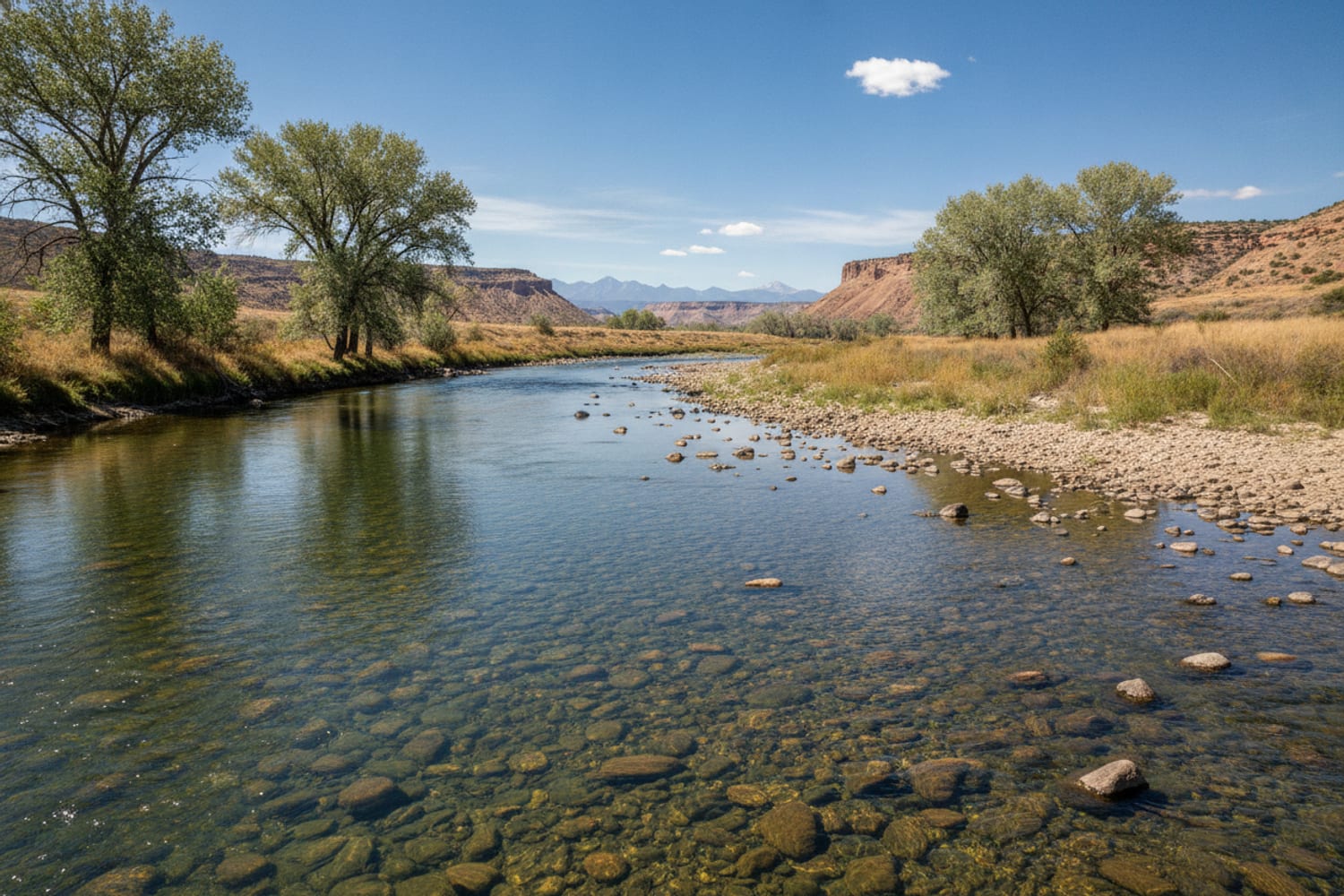
The Pueblo tailwater has excellent public access through a series of parks and wildlife areas along the river corridor. The Nature Center and the adjacent river access sections provide walk-in wading access to the special-regulation water. Parking is straightforward — more parking and easier access than the South Platte canyon sections.
The wading is moderate. The Arkansas at Pueblo runs wider and shallower than the South Platte canyons — think Deckers-style flat water and riffles rather than deep technical pocket water. Most of the productive water is wadeable without the boulder-hopping of Cheesman.
Is the Arkansas River at Pueblo worth the drive from the South Platte?
Yes — it’s a special-regulation tailwater about an hour from Colorado Springs (two hours from Denver on I-25) with fewer crowds than Deckers or Cheesman, less-educated fish that’ll take 5X, and a different hatch calendar. On a busy June Saturday it’s a legitimate alternative with room to breathe.
One caution: Pueblo Reservoir releases can change rapidly. Always check current releases before wading — a call to the reservoir management or a look at the live flow can keep you from getting caught in rising water. Live flow for the Pueblo tailwater comes from the Colorado DWR gauge (Arkansas River above Pueblo); the Arkansas River Pueblo river guide shows the most current flow and hatch conditions.
Hatches and Fly Selection
The Arkansas at Pueblo has a different hatch calendar than the South Platte, partially because of the warmer city temperatures and the river’s slightly different water chemistry from the reservoir.
Midges year-round: Same as the South Platte. Size 20–24 midge larvae and pupae are the consistent producers. The Pueblo fish are heavy midge feeders throughout the winter and spring.
Blue-wing olives (March–May, October–November): The Pueblo tailwater has good BWO hatches on overcast days in spring and fall. A size 18–20 BWO emerger or Parachute Adams covers the rising fish during these hatches. Pueblo in October with a BWO hatch running is as good as the South Platte for dry-fly fishing.
Caddis (May–July): The Arkansas caddis hatch can be prolific in June. Elk Hair Caddis in size 14–16 during the late afternoon and evening. Fish are more willing to move for a caddis imitation on the Arkansas than they often are at Deckers during the same hatch.
San Juan Worm: A pattern I fish constantly on tailwaters, and Pueblo is no exception. After any rain event, the Arkansas carries extra sediment and dislodged worms from the banks. A size 14 San Juan Worm in red or pink catches fish aggressively in post-rain conditions. Don’t overthink it.
Large stonefly nymphs: The Arkansas holds more stonefly species than the South Platte tailwater. A size 8–10 Pat’s Rubber Leg or similar large stonefly nymph fished as a point fly produces fish year-round at Pueblo.
My take
Pueblo is where I go to remember this sport doesn’t have to be a chess match. At Deckers I’ll agonize over 7X and fly changes; down here I tie on a worm after rain or a midge under whatever light tippet is already on the spool, and just fish. I spent years treating that exit as a “next time” — all it cost me was open water and willing trout. If your June Saturday plan involves fighting for a beat on the South Platte, drive south instead. The fish are honest, and 5X is plenty.
The Crowds (or Lack Thereof)
The South Platte between Deckers and Cheesman sees heavy pressure on weekends from April through October. Good beats fill by 7 AM and anglers are stacked through the most productive sections by 9 AM.
Pueblo doesn’t have that problem. The drive south filters out the casual crowd — turns out a little windshield time is a wonderful crowd repellent. On a Saturday morning in June, you can find open water and fish it without dodging other anglers. Weekdays at Pueblo are as close to a private fishing experience as public water gets in Colorado.
The fish have also seen fewer flies. A Pueblo brown in the special-regulation section is less educated than a Deckers brown that’s been exposed to every midge pattern on the market. You don’t need 7X tippet to catch Pueblo fish — 5X often works fine, and the fish are more willing to chase than their heavily pressured South Platte counterparts.
When to Go
Best: October through November for brown trout during pre-spawn aggression, and May through June for caddis and rising flows from snowmelt that push fish into feeding positions. The summer fishing is good but the city heat in July and August makes for uncomfortable wading. September is underrated — cooler temperatures and smart fish that have recovered from summer pressure.
The drive from Denver: Two hours on I-25 south. Straightforward, direct route. Plan on being on the water by 7–8 AM and fishing until 2–3 PM. Plenty of time for the drive each direction in a day trip.
Combined Trip: South Platte and Pueblo in One Weekend
The option I’ve done a few times: Deckers on Saturday, overnight in Colorado Springs, Pueblo tailwater on Sunday. Two different tailwater fisheries, two different river characters, all in a 48-hour trip from the Front Range. The contrast between Deckers’ technical flat water and Pueblo’s wide accessible flats makes it a complete weekend. Check the South Platte hatch calendar before planning the trip — the timing offset between Pueblo and the canyon sections determines which hatch you’re chasing at each stop.
Colorado anglers who limit themselves to the South Platte corridor are missing a significant fishery south of the Front Range. Pueblo earns the drive — and unlike me, you don’t have to spend a few seasons driving past the exit to figure that out. Take it.