
In this guide
There’s a stretch of late August where I quit fighting it.
The tailwater’s still fishable in the morning, sure. You can steal a couple of decent hours before the sun climbs over the canyon wall and starts cooking everything. But by noon the place has the energy of a DMV waiting room with worse parking — too many trucks at the pullout, too many guys stacked on the same seam doing their best impression of a man who knows something, and a river warming up by the hour while everybody politely agrees not to mention it.
That’s the dog days. And the move I make is the same one I’ve made for years now: I stop driving to the river and start driving past it. Up. Into the timber, up the drainage, to the little cold creeks where August never quite shows up to the party.
This isn’t a how-to on finding those creeks — I’ve already written that part down, and I’ll point you at it below. This is the seasonal piece. The why now. Because the reason I head up in late August isn’t just that I like small fish and quiet water, though I’ll cop to both. It’s that going up is the right call for the river I’m leaving behind.
What August actually does to the water
Here’s the thing about a Colorado summer that doesn’t show up on the flow charts: it’s not the flow that gets you, it’s the temperature.
Cold water holds more dissolved oxygen than warm water. That’s just physics. A trout sitting in 52-degree water has plenty to breathe. That same trout in 68- or 70-degree water is working a lot harder for a lot less, and if you hook it, fight it, and hold it out of the water for a hero shot, you may be handing it a death sentence even if it swims off looking fine.
Tailwaters cheat this a little. The South Platte coming out of the bottom of a dam runs cold most of the year, which is exactly why we love it. But “cold at the dam” and “cold three miles down” are two different numbers in August. The further the water travels from the outlet, the more the afternoon sun gets to work on it. The freestone stretches — the water that isn’t dam-fed — heat up even faster. By mid-afternoon the lower runs can climb into water temps where the honest answer is: you should put the rod down.
A lot of folks don’t. They keep fishing the warm water because that’s where they always fish, and they crowd into the one cold stretch near the dam because everybody else had the same idea. Now you’ve got pressure stacked on top of heat stress. Warm water carries less dissolved oxygen, and a trout that’s already working to breathe has nothing left in reserve for a long fight and a few seconds in the air. That’s the combination that kills fish after you’ve let them go.
I’ve been that guy elbow-to-elbow on the cold seam, telling myself the fish were fine. They probably weren’t, and neither was I.
I wrote a whole separate piece on the temperature math and where the ethical lines are — the summer tailwater water-temp ethics post. Read that one if you want the actual numbers. I carry a thermometer, which has talked me off the water more afternoons than I’d like to admit. For here, the short version is enough: in the dog days, the lower and freestone water gets hot, the cold tailwater gets crowded, and the fish pay for both.
So I go where the water can’t get hot.
Why does going up high fix the heat problem?
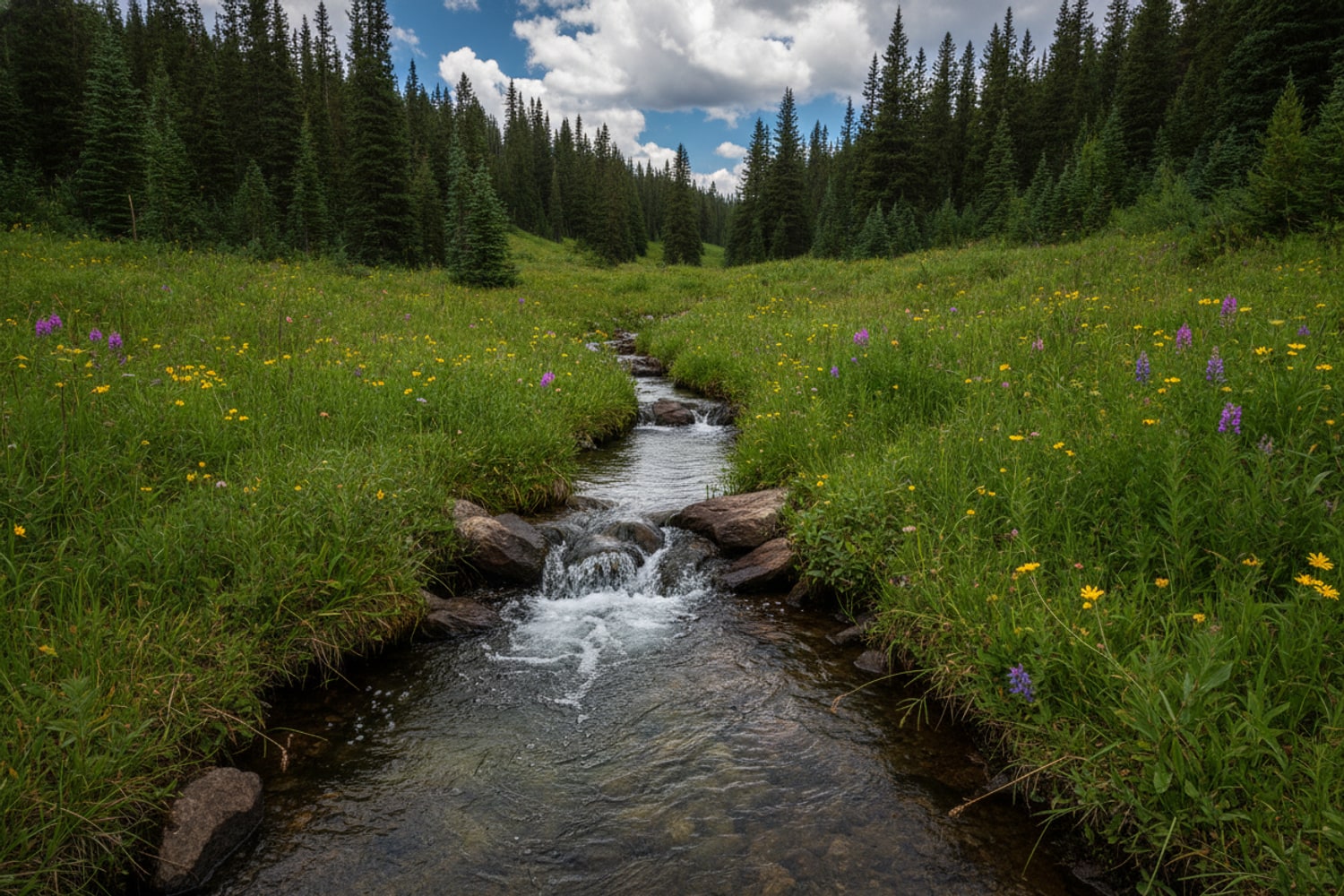
Elevation, shade, and motion. High-country creeks run off snowmelt and shaded springs, tumble fast and broken over rock, and stay oxygenated all day. A creek at 9,500 feet under spruce cover rarely gets anywhere near the temperatures that cook the valley — so you can usually fish it hard in the afternoon and your released fish recover fine.
That’s the whole trick. You’re not finding cleverer fish or a secret hatch. You’re finding water that has a much harder time getting into the danger zone, which means you can fish through the exact window when the tailwater’s telling you to go home — and the fish you release go right back to being fish.
Two honest asterisks, because “up high” is not a magic word. First, elevation alone doesn’t do it — a creek that leaves the timber and crawls through a wide, sunlit meadow or sits in a chain of beaver ponds can warm up several degrees in a mile, and in a dry year with thin snowpack there’s less cold water pushing through to hold it down. Second, the fish up there are the least heat-tolerant trout we have. Brook trout and cutthroat stress earlier than the rainbows and browns downstream — Keep Fish Wet puts their threshold at 61°F against 66°F for browns — so the number that makes you quit is lower up high, not higher. The thermometer comes up the hill with me. It just about never tells me to leave, which is exactly the point, but “just about never” is a thing you confirm, not a thing you assume.
The trout up there are different, too, and that’s the part people either love or can’t get over. These aren’t the picky, well-fed, twelve-times-pricked tailwater rainbows that have a PhD in your fly box and a long memory for tippet. Up high you’re mostly into wild brookies and cutthroat — smaller fish, a lot of them, and they eat like they’ve got a bus to catch. A creek brookie doesn’t get a long, scholarly look at your fly. He gets one shot before the fish behind him does, and he knows it. That willingness is the reward for the climb.
You give up size. A nine-incher is a trophy up there, and a foot-long cutt in a beaver pond is a fish you’ll be describing to people who didn’t ask. But you trade the inches for something the tailwater can’t give you in August: water you have entirely to yourself.
The gear gets simple
This is my favorite part of the dog-days move. I leave the system at home — the indicator, the sighter, the split shot, the whole apparatus that makes euro nymphing feel less like fishing and more like running a small lab.
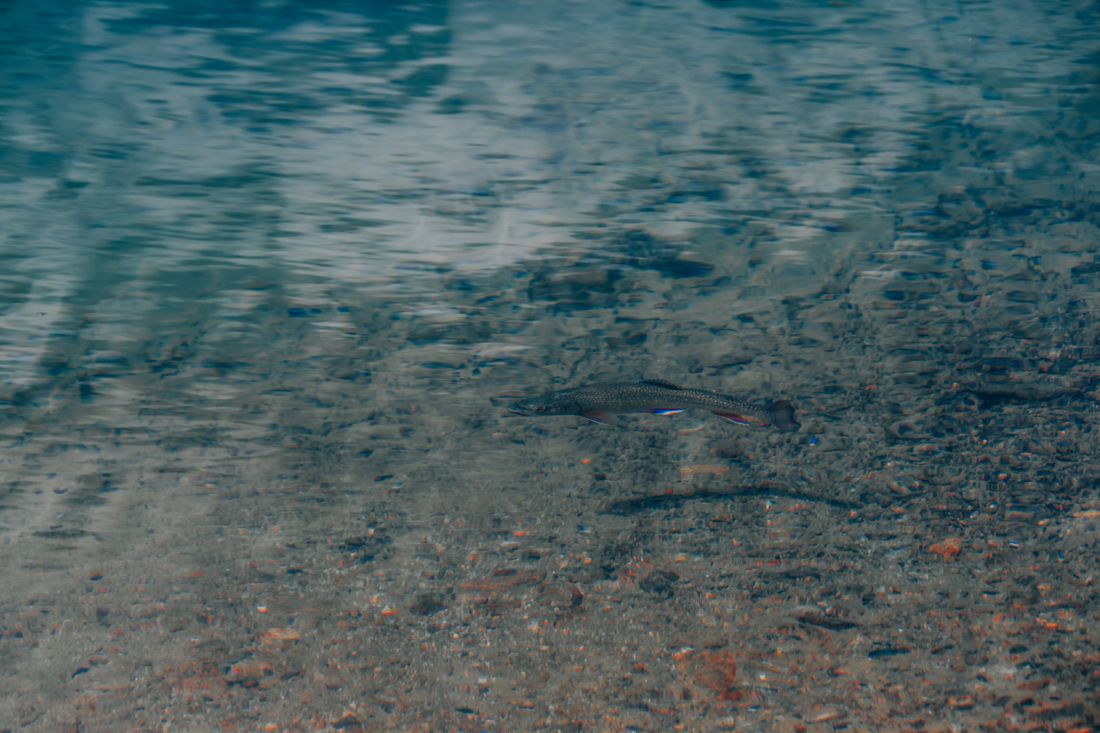
No indicator rig, no sighter, no fly box that looks like it ate a tackle catalog. For high-country creeks I carry about as little as I own:
- The Scott F Series 7’2” 3wt. A short glass rod is made for this. The creeks are tight, the casts are short, the brush is everywhere and personally offended by your backcast, and a slow glass blank loads on a ten-foot flick and protects a 6X tippet against a fish that hits like you insulted its mother. I wrote the long version in my Scott F Series review — but the dog days are when that rod earns its keep. There’s no euro nymphing up here, and no indicator rig either. Down on the tailwater I split my season pretty evenly between the euro setup and a regular line, and up here neither one comes out of the truck. For a few weeks I’m purely a dry-fly guy again.
- A click-pawl reel. I don’t need a drag for fish this size — asking a disc drag to stop a six-inch brookie is like installing a parachute on a tricycle. I need a reel that’s light, balances the glass, and makes that good noise. Mine is the Ross Colorado, which fits the F Series like the two were designed in the same room, and which I have never once adjusted, because there is nothing on it to adjust.
- A box of attractors. A Stimulator, a Royal Wulff, a Parachute Adams, an Elk Hair Caddis, a small Chubby for the bigger plunge pools. Bushy, buoyant, easy to see in broken water — the fishing equivalent of using a big font. The fish aren’t grading your tippet diameter. They’re grading whether it floats and whether you put it where they live.
That’s it. Rod, reel, line, leader, one box, nippers, and a net I forget I’m carrying about half the time, which tells you how often I actually need it. You can fish all afternoon with what fits in a shirt pocket, and there’s something genuinely good for the soul about that after a summer of arguing with split shot and untangling sighters in the dark.
My take
The simplicity is half the medicine. By late August I’ve spent two months solving the river like it’s a take-home exam, and I’m done. A bushy dry on a glass rod, a creek I have to scramble into on my hands and a prayer, fish that say yes without reading the fine print — it resets something. I come back to the tailwater in September actually wanting to fish it again, which by August is not a feeling I’d take for granted.
Why it’s better for the fish, not just for you
I want to land on this, because it’s the real argument and it’s easy to skip past in all the talk about solitude.
When you take your August afternoons up to cold water, you’re not just dodging crowds. You’re taking your pressure off a river that’s already stressed. Every afternoon you don’t spend playing and handling trout in 65-degree-plus water is a fish that didn’t get pushed over the edge. Multiply that across everybody who could make the same choice and it actually matters.
And the fish you do catch up high are released into water that lets them recover fast. Cold, oxygenated, moving. You can fight a brookie, slip the hook, and watch him dart back under the cutbank without that gut-check feeling you get releasing a hot trout into hot water. The whole transaction is cleaner. I take exactly zero hero shots up there, which is convenient, since a six-inch brookie was never making the highlight reel anyway.
It ties straight back to the temperature ethics I keep harping on. The most ethical thing you can do for a tailwater in the dog days might just be to leave it alone in the afternoon — and the high country gives you somewhere to go instead of just somewhere to stop.
The trade is the point
Let me be straight about what you’re signing up for. Small fish. Real scrambling — some of these creeks make you earn every hole with both hands and a quiet word with your knees. Cell service that gave up somewhere around the trailhead. A fly box that comes home looking like the willows took a tithe. And a long drive back with no twenty-inch photo to wave at anybody.
But you also get a whole drainage to yourself on a Saturday in August, which down on the tailwater is about as common as a free parking spot. You get fish that are genuinely thrilled to see your fly, which after a summer of being ignored by educated rainbows does wonders for a man’s confidence. You get a 3wt glass rod doing exactly what it was built to do. And you get the quiet kind of satisfaction that comes from knowing the river you usually fish is getting a break it actually needs.
If the small-stream thing grabs you and you want to go deeper, I’ve got the rest of it written down — I clearly have a problem. Why I started doing this in the first place is in why I started chasing blue lines. The actual how — reading a map, finding the cold water, getting there without dying — is in how to find blue lines in Colorado. When the heat finally breaks and you’re ready to come back down, the Deckers complete guide is waiting.
The dog days aren’t a problem to fish through. They’re a window to fish around — and the way around is up.
Frequently asked questions
When is the water too warm to fish a Colorado tailwater? Watch the water temperature, not the calendar. Once it reaches the mid-60s — and it will on lower and freestone stretches on a hot August afternoon — trout get oxygen-stressed and survive catch-and-release poorly. On the tailwater, 65°F is my line. Up high the line comes down, not up: brook trout and cutthroat are the least heat-tolerant trout we have, and Keep Fish Wet flags 61°F for them against 66°F for browns. Carry a small stream thermometer, fish the cold morning hours, and when the afternoon water heats up, that’s your cue to head higher or quit for the day. I go deeper on the exact numbers in the summer water-temp ethics post.
Why do high-country creeks stay cold when the tailwater warms up? Elevation, shade, and movement. The water’s coming off snowfields and springs, it runs through timber instead of open valley, and it’s broken and fast — all of which keeps it cold and oxygenated through the afternoon. That’s exactly why the fish stay healthy up there in August.
Do I need different gear for small high-country creeks? Less of it, not different exactly — but simpler. A short, slow rod like a 7’2” 3wt, a light click-pawl reel, and a box of bushy attractor dries cover almost everything. Tight casts, short distances, and willing fish mean you can leave the euro rig and the indicator system in the truck.
The river will be there in September. Go up.