
In this review
Most of my reels are sealed-drag machines, and they are very good at a job my trout fishing almost never asks them to do. The one I reach for when I want to actually enjoy myself — not catch the most fish, not land the biggest fish, just have the best two hours on a small creek I’ve had all week — is a click-and-pawl. It rides on my Scott F Series 7’2” 3-weight, it has roughly the stopping power of a polite suggestion, and it makes a sound when a fish runs that I would genuinely pay money to put on a vinyl record.
Here’s the thing the reel industry would rather you didn’t dwell on: for most trout fishing — including most days on Deckers — you do not need nine pounds of sealed carbon-fiber drag. You need a reel that holds your line, balances your rod, doesn’t fall apart, and gets out of the way. An 11-inch brown does not care about your drag curve. He’s going to make one short, indignant run, and you’re going to land him by stripping line in with your hand and pinching it against the cork — exactly the way your grandfather did it, on a reel that cost a third as much and weighed half as much.
That’s the case for the click-and-pawl, and it’s a better case than it’s been in thirty years. So this is the roundup I wish someone had handed me before I started buying these things one at a time like a man with a problem. Seven reels, all current for 2026, all specs and prices pulled from the maker’s own page, ranked the way I’d actually rank them — and one caveat about a reel that everyone calls a click-pawl but technically isn’t.
One thing to be straight about before the list: I fish two of these. The Ross Colorado lives on my Scott F Series, and a Clark Fork 2.5 — not in this roundup, because it’s a small-batch reel you can’t reliably buy new — rides on my bamboo. The other six I’ve handled in shops and judged on published specs and build. Where a verdict rests on handling rather than seasons of use, I say so in the entry.
Quick look: the best click-and-pawl reels of 2026
| Reel | Best for | Price | Made in |
|---|---|---|---|
| Ross Colorado | Best overall (and best made-in-Colorado) | $379 | Montrose, CO |
| Orvis Battenkill Click | Best value / best classic | $179–$198 | Imported |
| Sage Click | Best all-around performer | $330 | Imported |
| Hardy Marquis LWT | Best heritage / the original bloodline | $395–$525 | Alnwick, England |
| Abel TR | Best heirloom / endless customization | From $479 | Montrose, CO |
| Redington Zero | Best budget / best first click-pawl | $109.99 | Imported |
| Galvan Brookie | Best ultralight (with an asterisk) | $290–$320 | USA |
Every price above is the maker’s own 2026 list price, pulled from the manufacturer’s product page — not a shop’s sale sticker. Where a model spans a range, that’s the real spread across sizes.
A quick word on how I ranked these. I did not rank them on drag, because that’s like ranking sports cars on cup-holder capacity — it misses the point of the entire category. I ranked them on the things that actually matter in a reel you fish without a real brake: weight and balance, build quality, the sound, the palming rim, and whether the price makes sense for what you’re getting. If you want the deeper “why” behind that, I laid it all out in click-and-pawl vs disc drag for trout — read that and this list will make a lot more sense.
1. Ross Colorado — Best Overall
Specs:
- Sizes: 2/3 (3.22” diameter, 3.2 oz, WF2+75 / WF3+50), 4/5 (3.57” diameter, 3.5 oz, WF4+80 / WF5+70)
- Material: Fully machined bar-stock aluminum, semi-caged frame, Vesconite bushing
- Drag: Unidirectional click-pawl with an all-metal external clicker
- Made in: Montrose, Colorado
- Price: $379 (all four finishes, both sizes)

I’m leading with the Colorado, and yes, I’m aware that picking the reel that lives on my own rod as “best overall” looks a little like grading my own homework. But hear me out, because the reasons are real and they’re not just “I’m from Colorado and so is the reel” (though I am, and it is, and I’m not going to pretend that doesn’t make me happy).
The current Colorado is a genuinely modern click-pawl. Ross machines the whole thing from solid bar stock in Montrose, and the headline feature is an all-metal external clicker on the back of the reel — a little mechanism with a machined silhouette of the San Juan Mountains, the range you can see from the factory. It’s a flex. It’s also the source of the best click sound in this entire roundup, a crisp metal zzzip with none of the plasticky buzz you get from a composite check. The spool is a large arbor, the frame is semi-caged for stiffness without weight, and there’s a Vesconite bushing in there so the spool spins smooth and true. At 3.2 ounces in the 2/3, it balances a 3-weight glass or graphite rod beautifully — which, on a light rod, is the reel’s actual job. Drag is irrelevant. Balance is everything.

What you’re paying $379 for is build. I’ve dropped mine on creek rock more times than I’d like to confess and it’s come away unmarked. Ross specs an industry-first bushing machined from Vesconite — a material they borrowed from marine bearing applications, which is a fairly serious answer to a fairly small problem, and exactly the kind of over-engineering I’m happy to pay for. And because Ross builds the small reels to the same standard as their big sealed-drag reels, you’re not getting a downgraded “starter” product — you’re getting their full machining quality, just lighter.
Is it worth $379 when a $179 Battenkill holds the same line and stops the same fish (which, again, is no fish — you stop the fish)? That’s a question only you can answer. If you fish a click-pawl twice a year, no — buy the Battenkill or the Zero and put the difference toward a rod or a better fly line. The Colorado earns its price for the person who fishes light rods a lot, wants a buy-it-for-life machined reel, and cares about the sound and the made-in-Colorado story. That’s me. It might not be you, and that’s fine. I wrote a whole standalone review of the Colorado if you want the long version, but the short version is: this is the one I keep reaching for.
Why I chose it: it’s the click-pawl that does everything right — modern build, semi-caged frame, perfect light-rod balance, made a few hours from my house here in Colorado, and the best-sounding clicker on the list. If I could only keep one reel in this roundup, it’d be this one. (It is, in fact, the one I kept.)
Where to buy: Ross is built by Mayfly Outdoors in Montrose and sold through most full-service fly shops. It’s the same shop floor that turns out my Evolution LTX and San Miguel, which is a big part of why I trust the small one.
2. Orvis Battenkill Click — Best Value
Specs:
- Sizes: I (1–3 wt, 3.4 oz, 2.8”), II (3–5 wt, 3.8 oz, 3.0”), III (5–7 wt, 4.1 oz, 3.25”)
- Material: 6061-T6 aircraft-grade aluminum
- Drag: Classic click-and-pawl — Orvis specs it as an “audible, positive outgoing click” and publishes no drag settings
- Made in: Imported
- Price: $179–$198 across the three sizes
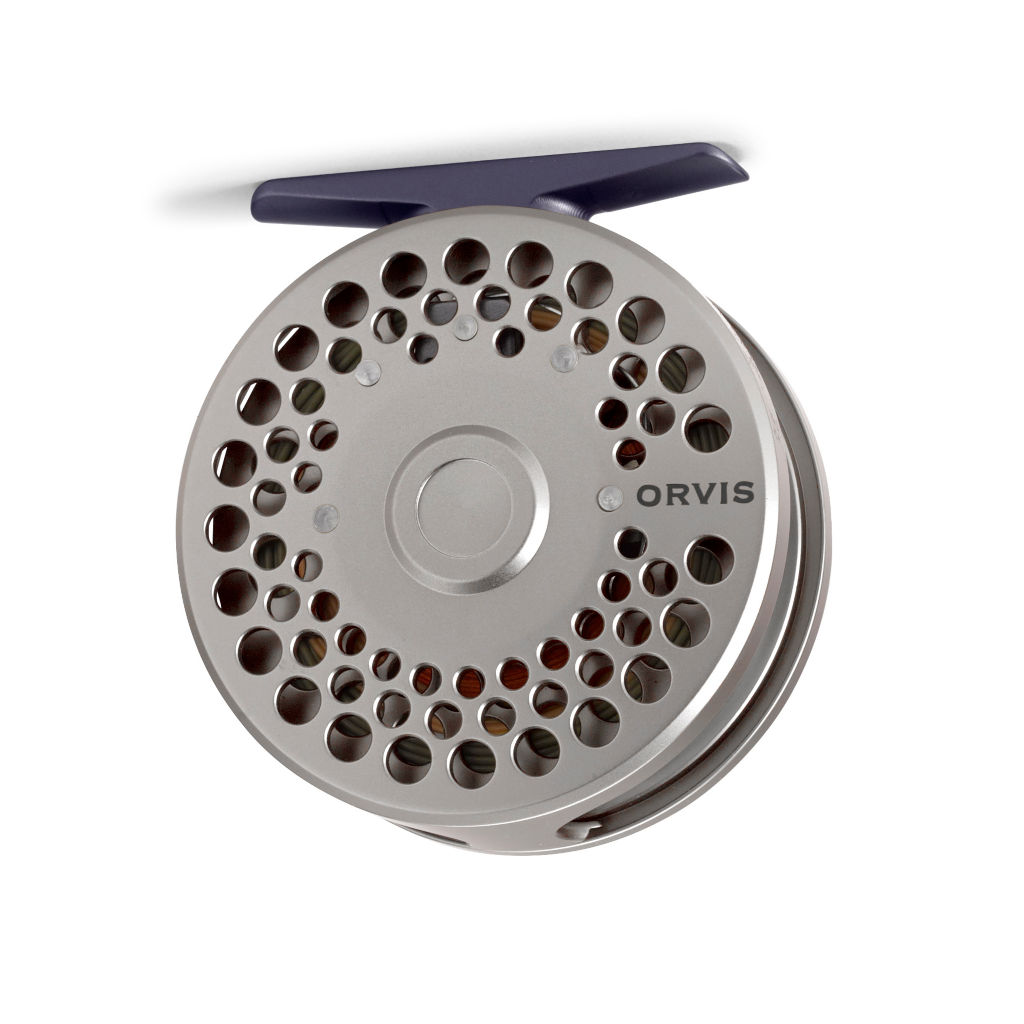
The Battenkill is the reel a lot of us picture when someone says “click-pawl” — that classic, drilled-out, silver-faced look that’s been hanging off Orvis rods since before I was tying flies badly in my dad’s garage. Orvis describes the current one as “ushered into the next decade with key design improvements,” which is catalog for we tightened it up without changing what it is: tighter tolerances for a smoother spin, a curved reelfoot that gives you kink-free leader storage when you set the rod down, and an ergonomic Delrin handle that’s comfortable for a full day.
Here’s what makes it the value pick. Orvis publishes no adjustable drag settings on this reel, and I’m not going to invent any. What you’re buying is a straight click-and-pawl — 6061-T6 aircraft aluminum, an audible outgoing click, and nothing to fiddle with — starting at $179. That is a lot of reel for the money. The Battenkill I and II are light at 3.4 and 3.8 ounces, which makes them natural partners for a 2- or 3-weight, and the absence of settings is arguably the point: there’s no knob for a beginner to get wrong on a fish. I’d happily recommend a Battenkill II to anyone building their first dedicated small-stream or dry-fly outfit. It’s the best fly reel under $500 story in click-pawl form: punches way above its sticker.
The catch: the Click line stops at size III (5–7 wt), so if you want a Battenkill for anything heavier you’re looking at the disc-drag Battenkill instead, which is a different reel with a different feel. Within the trout sizes that belong in this roundup, though, there’s nothing to complain about.
Why I chose it: the most reel-for-your-money in the category. Classic looks, a real click, and a price that leaves room in the budget for a better fly line — which, spoiler, matters more than the reel anyway.
Where to buy: orvis.com and Orvis dealers.
3. Sage Click — Best All-Around Performer
Specs:
- Sizes: 0/1/2 (1–2 wt, 2.31 oz, 3.13”), 3/4/5 (3–5 wt, 2.63 oz, 3.44”), 4/5/6 (4–6 wt, 3.0 oz, 3.75”)
- Material: Fully machined 6061-T6 aluminum, cold-forged and tempered
- Drag: Adjustable click-and-pawl
- Made in: Imported
- Price: $330
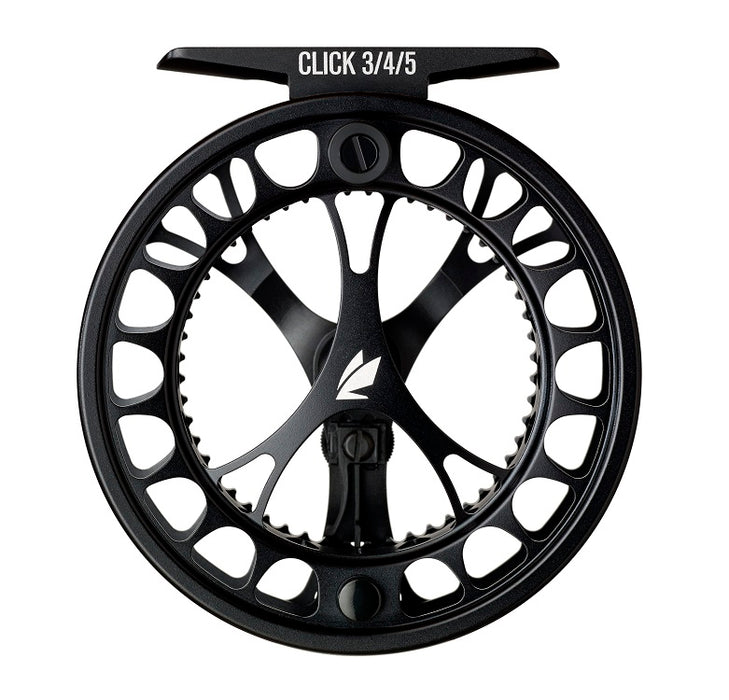
If the Colorado is the romantic pick and the Battenkill is the value pick, the Sage Click is the one I’d hand someone who says, “I want a click-pawl, but I also still want it to perform a little.” Sage took the traditional formula and dragged it gently into the modern era. The current Click is fully machined, cold-forged, and tempered 6061-T6 — strong, light, and crisp — and it runs a notably large arbor for the category.
That arbor is the headline. A lot of click-pawl reels use a small classic arbor, which looks gorgeous and traditional but retrieves line slowly and lets your line take on memory coils like a Slinky that’s seen things. Sage’s whole stated reason for the current Click is “larger arbor diameters creating a larger palming area for fighting fish and quicker line retrieval while maintaining backing capacities” — 3 7/16” across the 3/4/5, which is a big wheel for a reel this light. For an angler who wants the click-pawl feel and sound but also wants to reel up a long drift quickly when a fish bolts toward them, this is the sweet spot. The big open palming surface is the other half of it — you’ve got plenty of spool rim to cup your hand against when you need to add real resistance, which on a click-pawl is the only way you add real resistance.
At 2 5/8 ounces in the 3/4/5 it’s the lightest reel here that I’d still call a do-everything trout option, and the composite check has its own distinctive voice — a little softer than the Colorado’s metal-on-metal snap, but plenty satisfying. It’s $330, which lands it right between the Battenkill and the premium machined reels, and the performance-per-dollar is excellent. If you fish a 4- or 5-weight and want one click-pawl that handles a full range of trout days, start here.
The catch on the performance pick: at $330 you’re $151 from a Battenkill that does the same job on the same fish, and $49 from a Ross Colorado. It’s squeezed from both sides, and if what pulled you toward a click-pawl was the romance rather than the retrieve rate, the Sage is the one reel here you might talk yourself out of on the drive to the shop.
Why I chose it: it’s the click-pawl that doesn’t make you give anything up on the water. Big arbor, fast pickup, low memory, real palming rim, modern build — all the romance, none of the “well, it’s a little slow to reel.” The performance pick.
Where to buy: sage dealers and shops like Red’s Fly Shop.
4. Hardy Marquis LWT — Best Heritage
Specs:
- Sizes: Eight models (2/3 through 7, then Salmon No1–No3); the Marquis LWT 5 weighs 3.77 oz, the 4 weighs 3.4 oz
- Material: Bar-stock 6061 construction, modified porting to reduce weight
- Drag: Traditional click-check with an indented regulator button and an improved range of adjustment — Hardy rates the trout sizes at 0.5 lb
- Made in: Alnwick, England
- Price: $395–$525 (trout sizes $395–$450)

You cannot write a serious click-and-pawl roundup without Hardy, because — and I mean this almost literally — every reel on this list is descended from a Hardy. William Hardy set up shop in Alnwick, Northumberland in 1872 — as a gunsmith, which is a wonderfully unlikely origin story for the most famous fly reels ever made. The firm was advertising “superior River and Sea Fishing tackle” by 1874, and in 1891, after three years of development, launched the Hardy Perfect. That reel and the Lightweight series that followed basically invented the refined click-check reel everyone else has been iterating on ever since. When you hear that singing click in an old fishing film, you’re hearing a Hardy. So the Marquis LWT isn’t just a reel; it’s the bloodline.
The modern Marquis LWT is the current evolution of that classic — still bar-stock 6061, still made in Alnwick, with modified porting to shed weight, an indented regulator button, and what Hardy calls an improved range of adjustment. Hardy rates the check on the trout sizes at half a pound, which tells you everything about the category: the spec sheet’s proudest number is the one a good tippet knot laughs at. The Marquis LWT 5 comes in at 3.77 ounces, a substantial counterweight for a medium trout rod, and the whole thing carries that understated grey-and-silver British look that makes a graphite rod feel suddenly more dignified than it has any right to. Engraved right on the back plate: Hardy (Alnwick) Ltd. Made in England. It is, frankly, a little bit of an heirloom you can buy new.
Is it the most rational purchase on the list? No. You’re paying for heritage and provenance as much as performance, and a $109 Redington will hold the same line and stop the same fish (which is to say, neither will stop the fish — you will). But there’s a real argument that the original tradition is worth owning at least once, and if you’re going to buy a “forever” click-pawl, there’s something genuinely satisfying about buying it from the company that started the whole genre. The range runs $395 to $525, and the climb to the top of it is entirely about size, not finish: the big money is in the Salmon No1–No3 models built for WF10 through WF12. Every trout-weight Marquis sits between $395 and $450. Hardy’s modern sealed-drag work is a separate conversation — I got into that with the Averon streamer reel.
Why I chose it: it’s the source. Made in Alnwick, the look that defined the category, from a company that has been doing this since Ulysses S. Grant was president. If heritage is part of why you want a click-pawl, this is the one.
Where to buy: hardyfishing.com and Hardy dealers.
5. Abel TR — Best Heirloom
Specs:
- Sizes: 2/3 (4.19 oz, 3.06” spool), 4/5 (4.65 oz, 3.29”), 5/6 (5.19 oz, 3.68”)
- Material: Machined aluminum — Abel builds the whole reel from 21 parts, with machined stainless accents on frame and spool
- Drag: Click-and-pawl with an integrated, precision-balanced clicker on the spool
- Made in: Montrose, Colorado
- Price: From $479 (climbs steeply with custom finishes and engraving)
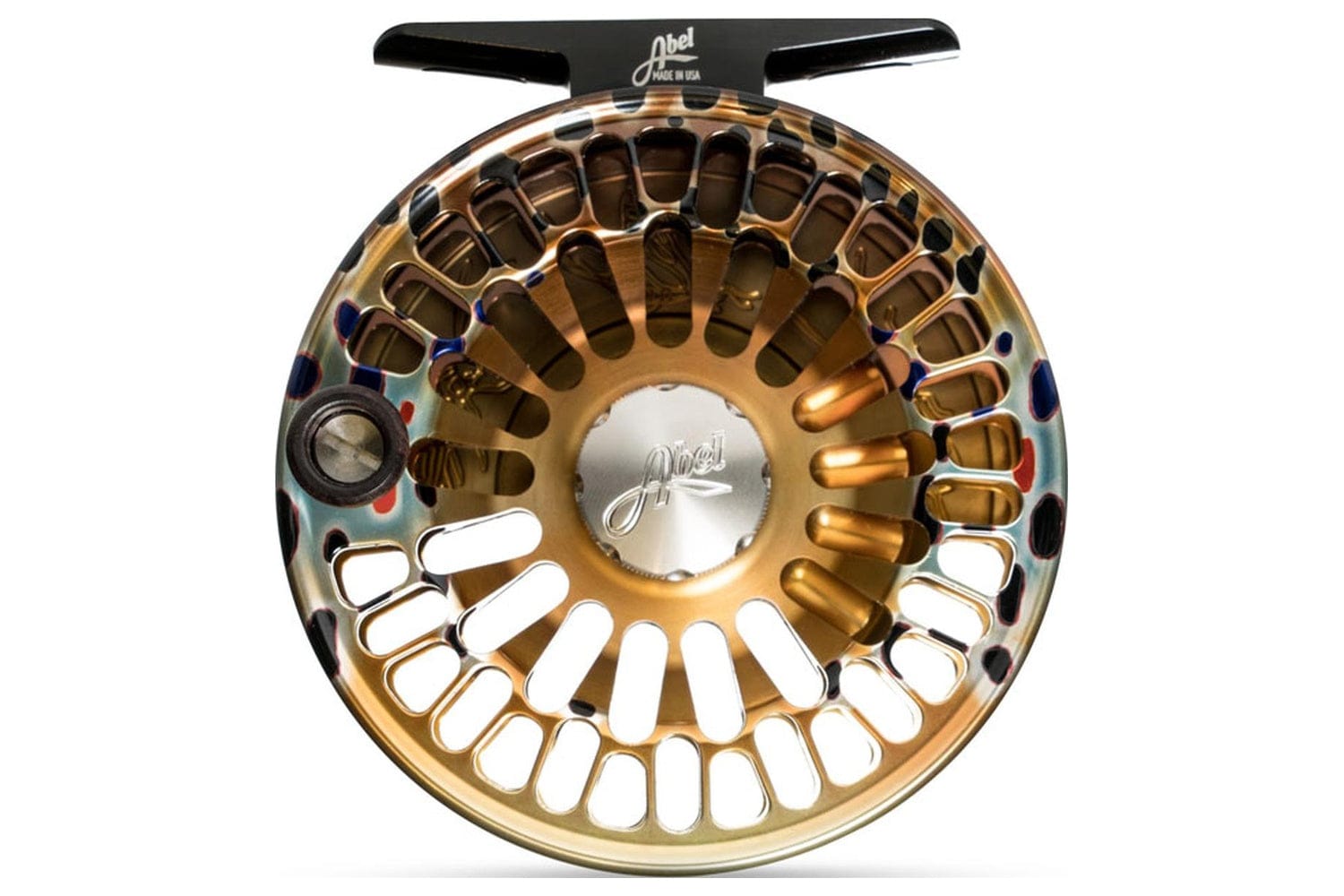
The Abel TR is the reel you buy when you’ve decided a fly reel can also be a piece of art and you’ve made peace with what that decision does to your bank account. It’s machined in Montrose, Colorado — same town as the Ross, interestingly, which makes that little corner of the Western Slope the click-pawl capital of America — and it’s an updated version of Abel’s classic click reel. The clever bit is an integrated, precision-balanced clicker built right into the spool, which eliminates the need for a separate counterweight, so the whole reel spins dead-true while keeping that iconic click-pawl sound.
What separates the TR is finish and customization. Abel’s custom shop will do solid colors, fades, and fish graphics with engraving on top — the brown-trout pattern in the photo is a real example, all coppers and spots and blue halos, the kind of thing you catch yourself just looking at on the drive home. Look inside the frame and there are milled silhouettes of a stonefly, a caddis and a mayfly, which nobody will ever see but you. The machined stainless accents on the frame and spool are the same kind of detail — invisible until you’re holding it, and then impossible to stop noticing. It is, no question, the prettiest reel in this roundup. Be aware that the custom work carries real lead times: Abel quotes roughly two to three months for solid colors and fades, and four to six months for custom fish graphics. You are, functionally, commissioning it.
Now the part the custom-shop photos don’t tell you. At 4.19 to 5.19 ounces, the TR is the heaviest reel here in a comparable size — a full ounce over the Colorado in the same 2/3 size, and nearly two over the Sage. On a delicate 3-weight, that extra mass can tip the balance from “perfectly counterweighted” toward “a little butt-heavy,” depending on your rod. It’s not a flaw so much as a different philosophy: the TR leans substantial and heirloom-solid rather than wispy and minimalist. If you fish a 4- or 5-weight, it balances great. If you’re putting it on a tiny 2- or 3-weight glass rod, rig it up and find the balance point before you fall in love — rod action and balance matter more here than the spec sheet suggests. And starting at $479 before you touch the custom menu, it’s the priciest standard reel here — but you’re not really buying it on a spec sheet, are you?
Why I chose it: it’s the one you hand down. Machined in Colorado, finishes that belong on a wall, an integrated balanced clicker, endless customization. Heavier than the rest — go in knowing that — but nothing else here feels quite this much like a keepsake.
Where to buy: Abel Reels (also a Mayfly Outdoors brand) and select shops.
6. Redington Zero — Best Budget
Specs:
- Sizes: 2/3 (2.7 oz, 100 yd/20 lb backing), 4/5 (3.0 oz, 100 yd/20 lb)
- Material: Die-cast aluminum — Redington’s own line is that die-casting produces “an incredibly lightweight design not achievable with CNC machining processes”
- Drag: Spring-loaded clicker drag system
- Made in: Imported
- Price: $109.99, every size and color

The Redington Zero exists to prove a point I happen to believe in deeply: you do not have to spend $379 to enjoy a click-pawl reel. At $109.99, the Zero is the entry door to the entire category, and it’s a surprisingly good one. It’s a genuine featherweight — 2.7 ounces in the 2/3, 3.0 in the 4/5, which makes it the lightest die-cast reel here and lighter than most reels costing three times as much (the machined Sage Click and Galvan Brookie go lighter still in their smallest sizes) — with a clean, skeletonized spool, a large arbor for faster line pickup and less memory, and a spring-loaded clicker drag. It makes a real click. It holds 100 yards of 20-pound backing. It balances a light rod. That is, genuinely, the whole job.
The trade-off is in how it’s built. The Zero is die-cast, not machined from bar stock like the Ross, Sage, Abel, or Hardy. Die-casting pours molten aluminum into a mold rather than carving the reel out of a solid block, which is cheaper — and, to be fair to Redington, is exactly how they get it this light; they say the design isn’t achievable by machining at all. What you don’t get is the jewel-like tolerances or the lifetime-heirloom feel of a machined reel. The finish will show wear faster, and you won’t get that buttery, dead-true spin a $400 machined reel gives you. So: if you’re new to small-stream or light-line fishing and you’re not sure how much you’ll fish it, buy the Zero, put the $269 you saved toward a good rod and a quality line, and upgrade later if you fall in love. There’s no shame in it.

Why I chose it: it’s the no-excuses on-ramp. Lightest reel here, large-arbor, real click, dirt cheap, and it does everything a click-pawl needs to do. The reel I’d put in a kid’s first outfit without a second thought — and the one I’d put on my own gear checklist for anyone starting out.
Where to buy: Redington’s Zero 2/3 and Zero 4/5 direct, plus most shops.
7. Galvan Brookie — Best Ultralight (read the asterisk)
Specs:
- Sizes: 0/1 (2.54 oz, 2.7”), 2/3 (2.72 oz, 2.95”), 3/4 (2.97 oz, 3.2”), 4/5 (3.20 oz, 3.45”)
- Material: USA bar-stock 6061 aluminum
- Drag: Galvan’s “Click-Ball Tension System” — not a traditional click-and-pawl (more below)
- Made in: USA
- Price: $290–$320
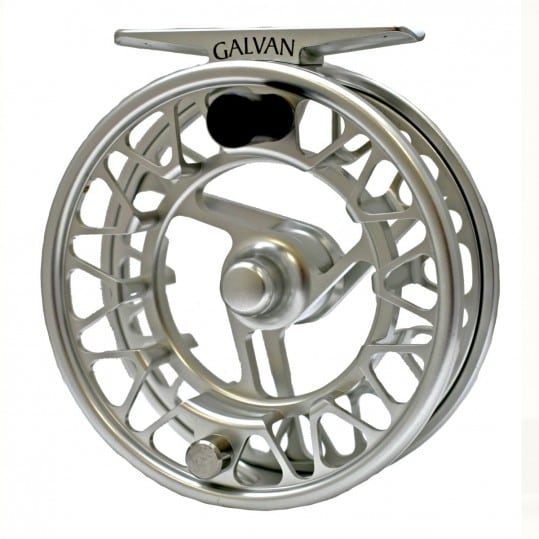
Here’s the asterisk, right up front, because I’d rather lose your trust by being boring than keep it by being misleading: the Galvan Brookie is not technically a click-and-pawl reel. Galvan markets it as a “foolproof departure from traditional click-and-pawl reels,” and it uses what they call a Click-Ball Tension System — instead of a spring-loaded pawl riding over a toothed gear, it uses a ball-and-detent tension mechanism that you adjust with a few turns of an Allen wrench. It makes a click. It gives you light, simple resistance. It lives in the same world and is bought by the same people for the same reasons. But it is a different mechanism, and a roundup that quietly pretended otherwise wouldn’t be worth reading.
So why include it? Because if you want the simplest, made-in-USA minimalist trout reel — the click-pawl experience in spirit, if not in literal mechanism — the Brookie is sensational, and a lot of small-stream anglers cross-shop it against everything else on this list. Galvan machines it from 6061 bar stock in the USA and calls it one of the lightest fully machined American-made reels available, which is a carefully worded claim and a true one: 2.54 ounces in the 0/1, 3.20 in the 4/5. (The die-cast Zero undercuts it in the 2/3, but “fully machined” is doing real work in that sentence.) The Click-Ball system has the genuine advantage of being adjustable to a precise, repeatable tension and having almost nothing to wear out or fail — no pawl to wear, no spring to tire. For a fiberglass or bamboo 2- or 3-weight where you want the absolute minimum weight to counterbalance the tip, it’s hard to beat.
The catch — beyond the “it’s not really a click-pawl” thing — is that some traditionalists specifically want the pawl-and-gear sound and the field-repairable simplicity of a true click-pawl, and the Brookie’s system, while clever, doesn’t sing quite the same song. If the sound is half the reason you’re here (and for a lot of us, it is), audition it before you commit. But if your priorities are weight, simplicity, and a flawless USA build above strict mechanical tradition, the Brookie earns its spot — caveat and all.
Why I chose it: it’s the lightest, cleanest minimalist trout reel here, and it belongs in the conversation even if it’s technically wearing a different jersey. Just buy it knowing exactly what it is — a Click-Ball tension reel, not a true pawl — so you’re never surprised.
Where to buy: galvanflyreels.com and dealers.
What is a click-and-pawl reel, anyway?
A click-and-pawl reel is the original fly reel design: a toothed ratchet fixed to the spool, one or more spring-loaded pawls riding over it, and just enough resistance to stop the spool over-running into a backlash. That resistance is the “check”; the pawls snapping into each gap is the click. Hardy publishes the number on the Marquis, and the number is half a pound. None of these reels, adjusted to the moon, will stop a determined fish.
Which is the point, not the flaw. On a click-and-pawl, you are the drag — you cup your hand against the exposed spool rim and add exactly as much as the moment needs, instantly and infinitely variably. That’s why every reel below has a usable palming rim, and why I weighted that feature so heavily in the ranking.
I’ve written the mechanism up properly, along with when a sealed disc is genuinely the better answer, in click-and-pawl vs disc drag for trout and what reel startup inertia actually is. Short version for the purposes of this list: on light rods, light tippet, and trout that mostly stay close, the click-pawl is the correct tool. On big browns, streamers, and fish that reach your backing, it isn’t, and I fish a sealed Lamson Liquid S for that.
The other thing worth naming, since the spec sheets won’t: a click-pawl is light, and on a 2-, 3-, or 4-weight the reel’s real job is counterbalancing the tip so the outfit doesn’t feel dead in your hand after six hours. An over-built disc reel ruins a delicate rod. It also has almost nothing in it to fail — a worn pawl or tired spring is a cheap, field-serviceable fix.
And the sound. Let’s not pretend that isn’t half of it.
What to look for in a click-and-pawl reel
Forget drag poundage — it’s the one spec that genuinely doesn’t matter here. These are the things that do, roughly in order:
- Weight and balance for your rod. Match the reel to your rod weight and, ideally, rig it up and find the balance point before you buy. A 2.5-ounce reel and a 4.5-ounce reel feel like totally different fishing on a 3-weight — and if you’re still working out how many rods you actually need, sort that before you sort reels.
- Build: machined vs die-cast. Machined bar-stock aluminum (Ross, Sage, Abel, Hardy, Galvan) gives you tighter tolerances, a truer spin, and buy-it-for-life durability. Die-cast (Redington Zero) is lighter on the wallet and perfectly serviceable, but won’t have the same finish life or jewel-like feel.
- The palming rim. You want a generous, smooth, exposed spool edge you can cup your hand against. This is your actual drag. A reel with a cramped or shrouded rim is fighting you.
- The sound. Metal-on-metal clickers (Ross, Abel) tend to be crisper; composite checks (Sage) are a bit softer. Neither is wrong — but it’s worth knowing you have a preference before you spend the money.
- Arbor size. A large arbor (Sage Click, Zero, Colorado) picks up line faster and reduces memory coils. A small classic arbor looks beautifully traditional but reels slower. Mostly a feel-and-looks decision on a trout reel, not a performance one.
A little history (because it’s a good story)
The click-pawl isn’t a budget version of a “real” reel — it’s the original reel, and the lineage is worth knowing. The earliest trout reels were simple click winches: line storage plus a ratchet to stop the spool over-running. Hardy of England (since 1872) refined that into the legendary Hardy Perfect and Lightweight series, the archetype every modern click-pawl descends from — which is exactly why the Marquis LWT made this list as the heritage pick. Across the Atlantic, the Vom Hofe brothers in New York hand-built hard-rubber-and-nickel-silver reels that collectors still chase, and later Stanley Bogdan in New Hampshire set the gold standard for the handmade reel, each one built by a single craftsman.
Then disc drag arrived — funnily enough, from the saltwater big-game world, where anglers needed something that could actually stop a tarpon or a tuna, and cork friction drags delivered it. That technology trickled down to freshwater through machined-reel makers like Abel and Tibor in the 1980s and ’90s, and by the 2000s the sealed disc drag was the default trout reel. Which is how a solution engineered for hundred-pound fish ended up standard equipment on a rod built for eleven-inch ones. But here’s the twist that makes 2026 a fun time to write this: the click-pawl is in the middle of a genuine renaissance. Small-stream, glass, and bamboo anglers rediscovered that you don’t need — or even want — heavy drag for small trout, and that a light, singing click reel is a better match for the fishing. Both trends are live at once. The disc drag is the sensible default, and the click-pawl is having its moment in the sun. I’m firmly, happily on the click-pawl side of that fence — at least when the 3-weight comes out.
Why a click-and-pawl pairs so beautifully with cane and glass
There’s a reason you almost never see a chunky sealed disc reel on a bamboo rod, and it’s not just aesthetics (though it is partly aesthetics). A bamboo or fiberglass rod is a slower, deeper-loading, more deliberate tool — built for delicate presentation and tippet protection on technical water, not for hauling line at distance. A simple, light, well-made click-pawl matches that character perfectly: it keeps the outfit balanced, it doesn’t fight the soft tip, and its gentle check protects the fine tippet that cane and glass were made to fish. The reel and the rod are speaking the same language — quiet, classic, presentation-first.
I found this out firsthand this summer on the Headwaters Gallatin, a 7’6” 4-weight cane rod I’ve been fishing with a Clark Fork 2.5 click-and-pawl hung underneath it. The pairing is the whole argument in one outfit: the rod loads slowly, the reel does nothing but hold line and make noise, and the entire rig weighs less than the reel-and-line on my nymphing setup. If you’re building around glass or bamboo, a click-pawl isn’t only the traditional choice — it’s the correct one.
The honest trade-off: pros and cons
Seven reels, but they make the same case and carry the same caveat. Here’s the whole argument in one place, so you can decide before you spend.
Pros
- They’re light, and they balance a light rod. On a 2-, 3-, or 4-weight the reel’s real job is counterbalancing the tip so the outfit doesn’t feel dead in your hand after six hours. A click-pawl does that; an over-built disc reel ruins a delicate rod.
- You are the drag. Cup your hand against the palming rim and you add exactly as much resistance as the moment needs — instantly, and infinitely variably. No knob, no drag curve, no guessing.
- Almost nothing to fail. A toothed ratchet and a spring or two. A worn pawl or a tired spring is a cheap, field-serviceable fix, not a warranty claim.
- The sound. Half the reason anyone fishes one, and I’m not going to pretend otherwise.
- The right match for cane, glass, and small-water trout. Light tippet, short fights, presentation-first fishing — here the click-pawl is the correct tool, not a compromise.
- You can get in cheap. A hundred and ten dollars buys a fully functional one; the buy-it-for-life machined sweet spot is $300–$400.
Cons
- There’s no real stopping power. Hardy rates the Marquis’ check at half a pound, and none of these, cranked to the moon, will turn a determined fish. On big browns, streamers, or anything that reaches your backing, fish a sealed disc instead.
- You have to palm to fight a fish. There’s no set-and-forget drag — if you want to lock a knob and crank, this isn’t it.
- At the top, you pay for provenance, not performance. Heritage and heirloom reels run four-figure-adjacent and are mechanically no more capable than the $300 pick. Worth it if holding it means something to you; not if you’re buying on spec.
- Small classic arbors reel slowly. Gorgeous and traditional, but a large arbor picks up line faster and fights memory coils better. That one’s a looks-versus-feel call.
Frequently asked questions
Is a click-and-pawl reel good enough for trout? Yes — for most trout fishing it’s not just good enough, it’s arguably better. On small-to-average trout fished on 2–5 weight rods with light tippet, a click-pawl is lighter, simpler, more sensitive, and there’s nothing to fail. You land the fish by stripping line and palming the rim, not by cranking down a drag knob.
Do I need to adjust the drag on a click-and-pawl reel? Mostly no — and on several of these you can’t. The Hardy Marquis (indented regulator button) and the Sage Click let you adjust the spring tension across a small range; Hardy rates the trout sizes at 0.5 lb even at the top of it. Orvis publishes no settings at all for the Battenkill Click, and the Galvan Brookie is set once with an Allen wrench rather than adjusted on the water. The real “adjustment” happens with your palm regardless. Set the check where it sounds and feels right and then forget about it.
What’s the best click-and-pawl reel overall? The Ross Colorado is my overall pick for 2026 — modern machined build, a Vesconite bushing that keeps the spool dead-true, perfect light-rod balance, the best clicker sound on the list, and made in Montrose, Colorado. The Sage Click is the best all-around performer, and the Orvis Battenkill is the best value.
Click-and-pawl or disc drag for small streams? Click-and-pawl, easily. On small streams and blue lines you’re dealing with short fights and wild trout that need to be landed and released quickly, not 50-foot runs into your backing. The light weight, sensitivity, and tippet protection of a click-pawl are exactly what small-water fishing calls for, and the lack of heavy drag is a feature, not a flaw.
Can I put a click-and-pawl on a graphite rod, or is it just for bamboo and glass? You can absolutely fish one on graphite — plenty of people run a click-pawl on a light graphite 3- or 4-weight and love it. The pairing is most celebrated with cane and glass because the classic, presentation-first character matches, but the only real requirement is matching the reel weight to your rod so the outfit balances. If it balances and you like the sound, fish it on anything.
How much should I spend on a click-and-pawl reel? As little as $110 (Redington Zero) gets you a fully functional one. The sweet spot for a buy-it-for-life machined reel is the $300–$400 range (Ross Colorado, Sage Click). Above that you’re into heritage and heirloom territory (Hardy Marquis, Abel TR), where you’re paying for provenance and finish as much as function. Spend based on how much it’ll mean to you to hold it — because performance-wise, they all do the same simple job well.
My take
Buy on weight, balance, build, and the sound — in that order — and rig the reel to the rod before you commit, because balance is the one thing a spec sheet cannot tell you and the one thing you’ll feel every hour of every day you fish it. Everything else on the list is preference. Mine is the Ross Colorado, and the reason isn’t performance: it’s that a light rod with the right reel under it stops feeling like equipment somewhere in the first hour, and I have never once stood in a creek wishing I’d bought something with a knob on it.
The short version, by budget: the Ross Colorado for the best of everything, made a few hours from my front door in my home state. Tightest budget? The Redington Zero, no apologies. Want the performance edge? The Sage Click. Buying a forever reel or an heirloom? The Hardy Marquis for heritage or the Abel TR for art. And if you just want the simplest minimalist machined reel and you don’t mind that it’s a Click-Ball and not a true pawl, the Galvan Brookie is sensational — just buy it knowing exactly what it is.
Whatever you land on, put it on a light rod, fish it on small water, and let a wild trout sing it once. You’ll understand the whole appeal in about four seconds.
Next up: sort out the drag question for good with click-and-pawl vs disc drag for trout, then see how a click-pawl fits into a real working setup in my six-rod South Platte quiver.
Rocky Drift Co. may earn a commission through affiliate links at no cost to you. Full disclosure.