
In this guide
There’s a version of a trout river that almost nobody sees. It starts about forty minutes after the last angler walks back to the parking lot, and it belongs almost entirely to brown trout.
Mousing is fishing a big, buoyant surface fly — a clipped-deer-hair or foam pattern that pushes a visible wake — in full darkness, for the fish that spend daylight hours refusing to be caught. It’s not a numbers game. Most nights produce a handful of eats. But the fish that eat a mouse are, on average, the largest brown trout in the river, and anglers who fish it all describe the take the same way: no rise ring, no sipping, no drag-free drift. A sound.
This is a technique guide, not a trip report. The Arkansas tailwater below Pueblo Reservoir is the right kind of water for it in Colorado — cold releases, a real brown trout population, and structure that fish patrol after dark. It also comes with access rules and water-temperature limits that decide, more than anything else, whether you should be out there at all. Those are in here too.
When is the best time to mouse for brown trout in Colorado?
Roughly July through mid-September, after full dark. That’s the reliable window, and it holds on the Pueblo tailwater with the cold release stretching the tail of it into early October in a mild year.
That’s the temperature-driven window, and it’s the one most general guidance describes. But it isn’t the only one on this river.
There’s a second window that gets far less airtime: fall. On the Pueblo tailwater the mouse keeps producing well past the summer temperature window, and the local pattern is that autumn is when it’s actually at its best — browns and bows coming up to eat a big fly on top, at a time of year when most anglers have already switched to streamers. A lot of it is visual, too: you watch the fly push water and get crushed, rather than fishing blind into the dark. That’s a different mode from midnight mousing, and worth knowing it exists.
So carry both windows. Summer is about water temperature and darkness. Fall is the less-conventional one — a stretch when this water reportedly fishes best on a mouse, and when a big surface fly can be the better call than a streamer.
One thing the fall window is not about is the spawn. Brown trout spawn in Colorado from roughly late September through November, and pre-spawn fish do get aggressive — but pointing at the spawn as the reason is a guess, and fishing that window comes with an obligation. See the spawning note at the end.
What actually drives the summer window is simpler, and there is real research behind it rather than just campfire theory:
- Brown trout move most in low light. Telemetry work on stream browns found them least active when light levels were high, with activity picking up at twilight and through the night. The explanations researchers offer are food availability, predation risk and water temperature.
- Big browns leave cover to feed after dark. Tracking work on large browns describes fish moving out to midstream to forage at night and returning to specific daytime holding cover — which is another way of saying the fish that spends daylight under a log is out on the shallow tailout at midnight.
- Warm — not hot — water raises feeding activity. Cold water suppresses it. That’s why this is a July-to-September technique rather than a year-round one.
- Terrestrial food peaks in late summer. Brown trout diets carry a real terrestrial subsidy at that time of year.
One caveat on that last point: the terrestrial subsidy in the research is mostly insects, spiders and worms. There’s no study showing Colorado rivers fill up with swimming mice in August. Brown trout do eat small vertebrates, but ordinary diet studies are dominated by aquatic invertebrates, terrestrial insects and baitfish.
Which raises the obvious question.
Do trout actually think it is a mouse?
No — they’re responding to the wake and the vibration, not the shape. What a mouse fly does is push a wake and throw a broad silhouette across the surface film. To a brown trout hunting by sound and vibration in the dark, that reads as something struggling on the surface — which could be a vole, a frog, a big moth, or a wounded baitfish. Experienced night anglers openly question whether the fish ever registers “mouse” at all.
This is useful rather than academic. It means you should stop worrying about whether your fly looks like a field mouse and start worrying about whether it makes the right disturbance. A mouse pattern that pushes a clean, steady V-wake will out-fish a beautifully tied one that planes, rolls or skitters.
Think of it less as a portrait and more as a doorbell. Nobody admires the doorbell.
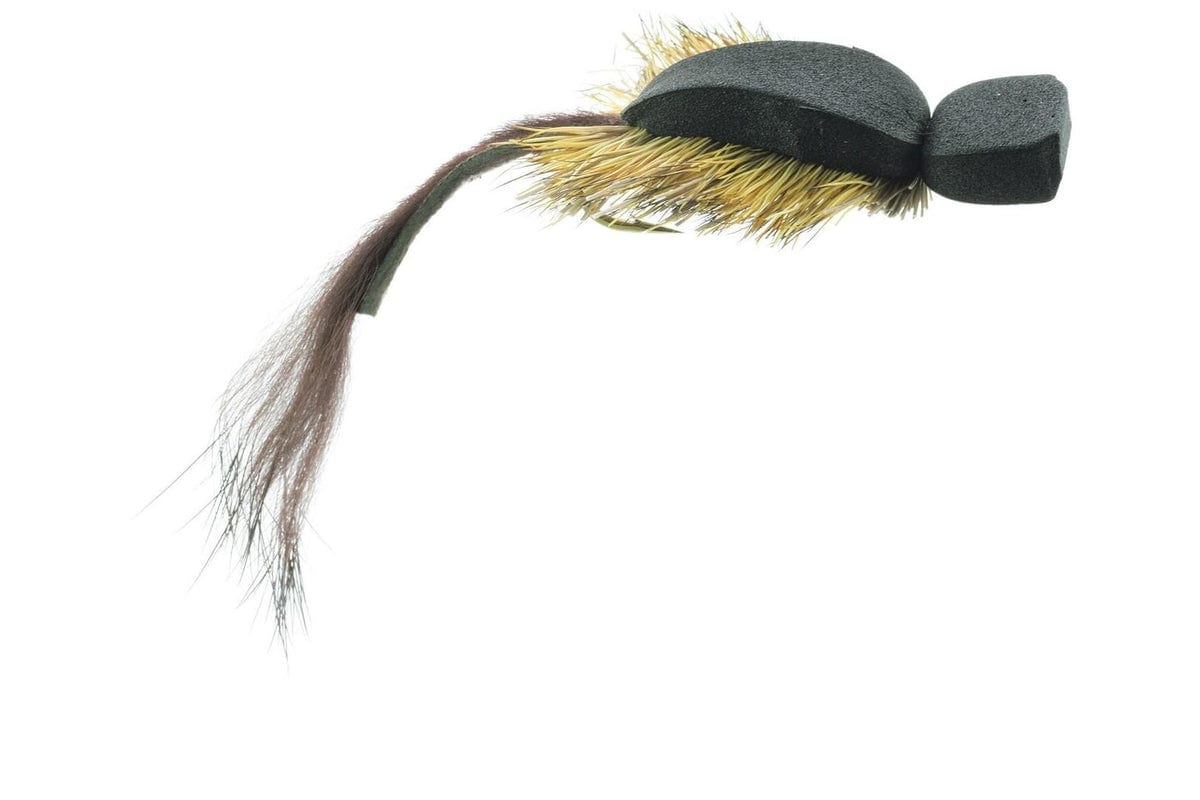
Look at the shape rather than the fur. The deer-hair body is buoyant and broad, the foam back and head keep the front end riding high and blunt, and the tail is long and soft. That combination is what pushes water at a slow retrieve. A slimmer, prettier fly cuts the surface instead of shouldering it, and the fish never hears it coming.
Where this works on the Arkansas
The Arkansas below Pueblo Reservoir is a bottom-release tailwater. The water leaving the dam runs cold through the summer, which is exactly what makes it a candidate when freestone rivers are cooking. Browns are established through the tailwater, and while stocked rainbows are conspicuous in the upper section, the brown population is real.
Set expectations on size: a defensible expectation for browns in this system is 10 to 18 inches, with 12 to 15 very common and the occasional genuinely large one. Reports of twenty-inch-plus fish exist — they always do. Claims that trophy browns are common here are mostly marketing.
Now the part that decides your night.
Two separate constraints govern this water after dark, and they aren’t the same thing:
1. Access hours. Night fishing is legal in Colorado — waters are open day and night, year-round, unless a water-specific rule says otherwise. But legal to fish isn’t legal to be there:
- Waterworks Park is dawn to dusk. It’s not a night-access site, full stop.
- Pueblo city parks run a 10 p.m. to 6 a.m. curfew, which covers the downtown Whitewater Park stretch.
- Lake Pueblo State Park lists general hours of 5 a.m. to 10 p.m. Check the gate, the parking area, and posted signs before you count on after-hours access.
That’s the real picture, and it rules out a lot of the water people imagine when they think “Pueblo tailwater at night.” Confirm your specific access point rather than assuming.
2. Water temperature — and the closures that come with it. In a hot, low-water summer, CPW activates voluntary fishing closures on this river. They are typically time-of-day closures rather than full ones, and they have covered the reach from Pueblo Boulevard downstream to Fountain Creek. ⛔ Check CPW’s current closure page before every trip — it is the first thing to look at, ahead of the flow gauge.
A real example of how bad the spread gets: in August 2026, afternoon water ran roughly 65°F near the dam, over 73°F near Dutch Clark, and over 80°F near Moffat — and CPW asked anglers to stay off the reach from Pueblo Boulevard down to Fountain Creek from noon until midnight.
⛔ Read that against the rest of this article, because the two collide. A noon-to-midnight closure covers almost exactly the hours this technique needs. When a closure like that’s active on the lower reach, the water this article is about is closed for the hours this article recommends. There’s no clever way around it. Check first — and if it is on, fish somewhere else or go another night.
Where that leaves you when the lower river is closed: the cold releases keep the upper tailwater — above Pueblo Boulevard, including the fly-and-lure water from the Valco Ponds bridge down — cool enough for trout when the downstream reach isn’t. That’s the thermally honest option — with one honest catch. Several of those upper accesses sit on park or state-park land that closes at 10 p.m. (see the access hours above), and mousing wants the hours after that. So the upper reach can solve the temperature problem and hand you the access problem right back. Up there the binding constraint flips from temperature to access hours — so before you count on it, confirm your specific access point is one you can legally stand on after 10 p.m. Not all of them are.
Read those three numbers again, because they make a point that matters more than any technique in this article: “the tailwater runs cold” is true near the dam and false a few miles down during a heat event. A thermometer reading at the dam doesn’t transfer downstream. And note what CPW did with the hours in August 2026: the request ran to midnight, not to sunset. That tells you what they think of the “it cools off after dark” assumption.
What water temperature is too warm to mouse?
My line is 65°F — at 65 I’m done for the day. Past 68°F the mortality risk climbs steeply, and at 71°F or above do not fish for trout at all. The band you actually want is 55 to 65°F.
| Water temp | What to do |
|---|---|
| 50–55°F | Good, especially late season |
| 55–65°F | The band you want |
| 65–67°F | Past my line. If you are out here at all, fight and release fast and re-check as the night goes |
| 68–70°F | Stop. Release mortality climbs steeply past about 68°F |
| 71°F+ | Don’t fish for trout. CPW’s own threshold — cold-water fish are unlikely to recover |
| 73°F+ | One field study found release mortality 69% higher than below 66°F |
And don’t assume nightfall fixes it. Water cools after sunset but can sit above 68°F for hours.
Carry a thermometer. Take the temperature where you’re actually standing, at the hour you’re actually fishing. If it reads 69, go home; there will be another night.
More on where that line sits, and why I stop at 65, in summer tailwater ethics and water temperatures.
Fish it dark
The single biggest adjustment is turning your lights off and leaving them off.
Fish with no light at all. Your eyes take twenty to thirty minutes to fully dark-adapt, and one careless sweep of a white headlamp across the water undoes it instantly — for you and, by most accounts, for every fish in the run.
Use a red light sparingly, and only for a job: moving spots, retying, or untangling yourself from the brush. Red light preserves your night vision far better than white. It will happen a lot, by the way — you’ll end up in the willows, and you’ll hear yourself apologizing to a tree at 11 p.m.
Two things worth being precise about, because this one gets oversold. Red light isn’t invisibility; the claim that trout can’t see red is an oversimplification. Keep any beam off the fishing water regardless of color. And carry a white light anyway — a bright one, plus a backup — for walking, for landing a fish, and for an emergency. The rule isn’t “no white light ever,” it is “no white light on the water.”
Where do brown trout hold after dark?
In the shallow, soft water they won’t sit in during daylight — bank edges, inside bends, tailouts, slow shelves, the seam beside faster water, and the shallow margins of pools.
That’s the whole shift, and it’s why any of this works. A brown that spends the day pinned under a cutbank isn’t there at midnight; it’s out on the flat where it would be hopelessly exposed at noon. You’re not fishing the deep holding water you’d nymph in daylight — you’re fishing the water you normally wade through to get there.
On this stretch specifically, the engineered drops in the Pueblo whitewater park do what any structure does: they build tailouts and soft shoulders below them. That makes them both the best-looking night water on the reach and the most dangerous thing to be standing near in the dark — know precisely where they are, as holding water and as hazard at the same time. The fly-and-lure water from the Valco Ponds bridge down has the same shelves and inside bends without the engineered drops.
Keep your casts short
Twenty to thirty feet is all you need. That’s not a compromise for the dark; it is better fishing.
Short casts are more accurate, easier to control, and hold far better contact with the fly — which matters enormously when you’re fishing entirely by feel and sound. They also tangle less and put fewer flies in the trees. Trying to cover the whole river in the dark is like trying to find something in a dark kitchen by sweeping your arms: the wider you reach, the more you knock over.
Work the edges — the soft water listed above. Cast across or slightly downstream, keep the rod tip low, and retrieve slowly and steadily so the fly leaves a clean V behind it. If a steady wake gets refused, try a swing across the lane with an occasional twitch, or a near-dead drift along the bank.
There’s no single proven mouse retrieve. The one rule: don’t strip so fast that the fly planes or cartwheels.
The pause before the hook set
This is the part that costs people fish, and it is worth putting plainly.
When you hear the splash of a fish blowing up on your mouse, wait a beat before you set the hook. Give the fish the split second it needs to actually take the fly under.
A surface boil in the dark isn’t proof of a hooked fish. It might be a swipe, a miss, or a fish turning on the fly without ever getting it in its mouth. Big browns don’t always have the pattern secured at impact. The instinct is to strike at the sound, and by every account it’s a hard one to beat — the noise arrives out of total silence. Striking at the sound pulls the fly away from a fish that was about to eat it.
The phrase night anglers use is “wait for the weight.” Keep stripping. When the line comes tight and you feel the fish, make a firm strip-set. Not a trout-set with the rod tip — a strip-set, straight back with the line hand.
Landing it
You have a heavy fish on heavy mono in the dark. Two things follow.
Bully it. The 12-to-16-pound tippet exists so you can. Keep the rod low and to the side, turn the fish’s head, and don’t play it to exhaustion — a long fight on a warm summer night is what kills the fish you were trying to admire.
This is when the white light is legitimate. The rule was never “no white light ever,” it’s “no white light on the water while you’re fishing.” Landing and unhooking is the job it’s for. Net in the water, fish stays in the water, hook out with wet hands, and let it go before you reach for anything else.
Gear, briefly
Leader: short and stiff — about four to seven feet. A long, fine leader won’t turn over a wind-resistant mouse, and it tangles more in the dark.
Knot: whatever you can tie by feel. That’s the actual requirement — heavy mono to a big fly, in the dark, and it’s the best argument there is for having a few knots drilled so hard you don’t need to see them.
Tippet: heavy. 12 to 16 pound mono is a sound default; 16 to 20 around heavy cover or if you genuinely expect a big fish. This isn’t about the fish’s leader-shyness at midnight — it is about turning the fly over, surviving brush, and landing fish fast enough that they swim away. In warm conditions, heavy tippet is a conservation tool.
Rod: whatever you throw streamers with. A 6-weight is the sensible floor and a 7 is easier — you’re turning over a wind-resistant fly on heavy mono, and that isn’t a 5-weight job. Leave the delicate stuff home; nobody’s admiring your loop at midnight anyway.
Barbless hooks — you’ll thank yourself the first time you have to get one out of something in the dark.
Moon phase
Most guidance says dark nights are better — new moon, heavy cloud, or the window before moonrise — on the theory that big fish feel safer entering shallow water. That’s the strong majority view among experienced night anglers.
But it isn’t settled. A credible minority argues that a quarter or half moon is actually best, because the fish can locate the fly without feeling exposed, and that both a full moon and a pitch-dark new moon can fish slowly. Others prefer bright nights outright, because fish and angler can both see.
What’s actually well supported is narrower and more useful: brown trout movement increases as light levels fall. Everything stacked on top of that’s accumulated experience, confounded by cloud cover, moonrise time, water clarity and pressure.
So here’s the decision rule: plan the trip around darkness and stop reading moon tables. Go when it’s dark, or cloudy, or before the moon is up. If the only night you have falls on a full moon, go anyway — a full moon beats not going.
One local wrinkle worth knowing: in downtown Pueblo, street light functions like moonlight — bright lanes and hard shadows on the water. Factor it in the same way. It’s the only trout water I know of that comes with its own parking-lot lighting.
For planning, the 2026 new moons in the back half of this season fall on September 10 and October 10.
Safety
Night wading a tailwater is the most genuinely dangerous thing in this article. Treat it that way.
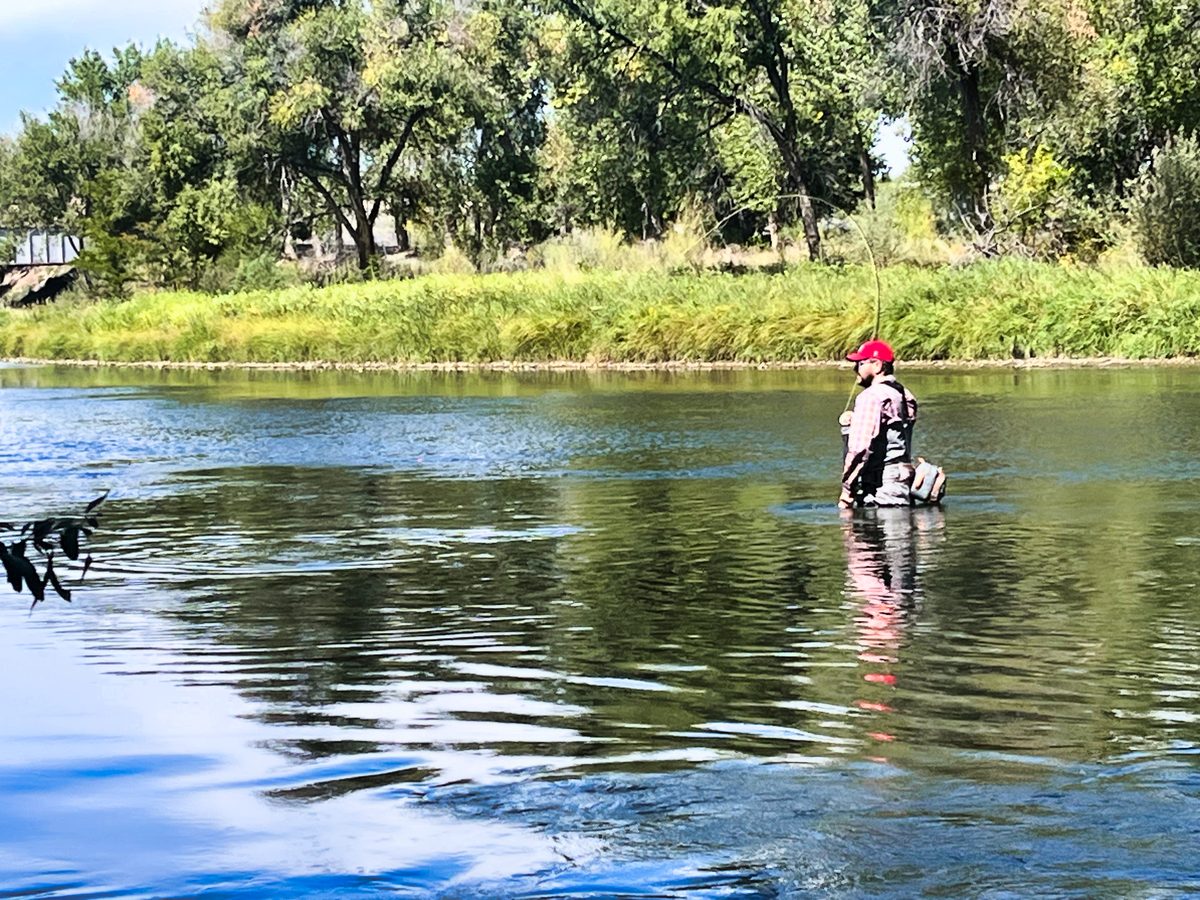
Everything below starts from one habit: the stretch you fish at night is a stretch you already walked in daylight. Not a similar run. That one.
Before you go in
- Check the dam and downstream gauges immediately before you go in, and never enter on a rising hydrograph. Releases change. Pick a reference rock or a mark on the dry bank, and if it starts disappearing, get out immediately.
- Scout the entire stretch in daylight first. Every ledge, drop, hole, strainer and exit point. Don’t explore new water in the dark. The Pueblo whitewater structures are engineered drops — know exactly where they are.
In the water
- Wade less than you would by day. Fish from shore where you can. Use a wading staff, and give some thought to what’s on your feet — boots and traction matter more at midnight than they ever do at noon. Use short sliding steps, take short sliding steps, and stay in water shallower than your daylight comfort level.
- Wading belt tight, and wear a PFD. Inflatable or inherently buoyant.
Gear and awareness
- Two independent lights, spare batteries, a charged phone.
- Eye protection, and a line cutter you can reach with either hand.
- Don’t fish alone if you can avoid it. Agree a turnaround time and a meeting point, and tell someone on shore your route and return time.
- Do not cross the river at night. If it is somehow unavoidable, you should have done it in daylight first.
- No alcohol. None. You are wading moving water in the dark, and there is no version of this where a drink helps.
- Carry dry insulation in a dry bag. The release near the dam is cold enough to take your coordination quickly. If you go in fully, the night is over — go home.
- Urban awareness. Park somewhere lit and authorized, keep valuables out of sight, and stay conscious of your surroundings on isolated trail sections.
Handling fish in warm conditions
If you’re fishing near the top of the temperature band, this matters as much as anything else. Land fish fast on the heavy tippet. Keep them in the water. Wet hands. Skip the photograph — a grip-and-grin at 68°F water on a warm August night is exactly the fish that doesn’t recover. CPW’s guidance during the August 2026 closure was exactly this: heavier tackle, and release the fish in the water.
And when browns start staging in late September and October: don’t cast to paired fish on clean, shallow gravel, and don’t wade across redds. There’s no formal fall spawning closure on this stretch, which makes it a question of ethics rather than enforcement. Fish the deeper water and leave the gravel alone.
Frequently asked questions
Is night fishing legal in Colorado? Yes. A water-specific regulation is the only thing that can close a Colorado water to night fishing — the state default is that waters are open day and night, year-round. If the special-regulations table in the CPW brochure doesn’t list a night restriction for your stretch, there isn’t one. Park hours are a separate question, and on this river they’re the ones that will actually stop you.
What are the regulations on the Pueblo tailwater? From the Valco Ponds bridge downstream to Pueblo Boulevard the water is artificial flies and lures only, and all trout 16 inches or longer must be released immediately — except at the Pueblo Nature Center, which is signed separately. Check the current CPW brochure before you go; regulations change.
What size mouse pattern? Commercial mouse patterns run roughly 2 to 3 inches overall, usually on a size 2 to 6 long-shank or stinger hook — the Morrish Mouse above sits in that range. Much under two inches and you stop moving enough water to be heard. Past that, how it swims beats what it looks like: a fly that planes or rolls is the wrong fly, however good it looks in the vise.
Should I fish a dropper off the mouse? Some anglers do. In the dark, on a short heavy leader, near structure, it mostly buys you tangles. Start without one.
What flow is fishable? It varies enormously, and recent history is a warning against planning off an average. In a normal summer this stretch runs from a few hundred cfs to over a thousand with irrigation demand. In August 2026 it was running in the tens of cfs (a genuinely low-water summer) — an order of magnitude lower, which is a large part of why CPW closed it. ⛔ Don’t plan off a typical-year number. Pull a same-day gauge, and check whether it is rising. And note what a gauge won’t tell you: a spike release can push the water off-color, and stained water mutes the wake-and-silhouette the whole technique runs on — clear water fishes the mouse better than dirty.
Is mousing worth it if I only get one or two eats a night? Here’s the actual trade. Those same four hours nymphing in daylight might give you eight or ten fish in the 10-to-14-inch class. Mousing might give you nothing — or one fish bigger than anything in that daylight count. You’re not buying fish, you’re buying variance. If that trade sounds bad to you, it is bad: fish nymphs in daylight, and there’s no shame in it.
My take
Rig the whole thing in daylight — not most of it, all of it. Leader on, fly tied, floatant worked into the deer hair, a spare mouse pre-tied to a second leader and coiled in your pocket, headlamps tested, thermometer where you can reach it. Then sit down and let your eyes adjust while the light goes. The reason is arithmetic: every job you postpone is one you’ll do blind, by red light, with cold fingers, in moving water, and each costs ten minutes of dark you can’t get back. There’s little window as it is — don’t spend the good part of it tying knots you could have tied on the tailgate.
The short version
Fish it July through mid-September, after full dark, on a cloudy or low-moon night. Take the water temperature where you’re standing and go home if it reads 69. Confirm your access point is legally open after dark, because several of the obvious ones aren’t. Turn your lights off. Keep your casts to twenty or thirty feet. And when something detonates on your fly in the dark, wait for the weight before you set.
If the temperatures or the closures say no on the night you had planned, they say no. There’s another night in September, and the fish will still be there.
Next: before you go, check the current conditions on the live flows page and read up on the water you’ll be standing in with the Arkansas River at Pueblo river guide. If you want the temperature question in more depth, summer tailwater ethics and water temperatures covers where the line is and why.
Fishing this water after dark this season? Reply on the contact page and tell me how it went — I would rather run a reader’s honest night than another rewritten technique piece.