
In this guide
I have blamed a lot of things for a slow day. Bad flies. Wrong color. The hatch didn’t come off. Barometric pressure, out loud, to a man who was catching fish forty feet upstream of me. The one I’d take back is a Cheesman flat where I cycled through the same three patterns for an hour, convinced the trout had developed opinions about my fly selection, when the actual culprit was the heavy, wind-knotted tippet I hadn’t replaced. The fish were fine. My last four feet were a disgrace.
That’s the part nobody photographs and nobody brags about: the skinny end of the rig.
Leaders and tippet are the connection between everything you did right and the fish that won’t eat. On a freestone in spring, you can get away with murder down there. On a clear, pressured tailwater like the Dream Stream or Cheesman Canyon, you can’t. The trout have seen it all, and a clumsy leader is the first tell.
What a leader actually is
A leader is not a single piece of line. It’s a tapered system, and the taper is the whole point.
Start at the fat end. The butt section is the thick part that connects to your fly line — trout leaders generally run somewhere in the .019” to .023” band, and most commercial ones land at .021”–.022” of stiff nylon. The working guideline is that the butt should be roughly two-thirds the diameter of your fly line’s tip, so the handoff isn’t a cliff. Its job is to take the energy your fly line hands off and keep it moving. A butt that’s too limp folds; a butt that’s too stiff hinges. Get it right and the cast keeps unrolling instead of dying in a pile. Get it wrong and you will spend the afternoon adjusting your casting stroke to compensate for two feet of the cheapest material in your entire kit.
Then comes the taper — the middle, where the diameter steps down in stages. This is the transmission. It carries the energy from the heavy butt down toward the thin end, slowing the unroll so the fly turns over last and lands soft. A well-built taper is why a good leader lays a dry fly down like it floated in on its own.
Finally the tippet — the skinny terminal end, the part tied directly to the fly. It’s the lightest, most flexible, least visible piece, and it’s the one you replace constantly as you cut back and re-tie. Tippet is where the trade-offs live: thin enough to fool the fish and let the fly drift drag-free, strong enough to land it.
Turnover is the test of whether the whole thing works. If your leader rolls over and the fly settles last, the taper’s doing its job. If everything lands in a heap, the taper’s wrong for the cast — too short, too abrupt, or too light up top.
My take
Most leader problems aren’t the tippet at all — they’re a butt section that’s too soft, or a taper that’s already been cut back into a stub. Fix the front before you blame the back. I’d go further: if you change one habit this season, retire your leader on a schedule instead of when it finally snaps. That’s roughly one tapered leader per two or three full days on the water, and one comes off immediately whenever the butt section picks up a set it won’t straighten out of. A leader you’ve been adding tippet to tippet on will make you think you’ve lost your casting stroke. You haven’t. You’ve lost the taper.
The X system, minus the mystery
Tippet is rated by an X number — 4X, 5X, 6X, 7X. The higher the number, the thinner the line. That’s the part everyone knows. Here’s the part that makes it click.
The X number describes diameter, and there’s a clean shortcut called the rule of 11: subtract the X number from 11 and you get the diameter in thousandths of an inch.
- 0X — .011”
- 3X — .008”
- 5X — .006”
- 6X — .005”
- 7X — .004”
So 6X is five-thousandths of an inch. 7X is four. Every step up in X number drops the diameter by exactly one thousandth. That’s it. The whole “X” thing is a holdover from the silkworm-gut era: a strand of gut was pulled through a drawplate — a steel plate with a row of progressively smaller holes — and the X number recorded how many holes it had been through. One pass, 1X. Four passes, 4X. Gut ran the sport for roughly two centuries before nylon took over in the 1940s, and the numbering outlived the material by about eighty years, which is a very fly-fishing outcome.
What the X number does not tell you is breaking strength. The X is a diameter target and nothing else. Two spools rated 5X from different makers — or from the same maker in nylon versus fluorocarbon — can differ substantially in both measured diameter and pound test, because nothing in the rating system constrains either. Read the pound test printed on the spool rather than assuming the X implies it, and don’t assume last year’s spool of the same product tests the same as this year’s.
That test also kills a widespread assumption: fluorocarbon is not automatically the stronger material — in that 5X field the top three finishers were all nylons. So read the spool, not just the X. The diameter is the constant; the pound test is the variable, and the label is not going to volunteer it.
And here’s the field shortcut for matching tippet to fly: take the fly size and divide by three or four. A size 18 wants roughly 6X. A size 22 midge wants 7X. A size 12 hopper is fine on 4X or even 3X. It’s not a law, but it’ll keep you out of trouble — too heavy and the fly won’t drift right, too light and you’ll break off on the set.
The temptation is to jam 5X through everything because it’s the spool already on your pack. The fish notice.
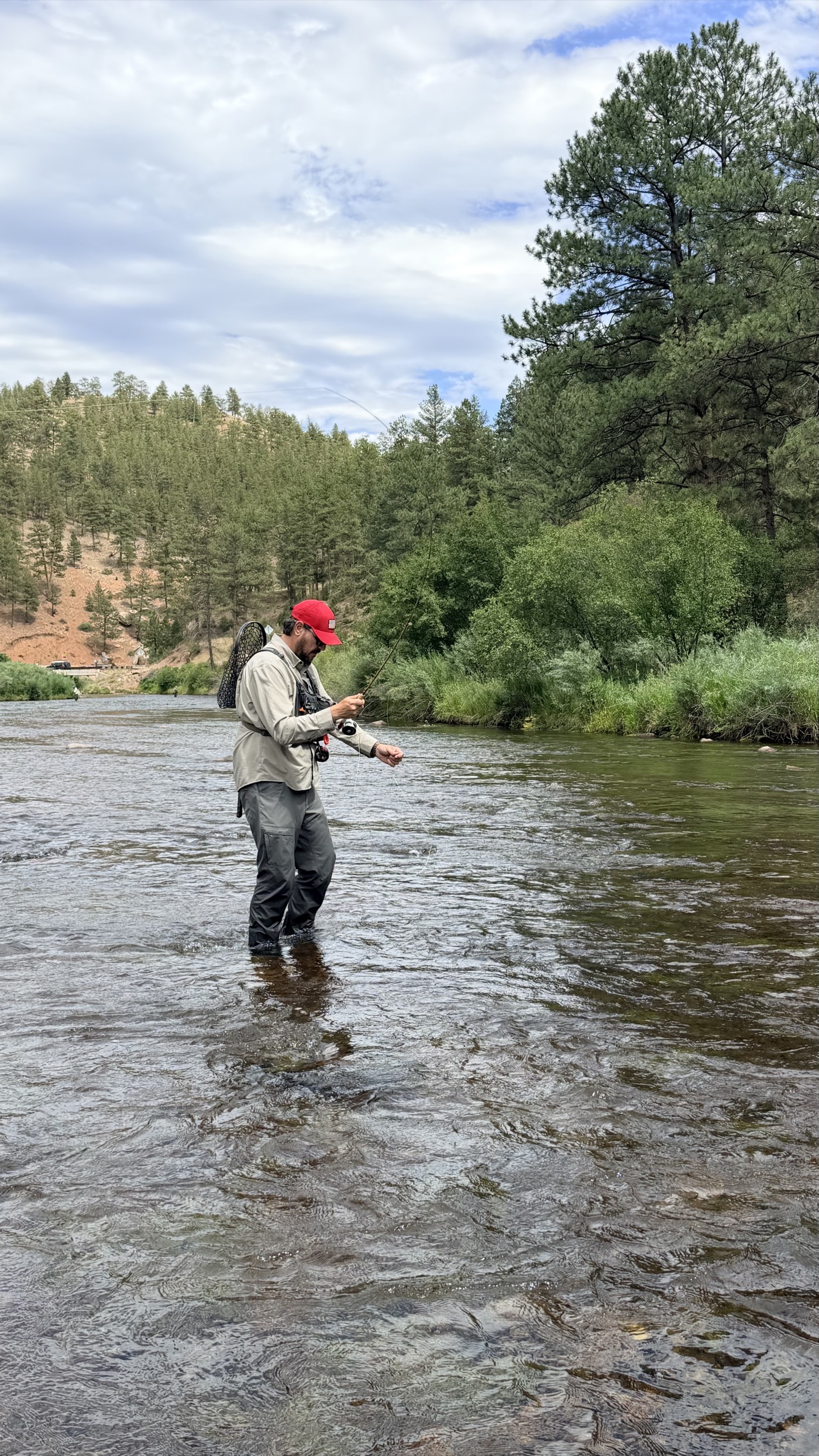
Should you fish fluorocarbon or nylon tippet?
Fish fluorocarbon below the surface — nymphs and euro rigs — where its near-invisibility underwater and abrasion resistance pay off. Fish nylon for dries and dry-droppers, where its suppleness turns the fly over cleanly and its stretch cushions hard takes on light tippet. Most Colorado anglers want a spool of each.
That’s the short answer. Here it is on one screen before I get into why:
| Nylon (mono) | Fluorocarbon | |
|---|---|---|
| Specific gravity | ~1.14 — sinks slowly, sits high | ~1.78 — sinks in earnest |
| Refractive index | ~1.53 (water is 1.33) | ~1.42 — closer to water |
| Stretch | Significant — cushions the set | Low — less forgiving |
| Abrasion | Good | Better — the real edge |
| Knots | Easy, forgiving | Stiffer, fussier, wet them |
| Cost | Less | More |
| Fish it for | Dries, dry-droppers, anything on top | Nymphs, euro rigs, anything below the film |
Now the longer answer, because people get tribal about this, so let me lay out what’s true and then tell you what I do.
Two numbers do most of the explaining here, and neither one is a secret: specific gravity (how heavy the stuff is compared to water) and refractive index (how much it bends light compared to water). Water is 1.0 on the first scale and about 1.33 on the second. Everything else is a comparison to those. It is the only part of fly fishing where the marketing copy and a high-school physics table are talking about the same thing, so it’s worth two minutes.
The table covers the numbers. Two of them deserve a sentence of context. Nylon’s stretch is the underrated one — it acts as a shock absorber, and it is the reason light tippet survives an over-enthusiastic hookset. Fluorocarbon’s abrasion resistance is the other; Troutbitten’s Domenick Swentosky, who has put in far more tight-line hours than I have, rates it “much more durable against things like rocks and split shot.” Fluoro also doesn’t absorb water over a long day the way nylon does.
Short version: nylon is supple, stretchy, cheaper and easier to knot; fluorocarbon is denser, tougher against rock, and marginally harder to see. Now the honest part, because the marketing oversells exactly one of those.
Invisibility is where I’d apply the salt. The refractive-index gap is real and measurable on a bench; whether a trout in moving, sediment-carrying water can act on it is a different question, and Swentosky — who has no reason to talk anyone out of buying fluoro — is openly skeptical it matters in a real river. His line is the one I keep coming back to: trout are not leader shy, they’re drag shy. Call it plausible on glassy pressured flats, moot in pocket water, and well behind diameter and drift on the list of things that actually get you eaten.
Sink rate is real but modest — if you’re nymphing a weighted fly, the tungsten bead is doing the sinking, not the last twenty inches of tippet. Abrasion resistance is the one I’d defend hardest, and naturally it’s the one printed smallest on the box.
Here’s what I actually use, and when:
- Subsurface — nymphs, euro rigs, anything below the film: fluorocarbon. The invisibility and abrasion resistance earn their keep down there, and I don’t care that it sinks because that’s the whole idea.
- Dries and dry-droppers: nylon. I want the supple turnover, I want the dry to sit up instead of getting pulled under by sinking tippet, and the stretch saves me on hard takes with light line. The slight visibility loss is worth it. That’s the top half of the rig; on the dropper below it I switch to fluorocarbon, and the rigging is in the dry-dropper guide.
That’s not gospel, and I’ll name the strongest argument against my own second bullet: plenty of good tailwater dry-fly anglers run fine fluoro to a dry on dead-flat water, on the theory that a tippet sitting in the film rather than on it is less obvious to a fish looking up through it. I’ve done it on Cheesman glass and caught fish. I just don’t do it by default, because on the average day I’d rather have the stretch and the turnover than the theory. Your flats may argue back.
Why do tailwaters demand a long, light leader?
Here’s the South Platte problem in one sentence: the water is clear, slow, and the fish have a PhD in your leader.
On the Dream Stream or in Cheesman Canyon, a trout sitting on a clean gravel flat has all day to inspect what drifts over it. Thick tippet drags the fly unnaturally and throws a shadow. A short leader plops the whole rig down in its window. Both get you refused.
The fix is long and light. Twelve feet of leader is a starting point, and I’ll run longer — fourteen, sometimes more with a tippet section added — when the water is glassy and the fish are spooky. The length puts distance between the fly line splat and the fly. The light tippet (6X on a normal day, 7X when they’re truly dialed in and eating size 22s) lets the fly drift drag-free and keeps the connection out of sight.
Diameter is also doing more work than most people credit. The rule I’ve heard Devin Olsen give in interviews — fish the thinnest tippet you can get away with — isn’t only about what the fish sees. Thin line cuts current faster than added weight does, so dropping a size can sink your rig better than pinching on another shot, and it does it without turning your drift into a pendulum.
Is 7X scary? A little. You will break fish off learning the touch, and a break-off leaves a fish swimming with your fly in it — that is a real cost, not a punchline. Soften the set and check your knots before you go down there. But on a Cheesman flat in low water, 5X is a closed door and 7X is the key. You fish the conditions, not your nerves.
Now the argument against everything I just said, because it’s a good one. Swentosky’s position is that 6X and finer become a crutch: thin tippet buys such easy drifts that anglers stop developing the casts that would have earned the drift anyway. His prescription is to fish 4X or 5X on purpose for a while and let the constraint force you to learn a tuck cast and a stop-and-drop. I think he’s right about the mechanism and I still fish 7X on Cheesman glass, which tells you something about my character. The honest synthesis: go light because the fish demand it, not because it’s easier than casting well.
How you get the length under control depends on which rod is in your hand, and I split my season roughly down the middle between the two. On a tight-line euro rig the leader is the system — a long mono butt and a sighter, no fly line on the water at all — and it holds thin tippet under control beautifully; the full build is in building a euro-nymphing rig from scratch and euro nymphing the South Platte. On the regular-line rod it’s the opposite problem: a nine-foot tapered leader is the standard build for indicator nymphing here (that’s what the South Platte nymph rig specifies), and it’s dry-fly work on slow pressured flats that pushes you out to twelve or fourteen feet — which a weight-forward line then has to turn over, in wind, without piling. That’s a real casting demand, and it’s the reason the butt section and the taper matter as much as they do — a long leader is only long if it straightens.
The three kinds of leader
1. Knotless tapered — what most people fish, me included. A single piece of nylon or fluorocarbon extruded in one continuous taper. Nothing to catch weed or fail under load, predictable turnover, and you pull one out of the pack and fish. I run Scientific Anglers Absolute Trout in 7.5 and 9 foot. For the large majority of trout fishing this is the right answer; buy a three-pack and stop thinking about it.
2. Furled. Fine threads braided into a supple, springy taper. They turn over beautifully, land with almost no disturbance, and last for seasons — you renew tippet off the end through a tippet ring. They hold water and can spray a little on the cast, and they cost more up front. Worth a look if delicate dry-fly presentation is the point of your day.
3. Hand-tied (formula). Sections of different-diameter mono blood-knotted to a recipe. Total control over stiffness and taper, cheap once you own the spools, repairable streamside. The cost is knots — each one is a failure point if you seat it badly. This is the euro and tinkerer’s path, and a lot of competition anglers swear by it.
How the leader connects — both ends
This is the part most guides skip, and it’s the one a beginner actually gets stuck on.
- Leader to fly line: most modern lines have a welded loop, so loop-to-loop with the leader’s own loop is fastest. If you dislike the way a loop hinges, a nail knot gives you a cleaner, smaller connection that shoots through the guides better.
- Leader to tippet ring, and tippet to ring: a clinch or a Davy. Both are quick and both hold; use whichever you tie better in bad light.
- Tippet to fly: same two. I make the case for each in the three knots that actually matter.
- Tippet to leader without a ring: a double surgeon’s or a blood knot. Fine, but it eats the taper every time — which is the whole argument for the ring.
Where to start, by how you’re fishing
Not gospel — a starting point you adjust from.
| How you’re fishing | Leader length | Tippet |
|---|---|---|
| Dry fly, general | 9 ft | 5X nylon |
| Dry fly, spooky tailwater flats | 12–14 ft | 6X–7X nylon |
| Indicator nymphing (the South Platte build) | 9 ft to a ring | 4X–6X fluoro |
| Dry-dropper | 9 ft | nylon to the dry, fluoro on the dropper |
| Streamers | 7.5 ft | 0X–3X |
| Euro / tight-line | dedicated euro leader, 10 ft+ level mono to a sighter | thin fluoro |
When in doubt, a 9-foot in 5X fishes everywhere passably while you work the rest out.
Four mistakes, all free to fix
- Fishing a stubby, chopped-up leader. Every retie eats the taper until you’re casting a fat six-foot club. Add tippet before it’s a problem, and put a ring on it.
- Tippet diameter wrong for the fly. Too heavy and the fly hinges and dies on the cast; too light and you snap off on the set. The old rule — fly size divided by three or four — gets you close.
- Never replacing the leader. It’s a consumable, like tippet and flies.
- Ignoring memory. Nylon comes off the pack in tight coils. Stretch it straight between your hands before you fish or it drifts like a corkscrew.
Tippet rings — small thing, big quiet upgrade
A tippet ring is a tiny metal ring — a size 2 or 3, which is 2mm to 3mm, is the trout standard, light enough to pass through the guides and small enough that you will drop at least one in the river the first time you open the packet — that you tie to the end of your tapered leader. From there you add tippet to the ring instead of cutting back into the leader itself. It’s the same junction the euro crowd builds their whole leader around, which is a decent hint about how well it works.
Why bother? Because every time you change flies or re-rig, you’re sacrificing line. Without a ring, you cut back into the expensive tapered section, and after a day of fly changes your 12-foot leader is a 9-foot stub with a wrecked taper. A tapered leader runs about six to nine dollars — more than a fly — and a ring costs pennies and makes the leader last several times as long. The arithmetic is not subtle.
Tie a ring at the business end and you only ever burn tippet — the cheap, replaceable part. The leader keeps its taper for weeks.
They’re not for everyone. Dry-fly purists sometimes argue a ring adds a hinge point or a faint disturbance on the surface. For nymphing and euro work — which between them account for most of my subsurface fishing either way — they’re a clean, cheap win. I run them more often than not.
If you want to go ring-free and just build connections by hand, the knots matter, and I broke those down in three knots for South Platte fishing.
Protecting light tippet on the hookset
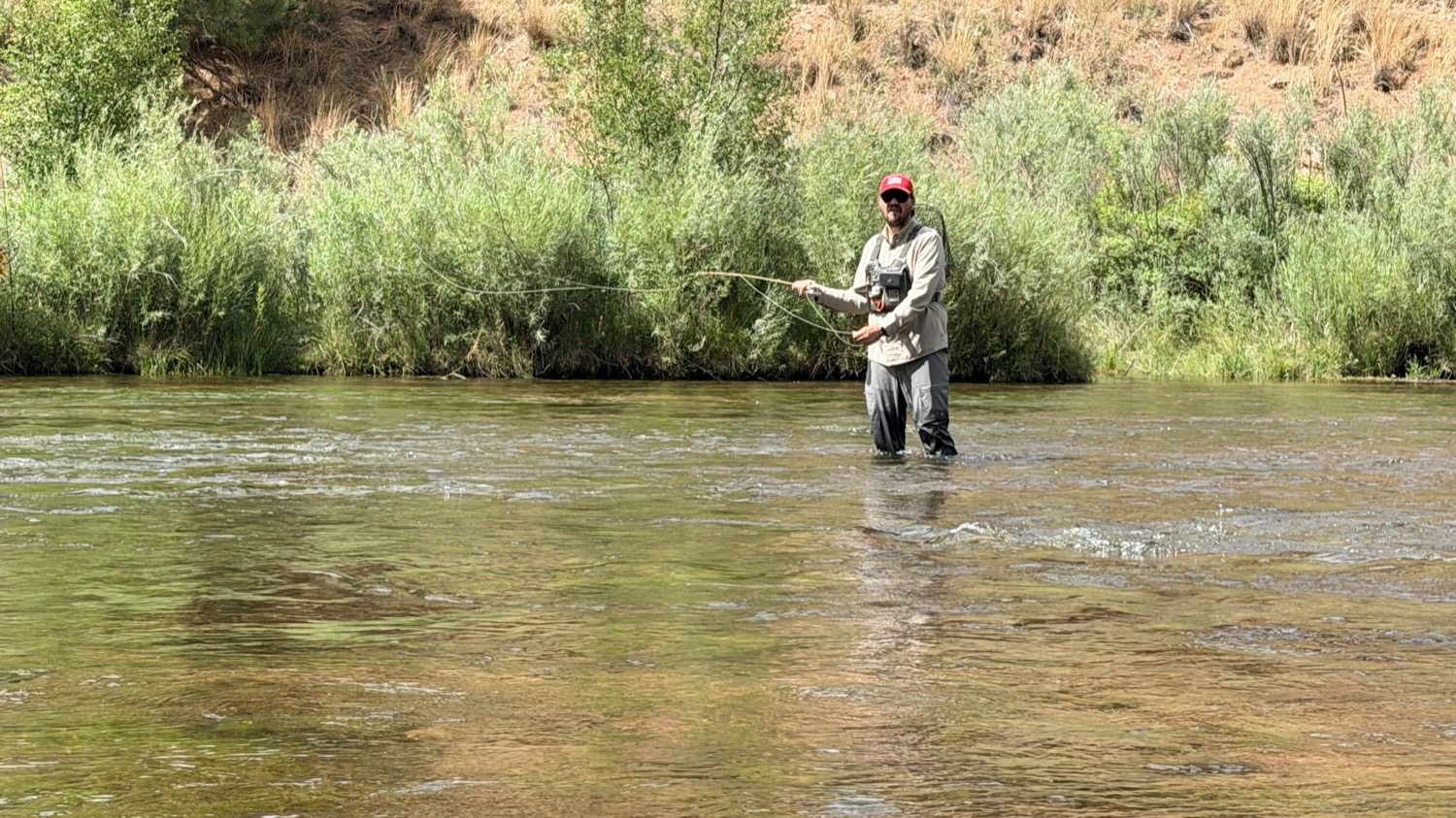
You did everything right. Long leader, 7X, perfect drift, the indicator dips. Now don’t blow it.
The single most common way to lose a good fish on light tippet is a violent hookset. With 6X and 7X, you are not setting on a bass. A hard trout-set snaps thin tippet at the knot before the hook even bites. The move is a firm, smooth lift — set the wrist, not the shoulder. Let the rod’s flex and the line’s stretch do the cushioning.
A few things that save light tippet:
- A softer rod tip helps. This is part of why I don’t fish a broomstick for delicate tailwater work — there’s nothing to absorb the surge.
- Nylon’s stretch is your friend on the set. Another reason I keep mono on dries, where the takes are visual and the urge to yank is strongest.
- Check your knots. Light tippet fails at bad knots far more than it fails in the middle. Cinch slow, wet every knot, and re-tie after you land a fish or snag hard.
- Let them run. Tune the drag light and let a hot fish take line. The tippet you baby in the first ten seconds is the tippet that’s still attached at the net.
Lose a fish to a screaming run and it’s bad luck. Lose one to a panicked, over-muscled set on 7X and that’s a habit worth breaking.
Frequently asked questions
How long does a spool of tippet actually last, and does it go off? Nylon degrades with UV and heat — a spool that has spent two summers on a truck dashboard is not the line it was, and it will fail at a knot with no warning. Fluorocarbon is far more stable. I date the spools with a marker when I open them and replace nylon annually whether or not it’s empty; the whole shelf costs less than a good fly line.
What knot goes at which junction? Leader butt to fly line: a loop-to-loop, or a nail knot if you want it to shoot through the guides cleanly. Leader to tippet ring, and tippet to ring: a clinch or a Davy. Tippet to fly: whichever of those two you tie best in bad light — I go through the case for each in the three knots that actually matter.
What does a season of leader and tippet cost? Roughly: four or five tapered leaders at six to nine dollars each, plus five spools covering 4X through 7X in the materials above, at seven to twelve dollars a spool. Call it a hundred dollars for a full season of fishing this river hard — about the price of one mid-range fly line, and it will affect your catch rate more.
Do I need different tippet for the euro rod? Yes, and it’s the one place I’d argue the material choice is not a preference. A tight-line rig has no fly line on the water, so the tippet is transmitting the take — you want fluorocarbon for the stiffness and the sink, and you want it thin. The build is in building a euro-nymphing rig from scratch.
Bottom line
The skinny end is the cheapest part of your kit to get right and the part that decides the most days. If you do one thing after reading this, put a tippet ring on the leader you’re fishing now and start a retirement schedule for the leader itself — those two habits cost about five dollars and fix most of what goes wrong down there. Everything else on this page is refinement.
For tippet and leaders, I buy from The Fly Fishing Place (code RDC) — solid selection and the spools don’t sit on a dusty shelf for two years before they reach you.
If you want the concrete version of all this — actual lengths, actual diameters, actual flies at each end — it’s laid out in my South Platte nymph rigging guide. Start there, then change one variable at a time. The leader is the cheapest experiment on the river.