
In this review
I am physically incapable of watching a fishing scene without narrating everything wrong with it. Just ask Luke, who is four, and who mostly wants to know why Daddy keeps pausing the TV. Somebody on screen rears back, false-casts eighty feet of line at a trout that’s holding fifteen feet away, hooks it, and a reel starts screaming like there’s a tarpon on — and I’m off, pausing the TV, explaining to a kid who did not ask that a click-pawl reel does not make that noise, that the fish is swimming toward the angler so the line physically cannot be peeling out, and that nobody on this planet needs that much line in the air to reach a fish in a creek you could spit across.
He’s a good kid. He nods like he understands. Then he asks to see the fish again. I’ve written elsewhere about taking him fishing for real; this is the indoor version, and he enjoys it considerably less.
So consider this the post version of that — me, on the couch, narrating what Hollywood gets right and what it gets gloriously, lovably wrong about fly fishing. I’m doing it with affection. These movies are the reason a lot of us are standing in cold water at all. But they also gave the world some of the silliest fishing footage ever committed to film, and I think that’s worth celebrating too.
Quick look: what to watch, and how long it’ll take
| Title | Year | Runtime | Format | Worth it for |
|---|---|---|---|---|
| A River Runs Through It | 1992 | 2h 3m | Feature | The one that matters — and the one that built the crowds |
| Mending the Line | 2022 | 2h 4m | Feature | The best why of fly fishing on film. Start here |
| Salmon Fishing in the Yemen | 2011 | 1h 47m | Feature | A good film that happens to fish |
| Low & Clear | 2012 | 1h 16m | Documentary | Two friends, steelhead, and how differently people fish |
| Where the Yellowstone Goes | 2012 | 1h 30m | Documentary | A 30-day float, start to finish |
| Yellowstone | 2018–2024 | Series | TV drama | One genuinely good fishing scene (S3E2) |
| Buccaneers & Bones | 2010–2018 | Series | TV | Saltwater, big names, no pretension |
| The New Fly Fisher | 2001– | Series | TV | Actual technique you can steal |
| Fly Fishing Film Tour | Annual | ~2h | Live tour | The only one you have to leave the house for |
Streaming rights on these move around constantly, so I’ve left services out on purpose — every feature here is rentable, and the two series are on the usual subscription tiers. Check before you plan an evening around one.
⚠️ Two of these overlap with things I’ve written about elsewhere: the Maclean novella is a different and better thing than the film, and I make that case in fly fishing books worth reading; the 1992 film’s effect on the sport is part of the longer arc in what the history of fly fishing teaches us.
A River Runs Through It: the one that actually matters
Let’s get the big one out of the way. A River Runs Through It is the fly-fishing movie, full stop. Robert Redford directed it in 1992 — he also narrates it — from Norman Maclean’s 1976 semi-autobiographical novella about two brothers, a Presbyterian minister father, and a Montana river. Craig Sheffer plays Norman; a very young Brad Pitt plays the doomed, gifted brother Paul. It won the Academy Award for Best Cinematography, and you’ll believe it about four minutes in.
Here’s what it gets right, and it gets a lot right. It understands that fly fishing is not really about the fish. It treats casting as a form of grace — something a person can be beautiful at, the way someone can be beautiful at music. Maclean’s opening line, the one everybody quotes — “In our family, there was no clear line between religion and fly fishing” — is doing real work: the film is about how you love people you can’t save, and the river is where that love is least clumsy. That’s the truest thing any fishing movie has ever said, and it said it in 1992.
It also detonated the sport. The numbers are genuinely absurd: fly-fishing business reportedly jumped about 60% in 1992 and another 60% in 1993, and Orvis’s Tom Rosenbauer has estimated the company’s gear sales rose something like 18–20%. Montana got the worst of it — nonresident licenses climbed, the famous rivers got crowded, and they have stayed that way. If you’ve ever wondered why your favorite trout town has eleven fly shops and a coffee place that charges seven dollars, you can thank Brad Pitt’s forearm.
Wait — that’s not even Brad Pitt
Did Brad Pitt really do the famous shadow-casting scene? No. The iconic shot — Paul standing on a rock midriver, sheets of line hanging in the air around him glittering in the sun — is not Brad Pitt. It’s a fly caster named Jason Borger, son of the fly-fishing author Gary Borger, who consulted on the film. Jason came on as a storyboard artist and ended up in the water.
Worth being precise here, because the internet flattens it: there wasn’t one casting double. There were three. John Dietsch, the fly-fishing coordinator, ran the department and doubled for Pitt in the stunt work. Jerry Siem — later Sage’s rod designer, which is a detail I enjoy more than I should — threw the long, beautiful casts. Jason did the shadow-casting. The sequences were storyboarded in advance and cut together in editing rather than caught live, which is the part people find disillusioning and I find kind of great: somebody sat down and designed those loops.
My favorite part of the whole story: by Borger’s own account, an elderly friend of the Maclean brothers who was on set watched that scene and told him afterward, “You are Paul.” That’s the highest compliment a caster can get, and it went to the guy whose face you never see.
And about “shadow casting” itself — it’s a real technique, sort of. You false-cast back and forth over the water repeatedly, the idea being to dry the fly and drop it gently. In practice it’s mostly showing off. On a real river, all those extra strokes over the fish are just extra chances to spook it. Gorgeous on film. A great way to put trout down in real life.
They didn’t even film it on the right river
This is the detail that made me laugh out loud when I learned it. The book and the movie are both set on the Blackfoot River near Missoula. The movie was not filmed on the Blackfoot. By 1991 the Blackfoot was carrying decades of mine-tailing contamination out of its headwaters, so Redford shot in the summer of 1991 about two hundred miles east instead — on the upper Yellowstone, Gallatin, and Boulder rivers, working out of Livingston and Bozeman. Livingston played Missoula. Most of the fishing you remember is the Gallatin, in the canyon south of Bozeman.
So the most reverent, place-rooted fishing movie ever made, the one that’s about a specific river the way a hymn is about a specific God, used a stunt river. I love that. It’s the most Hollywood thing imaginable, and somehow it doesn’t dent the film one bit.
Mending the Line: the one that got the soul right
If A River Runs Through It is the beautiful one, Mending the Line (premiered at Woodstock in 2022, in theaters June 2023, directed by Joshua Caldwell) is the one that surprised me. Brian Cox — yes, Logan Roy himself — plays Ike Fletcher, an older Vietnam veteran who fishes alone in Montana and doesn’t especially want company. Sinqua Walls plays Colter, a young Marine home from Afghanistan, wrecked, who ends up in a VA facility and gets pointed at Ike. Perry Mattfeld plays Lucy, who works at the library there and is carrying her own grief. It’s set around Livingston and Paradise Valley — the same water A River Runs Through It borrowed, which I doubt is an accident. The whole thing is about fly fishing as a way back to living when nothing else is working.
Is the casting flawless? No. Are there shots where you can tell an actor is thinking very hard about his loop? Sure. But I genuinely didn’t care, because the movie gets the why of fly fishing dead right — the part most films miss entirely. It understands that standing in a river is good for a broken brain. That the repetition is a kind of therapy. That the water doesn’t ask you anything. Anyone who’s gone to the river to get out of their own head — and that’s a lot of why I fish — will recognize it instantly.
That’s the trade I’ll always make: I’d rather a movie nail the feeling and fudge the technique than the other way around. Mending the Line nails the feeling. Go watch it.
Yellowstone, and the great horseback-casting incident
Then there’s Yellowstone, where Kevin Costner’s John Dutton fishes about as often as the writers remember he might. The show’s best fishing moment is just a joke — season three, episode two, “Freight Trains and Monsters,” when Dutton takes his grandson Tate out and explains that trout, like bankers, don’t do a damn thing before mid-morning. That’s a real fisherman’s line and it lands. Trout on a cold tailwater morning genuinely are useless until the sun gets on the water. Whoever wrote that one had stood in a river.
The fishing itself is set dressing, and I’ve made my peace with that. Yellowstone uses a fly rod the way it uses a horse and a fence line: to tell you what kind of men these are. Nobody in that writers’ room was trying to teach you a reach cast. It’s a ranch soap opera, and holding it to a casting standard is like reviewing a Western on its farrier work. I still narrate it. My family has stopped reacting.

A few more worth queuing up
Those three get the headlines, but they aren’t the whole shelf. If you want to fill a winter, here are a few more that actually exist — a handful of films and a couple of real fly-fishing shows, not ranch dramas that happen to wander past a river.
Movies & documentaries
- Salmon Fishing in the Yemen (2011) — a romantic comedy-drama, of all things, about a sheikh’s scheme to bring salmon and fly fishing to the desert. Lasse Hallström directing, Ewan McGregor and Emily Blunt starring. Lighter than it sounds and more charming than it has any business being.
- Low & Clear (2012) — Kahlil Hudson and Tyler Hughen’s documentary about two old friends and wildly different anglers, J.T. Van Zandt and Alex “Xenie” Hall, reuniting for one last steelhead trip in British Columbia. It’s really about getting older and the water you carry with you. Quiet and good.
- Where the Yellowstone Goes (2012) — a 30-day drift-boat float down the longest undammed river in the lower 48. More travelogue than how-to, and a love letter to wild water.
TV shows
- The New Fly Fisher — first broadcast in 2001 and more than two decades on the air since, on the World Fishing Network and PBS. Real guides, real destinations, actual technique you can steal. The opposite of the Hollywood casting clinic.
- Buccaneers & Bones — an Outdoor Channel travelogue that ran 2010–2018, chasing bonefish on the flats of the Bahamas and Belize with an absurd cast: Tom Brokaw narrating, Jimmy Kimmel, Jim Belushi, Huey Lewis, Patagonia’s Yvon Chouinard, novelist Tom McGuane, and the late, great Lefty Kreh. Saltwater, not trout, and it’s a back-catalogue watch now — but it’s a blast and the casting is the real thing.
And once a year the Fly Fishing Film Tour rolls through theaters, breweries and fly shops with the season’s best short films — by 2026 it’s closing in on two decades of touring. Worth catching live, in a room full of people who also yell at fishing footage.
What do fly-fishing movies get wrong about technique?
Almost everything mechanical — the casting distance, the reel sounds, the fight, and the fact that nobody ever fusses with their gear. Across nearly every movie and show, the same handful of sins show up. Once you notice them you cannot stop, and I am sorry in advance for ruining television for you:
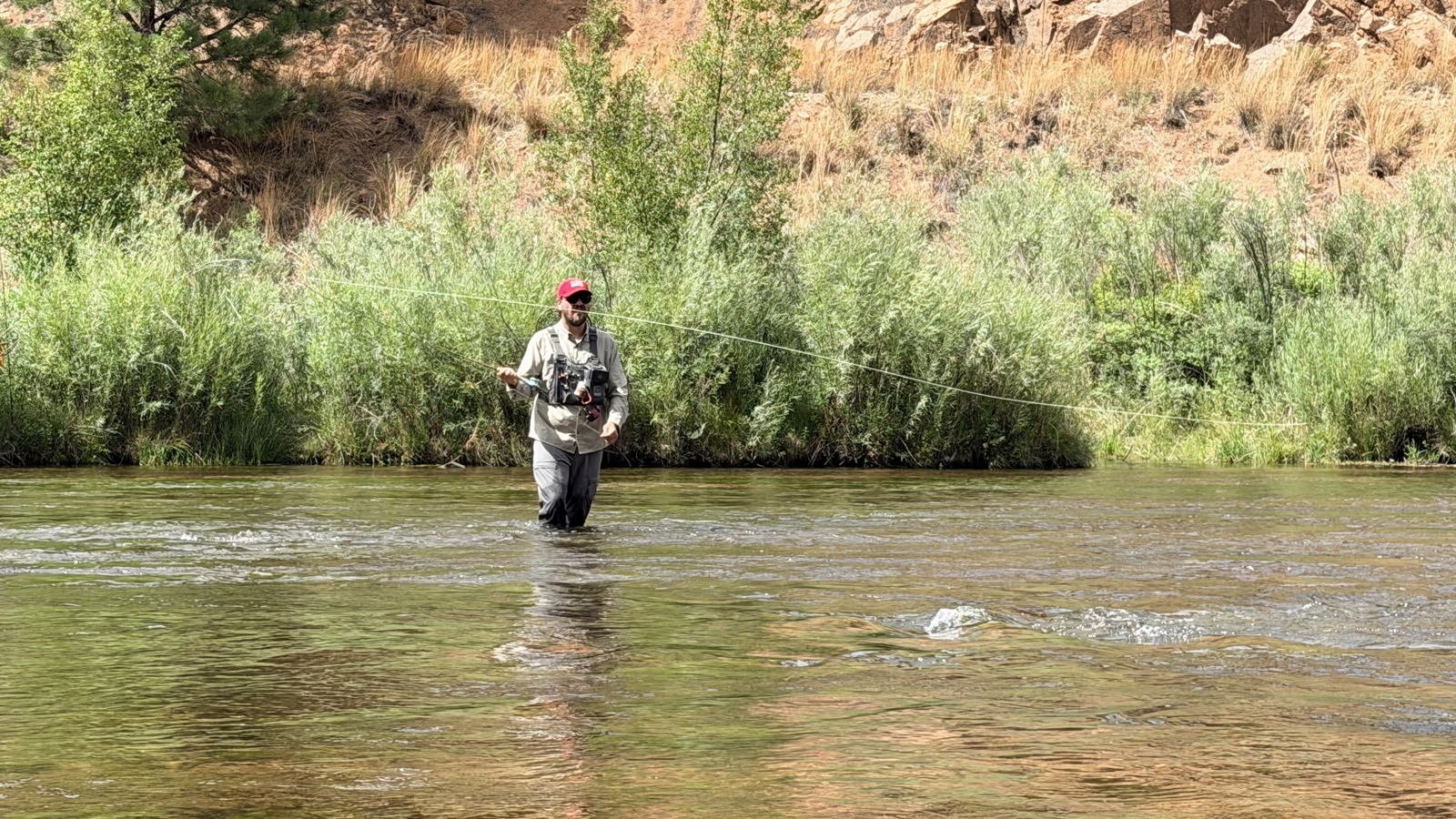
- The eighty-foot hero cast at a fifteen-foot fish. Cinematographers love a big arcing line against the light, so actors heave the entire fly line into the air for a trout that’s basically at their feet. In reality, most trout — especially on small water — get caught at twenty feet or less, with as little line out as you can manage. The long bomb is gorgeous and almost always wrong.
- The screaming saltwater drag. A trout gets hooked and the reel shrieks like something offshore is dragging a boat. That sound is a big-game saltwater reel, dubbed in by a sound editor who’s never held a 3-weight. Most trout reels — a click-pawl especially — make a polite little tick, not a banshee wail.
- The line that screams out while the fish swims toward you. A personal favorite. The reel is howling, line peeling off — and the fish is clearly swimming at the angler. That’s not physics. That’s foley.
- The instant airborne trout. Hooked fish in movies leap immediately and repeatedly, like a marlin, then get landed in roughly nine seconds. Real trout mostly bulldog deep and sulk, and a good one can take a couple of minutes to bring in.
- Nobody ever mends, checks tippet, or changes a fly. No drag management, no “let me re-tie that,” no staring into a fly box for ten minutes questioning your life. Movie anglers just catch. Must be nice.
What Hollywood actually gets right
Here’s the thing, after all the roasting. The movies get the most important thing right, and it isn’t the casting or the gear or the fish.
They get the pull right. The reason fly fishing keeps showing up on screen — as therapy in Mending the Line, as inheritance in A River Runs Through It, as the one peaceful thing in a violent show like Yellowstone — is that filmmakers understand, even when their casting coaches fail them, that there is something about moving water and a fly rod that fixes people a little. That it’s quiet. That it’s a place to put grief, or boredom, or a too-loud mind. They get that you don’t really go for the fish.
That’s why none of the technical sins bother me as much as they should. A kid watches Brad Pitt — or Jason Borger’s forearm — throw that line into the Montana light and decides he wants whatever that is. Twenty years later he’s standing in a creek at dawn tying on a real bug that no movie hero ever bothered with, perfectly happy, alone. The movie lied about the river and the reel sound and the casting distance. It told the truth about the rest.
My take
Watch Mending the Line first. That’s the actual recommendation buried in all of this — it’s the one I’d hand to a non-angler without a disclaimer, and the one most people haven’t seen. A River Runs Through It you already know, and it holds up, stunt river and bucket and all. Everything else on this list is a good winter evening rather than a reason to clear one. Hollywood gets the mechanics wrong constantly and the meaning right just often enough that I keep forgiving it, which is roughly the deal I’ve made with fishing itself.
Next: if these movies stirred something in you, go find the real version — why I started chasing blue lines, the small wild creeks where fly fishing actually feels like the movies promised. And if you want the mechanics behind the pretty loops rather than the mythology, start with how to tie the three knots that actually matter — deeply uncinematic, completely essential.