
In this guide
The first fish my son pulled through the ice was an Eleven Mile rainbow, and he got to the hole in a sled with the auger while I pulled. He’s five now. The companion post on ice fishing with kids in Colorado is about the day: the pace, the breaks, keeping a small person happy on a frozen lake. This one is the kit, piece by piece, sized for a small body.
The money goes to warmth and flotation. The fishing end of the list costs almost nothing, which is backwards from how most of us shop for ourselves and may be why it takes a while to sink in.
The rod and reel: cheap on purpose
A kid’s ice rod has three jobs. It has to be short enough that a small arm can hold the tip over the hole while sitting on a bucket. It has to be soft enough that a jerky, excited lift doesn’t rip the jig out of a fish’s mouth. And it has to survive being dropped, sat on, buried in slush and used as a sword. Sensitivity barely makes the list, because the adult is watching the bite anyway.
That points to a 24-to-28-inch light combo with a small spinning reel. For a real example, the Ugly Stik GX2 LE Ice Spinning Combo comes in a 26-inch light (2 to 6 lb line) with a size 20 spinning reel, one-piece stainless guides and a 10-year warranty, for about $47. The Berkley Lightning Ice combo runs in the same price range, and it’s the kid pick in the ice rod and combo roundup. Any short starter combo off the Scheels ice rod wall does the job. There are Ugly Stik combos in my own ice pile, which is the point: they take abuse.
What to skip: a kid-sized “character” combo from the toy aisle with a reel that grinds after a week, and anything nice. My own jigging rod is a 13 Fishing Tickle Stick with a left-hand inline reel, a setup I like a lot and would never hand to a five-year-old. Inline reels are their own skill, and a light, crisp rod is the first thing to break when it gets stepped on.
Two small things make a big difference. Spool the reel with fresh, light line before the trip, because a kid will find every kink in old line. And give the rod a home on the ice, either a cheap rod holder or a short cord tied from the reel seat to the bucket handle. A rod set down next to a hole is a rod that eventually goes down the hole. The cord also keeps the rod in one place while he goes off to scoop slush, which matters for the line rules further down.
The jig that gets bites, and when a tip-up makes sense
The bait side of the list is tiny: a few small tungsten jigs and a tub of waxworms. For trout at Eleven Mile, pink and orange jigs are what work for me, which is convenient, because those are also the colors a kid would pick off the shelf. Keep the box to a handful. Forty jigs in the box means forty jig changes.
Two upgrades help a kid see the bite. A spring bobber on the rod tip turns a light take into a visible dip, so the kid can watch for it instead of waiting for you to say “now.” And a barbless hook, or a barb pinched flat with pliers, makes unhooking quicker for both of you, which counts when small fingers are cold and the fish needs to go back.
Tip-ups deserve a look for kids because a flag popping up across the ice is the most exciting thing that can happen to a five-year-old in February. The catch is the line count: in Colorado a tip-up is a line, so for a kid without his own second-rod stamp it takes the rod’s place as his one line, and it has to stay close enough to be under someone’s control. If he fishes one, set it a few steps from the shelter where he can see the flag, give him the flag-watch job, and let him pull the line in hand over hand when it goes, with you on the hook end.
Kids, licenses and the second-line stamp
In Colorado, no license is needed for kids 15 and under, and CPW lets “all youth under 16” keep a full bag and possession limit. Anyone 16 and older needs a license. That comes from CPW’s licenses page for the license year running March 1, 2026 through March 31, 2027, and the Colorado fishing license guide covers the adult side.
Lines are where families get tripped up:
- One line per kid, same as you. Each angler gets one “personally attended line,” which under CPW’s Chapter W-1 is a rod and line, a hand line or a tip-up under the personal control of someone close to it. A kid’s tip-up is his line; it doesn’t ride along with his rod.
- His second line needs his own stamp, with his signature on it. W-1 says a person under 16 who doesn’t need a license “must have a second rod stamp with their signature in possession” to fish a second line, and CPW’s licenses page says the same for all youth.
- Your stamp is yours. A second-rod stamp can’t be used for another person to fish, so a dad’s stamp doesn’t let him run a tip-up on the kid’s behalf.
Rules get revised every year, so check CPW’s licenses page for prices and the current fishing brochure for your lake’s rules before you go.
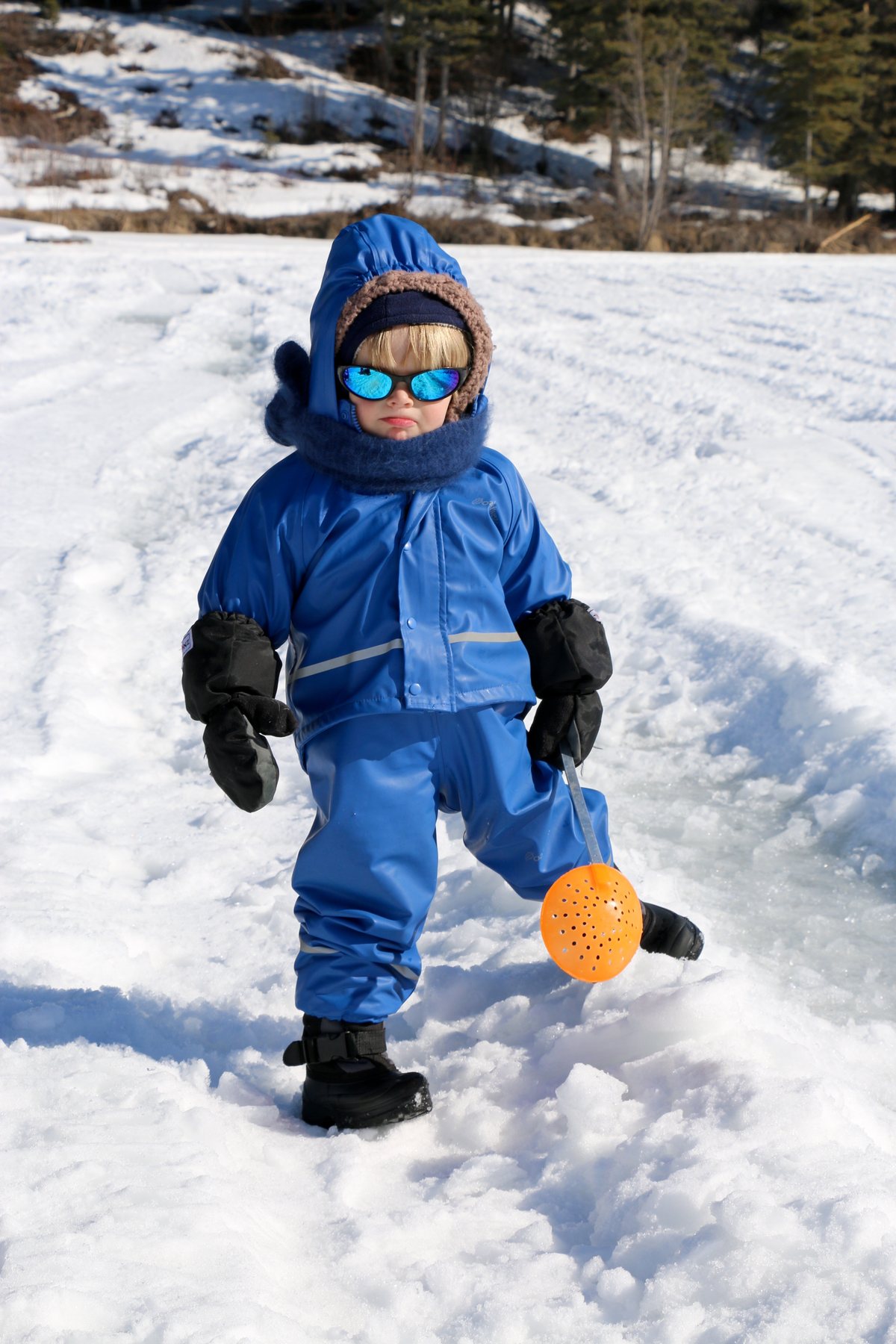
Warm layers, boots and mittens: where the real budget goes
A kid layers the same way an adult does, and the ice fishing clothing guide has the formula. What changes with a kid is fit, and how many spares you carry.
Boots. This is the line item worth paying for. Look for a waterproof, insulated winter boot with a removable liner, because a liner can come out and dry overnight and a sewn-in one can’t. Size it for one good wool sock and a little wiggle room, and resist going two sizes up “to grow into.” A boot that’s too big lets the foot slide, and a jammed-tight boot cuts circulation; both end up cold. Kids’ feet grow at roughly the rate my fly-rod budget does, so plan on buying boots every winter and look at the end-of-season sales in March.
Mittens. Mitts, not gloves. Pick a gauntlet style with a long cuff that pulls over the jacket sleeve, so snow can’t pack in at the wrist when he digs at the hole. Put the mittens on clips or a string through the sleeves; clipped mittens are still with you at noon. Bring a dry second pair. The adult does the re-baiting, so the kid’s mitts can stay on.
Face and eyes. In the photo of my son with his rainbow further down, he’s in ski goggles. Glare off clear ice is bright enough to sunburn eyes, and wind makes young eyes stream. Goggles or wraparound sunglasses plus a neck gaiter cover both.
Hand and foot warmers. HotHands’ US package says the warmers aren’t for anyone who can’t put one on or take it off by themselves, that children need careful supervision, that they don’t go on skin anywhere but the palm, and not to sleep with one. A warmer can burn without feeling hot at the time, which is the reason for all of that. So for a young kid, the warmer goes in a jacket pocket for him to hold and put down, or outside a layer, never sealed inside a mitten or boot he can’t open himself. Check his hands every so often anyway. Once a kid is old enough to pull a warmer out and say it’s too hot, the rules relax.
Ice cleats sized for kids
Glare ice puts kids down, and the back of a small head takes the hit. Cleats fix that, and sizing is the problem: most strap-on traction is made for adult boots. Kahtoola’s smallest MICROspikes, the XS, are listed for youth 4 and up (EU 35 to 37 over shoes, 36 to 37 over insulated boots), and they cost about $90. Yaktrax’s smallest Walk is listed for women’s 2.5 to 6 or men’s 1 to 4.5, and a men’s 1 is a youth size, so it goes a little smaller.
So measure before you buy. Check the kid’s boot size against the cleat’s chart, put the cleats on at home over the actual boots, and make sure the strap holds snug at the heel. If the smallest pair won’t stay on, a slipping cleat is worse than none. On the day, they go on at the truck before his first step onto the ice and come off before he climbs back in. On small feet, the fallback is a boot with an aggressive rubber sole, a hand held on every walk across glare ice, and the sled for the long stretches.
The sled: the gear hauler is also the kid hauler
Every sled post says to buy one bigger than you think, and the ice fishing sled guide covers the field. With a kid riding, the specifics change. You want high sides, so a small body sits down in the tub rather than on top of the load, and enough length that the kid and the gear aren’t fighting over the same spot. Otter’s Sport Sled starts at 43 by 21 by 9 inches in the small, and the Pro Sled small is 55 by 27 by 13, which is a lot more tub around a kid. A Shappell Jet Sled Jr, around $35, is the cheap option. It’s big enough to haul a kit, and a small kid can ride on top of the soft bags.
I run Otter sleds, and the photo of my son riding across Eleven Mile with the auger is in the companion post. He rode; I pulled. Cap the auger blades, strap the chisel down, and tie off anything that would slide forward into him when you stop. Throw a closed-cell foam pad in the bottom, because plastic over ice is cold on a small seat. On a long walk, look back now and then, because a kid can slide off a sled without a sound.
A seat, a shelter and a heater, with the kid in mind
A seat. The bucket does it, and a lid or a padded swivel top makes it comfortable enough for an hour. It puts a kid at the right height for a short rod over the hole and keeps his rear off the ice. For a very small kid, a low folding chair with a back is steadier than a bucket, which tips when he leans to look down the hole.
A shelter or windbreak. A heated shelter is what turns a short trip into a full day, and it’s the adult’s gear; the kid borrows it. A full hub is the big upgrade; mine is an Otter Vortex Pro Lodge. A simple windbreak, or even the sled stood on its side on the windward edge of the hole, costs nothing and takes the worst of the wind off a kid on a mild day. Either way, set the shelter up and get it warm before the kid leaves the truck. The poles are your fight, and he doesn’t need to stand in the wind for it.
The heater. I run a Mr. Heater Big Buddy in the hub. With a kid inside, the heater rules tighten, and none of this is optional.
- Carbon monoxide is the hazard. CO is invisible and odorless. Run only a heater rated for indoor use, keep two vents open while it runs (one low for fresh air and one high for CO to escape) and check them after snow or a wind shift, because a drifted-over vent is a closed vent. Put a battery-powered CO detector in the shelter, tested before you light anything.
- A sleepy kid is a warning sign. Drowsiness and headache are early CO symptoms, and a kid who gets sleepy in a warm shelter looks exactly like a kid who’s just cozy. The detector is how you tell the difference. If anyone gets a headache or turns drowsy or queasy, everyone goes out into fresh air right away, the kid first.
- Never run the heater while anyone is dozing, kid or adult.
- The front of the heater is hot. Mr. Heater’s Big Buddy manual says children should “stay away to avoid burns or clothing ignition” and that young children should be carefully supervised near it. It lists 24 inches of clearance in front and 30 above. Put the kid’s bucket off to the side of the heater, never facing the grill, and keep wet mitts off the heater; drying them on the grill is exactly the clothing-ignition hazard the manual means.
Flotation and ice picks
Reading the ice comes before any of this, and the first-ice safety guide covers it. Then the gear on the kid.
Flotation. Minnesota DNR calls a foam life jacket or flotation suit possibly “the No. 1 item that will keep you alive if you fall through the ice,” and says inflatable life jackets aren’t recommended for cold water. For kids, there are two routes.
- A youth float suit. Striker’s Youth Avenger jacket and bib each carry 150 g of Sureflote flotation and run $199.99 apiece. The jacket comes in youth sizes 6 to 16. Clam makes a youth float parka in its IceArmor line. Both brands describe these as flotation assistance, and Clam says plainly that its parka isn’t a Coast Guard-approved life jacket; treat the Striker the same way. I wear a Striker suit myself, and the Predator review covers what the flotation is and isn’t.
- A Coast Guard-approved child life jacket. Small kids often sit below the smallest youth suit sizes. For them, the answer is a USCG-approved child life jacket chosen by the weight and chest size on its label, worn over the snowsuit. Fit it over the coat he’ll actually wear. Minnesota DNR’s fit test: pick the child up by the shoulders of the jacket with his arms raised, and his chin and ears shouldn’t slip through. Its other rule applies too: don’t buy one too big for him to grow into.
Ice picks. The picks hang on the adult. A kid his size can’t haul himself over an ice edge, so the job is keeping him off ice that could put him in the water, with the person who can pull him out within reach. When he’s big enough to lift his own weight onto a ledge, he gets his own pair and a practice session on the lawn before the first trip.
Snacks and a thermos
Snacks on the ice have one problem, and it’s the cold: a granola bar turns into a roofing shingle by ten o’clock. Keep them in an inside jacket pocket where body heat keeps them soft, and pick foods he can eat with mittens on, out of an open bag.
A small insulated food jar is worth having. Thermos rates its 10-ounce FUNtainer food jar to keep food hot for up to five hours, which covers a typical kid session. Fill it with soup or noodles at home. Hot chocolate goes in a separate bottle, and let it cool to warm before it goes in a kid’s hands, because a lidded bottle hides how hot the drink is.
The kid kit: his own scoop, a ruler and a camera
This is the small bag that makes the day his. It’s also the smallest line on the budget.
His own scoop. A plastic ice scoop costs very little, and a kid will work a hole with one for as long as you let him. Give him his own so he isn’t waiting on yours.
A fish ruler. A cheap ruler or a measuring sticker on the bucket lid turns every fish into a number. A kid with a ruler will measure every fish, the bucket, the auger and you. It also does real work: some Colorado waters have size rules, so check the brochure page for your lake.
A camera. The photo is the trophy for a fish that goes back. A sturdy, cheap kid’s camera lets him shoot his own day. My Ray-Ban Meta glasses take a photo by voice, which is the right tool when both hands are holding a kid and a fish, though their battery isn’t great. Snap it fast, then get the fish back in the water.

My take
If I could only spend on two things for a kid on the ice, they’d be boots and flotation that fits. The heated shelter is the adult’s gear and the kid borrows it; the CO detector inside it is the one cheap item on this list with no substitute. The rod comes off a clearance rack and the jigs fit in a pill box. Spend where a mistake hurts the kid, and save on everything a fish can see.
How much should you spend on a kid’s ice kit?
The clothes and the flotation take most of it. Rough ballparks:
| Item | What to buy | Ballpark | Buy or skip |
|---|---|---|---|
| Rod and reel | 24-28” light starter combo | about $45-55 | Buy cheap |
| Jigs and bait | a few small tungsten jigs, waxworms | a few dollars | Buy a handful |
| Boots | insulated, waterproof, removable liner | varies | Spend here |
| Mittens | gauntlet cuff, on clips, plus a spare pair | varies | Buy two pairs |
| Cleats | sized to the actual boot | about $90 for small MICROspikes | Buy if they fit |
| Flotation | youth float suit, or a USCG child life jacket | about $400 for a Striker youth jacket and bib | Spend here |
| Sled | high-sided tub | about $35 for a Jet Sled Jr | Buy (or share yours) |
| Seat | bucket with a lid, or a low chair | cheap | Buy |
| Shelter and heater | yours; the kid borrows them | already owned | Share |
| CO detector | battery powered, tested | about $20 | Required with a heater |
| Kid kit | scoop, ruler, camera | cheap | Buy, it’s his |
What to skip entirely: a kid-sized auger, a kid’s own flasher, a kid-sized shelter, and a nice rod. Hand-me-downs work for most of it, and secondhand kids’ winter boots and suits are everywhere because kids outgrow them in a season, which is where I’d shop for myself too if I had any discipline.
Quick answers on kids’ ice fishing gear
What size ice rod should a kid use? A 24-to-28-inch light combo with a small spinning reel. Short enough for a small arm over the hole, soft enough to forgive a jerky lift, and cheap enough that a lost or broken rod is no big deal. A 26-inch light like the Ugly Stik GX2 LE Ice combo is a good template.
Can I run a tip-up for my kid on my second-rod stamp? No. CPW says a second-rod stamp can’t be used for another person to fish, and a kid under 16 who wants a second line needs a stamp with his own signature on it. The kid’s name on your stamp doesn’t exist as an option.
Do kids need a float suit for ice fishing? Flotation is the most important safety gear on the ice. Youth float suits, such as Striker’s Youth Avenger jacket and bib in sizes 6 to 16, are flotation assistance, not Coast Guard-approved life jackets. For a kid too small for a youth suit, use a USCG-approved child life jacket sized by the weight on its label and fit-tested over the snowsuit, and skip inflatable jackets on the ice.
Are hand warmers safe for kids? Follow the US package. HotHands says they aren’t for anyone who can’t put one on or take it off themselves, that children need careful supervision, and that they go on no skin but the palm. For a young kid, put warmers in a pocket he can reach, outside his base layers, and check his hands.
Do ice cleats come in kids’ sizes? A few do. Kahtoola’s smallest MICROspikes are listed for youth 4 and up, and Yaktrax’s smallest Walk starts at a men’s 1, which is a youth size. Check your kid’s boot size against the chart and test the fit at home. If they won’t stay on, hold his hand on glare ice instead.
Next: once the kit’s packed, the day itself is in ice fishing with kids in Colorado, and the Colorado ice fishing guide for beginners covers the rest of a first season. The rest of the winter is on the ice fishing hub.