
In this guide
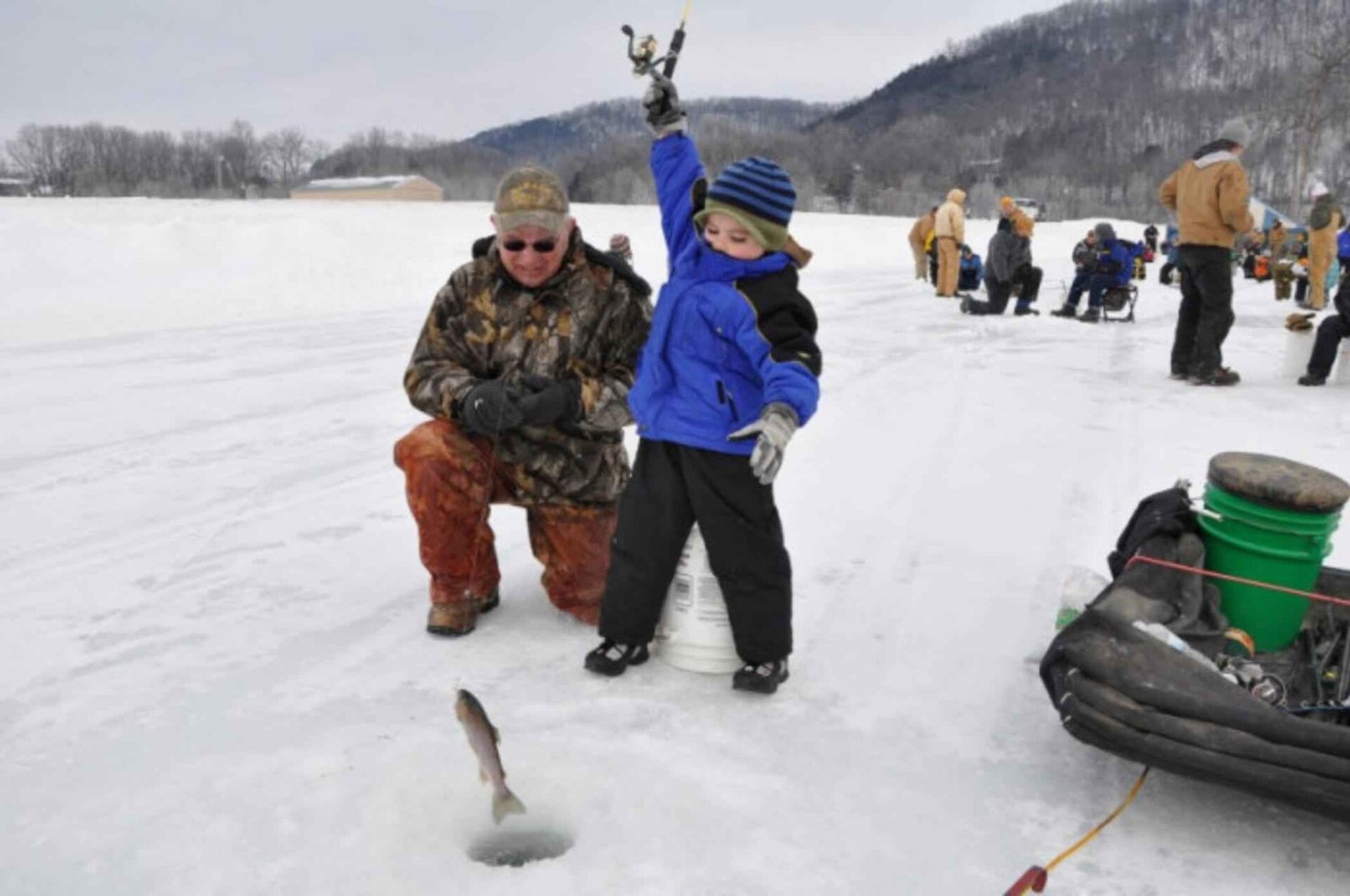
A small kid can announce they’re done thirty seconds after you reach the hole. Not because they’re cold yet, not because the fish aren’t biting — the line isn’t even wet — but because the walk from the truck used up their entire reserve of patience and there is, in kid terms, “nothing happening.” That’s the moment to drop a tiny jig, hand over the rod, and hope a perch is paying attention. When that rod tip pulls down, a kid who wanted to leave three seconds ago suddenly wants to live out there.
That’s ice fishing with a kid in short: the meltdown and the magic are about forty-five seconds apart, and your only job is to get the line in the water before the meltdown wins.
Here’s the thing nobody tells you — and the thing I’ll spend this whole post defending: hard water is the best kid fishing there is. Not despite the cold, not as a consolation for the off-season. It’s genuinely better for a young kid than a summer day on a river, and once you see why, you can’t unsee it.
Why ice fishing beats everything else for kids
Think about what a four-year-old actually wants out of fishing. Not to read current. Not a thirty-foot drift. They want a bite — the rod to pull down, something alive on the other end, the squeal-and-reel. Everything else is adult stuff we project onto them. Ice fishing front-loads the bite and strips out everything that makes summer fishing hard for a little kid.
There’s no cast to learn. On open water, half a young kid’s first day is spent untangling a cast they can’t make yet, hooking their own hat, and getting frustrated before a fish is ever in play. On the ice you drop a line straight down a hole. That’s it. A two-year-old can do it. The barrier to a fish on the line drops to almost nothing.
Panfish keep the rod bent. This matters more than anything else on the list. A pod of perch or bluegill will bite every few minutes, and bites-per-hour is the only scoreboard a kid cares about. One cagey trout an hour is a fine adult day and a total disaster for a six-year-old. Stack up panfish and a kid will fish until you’re the one who’s cold. Chase a trophy and you’ll be carrying a sobbing child back to the truck by ten. Trophy hunting and kid fishing are opposite sports — pick the right one.
The walk is short. You’re not hiking a mile of riverbank for the right run. On a small lake you park, walk a hundred yards, and drill. Short legs, short walk, more time fishing.
You can bail in five minutes. This is the safety valve that makes the whole thing low-stakes. When it goes sideways — and it will — you reel up, toss the rod in the sled, and you’re at the truck inside five minutes. No waders to peel off a squirming kid, no long march out. The easy exit is what lets you say yes to the trip in the first place, and a dad who knows he can leave fast is a relaxed dad — which makes for a better day than white-knuckling it hoping the kid holds together.
I wrote the open-water version of this for getting a kid into fly fishing on the South Platte, and I stand by it — but if you read it, you’ll notice I keep pointing back at the ice. That’s not an accident. If you’re choosing where a young kid starts, start on the ice. It’s the easiest possible on-ramp to the one thing that makes an angler: the feeling of a fish pulling back.
A cold kid is a done kid: warmth is everything
Write this on your hand: the entire trip lives or dies on whether your kid is warm. Not whether the fish bite, not your spot, not your gear. Warmth. A cold kid is a done kid, and there’s no negotiating with it — once they’re cold, the day is over and no amount of perch will save it. Their little bodies shed heat faster than yours, they won’t say they’re cold until they’re really cold, and at 6,500–9,000 feet with wind on an open reservoir, “really cold” arrives fast. So you over-prepare. Here’s the system.
Layer them, and no cotton anywhere. A merino or synthetic base layer against the skin, a fleece mid-layer, and a windproof insulated shell on top. Cotton is the enemy — it soaks up sweat from the walk in and then refrigerates them all day. That hoodie they love is probably cotton; leave it home. Dress them in more layers than you think they need, then put one more in the sled. I run the same base/mid/shell system on myself, and it scales straight down to a kid, just smaller.
Boots are where kids get cold first. Standing on ice pulls heat right out through the feet. Get them properly insulated, waterproof pac boots rated well below zero — not the sneakers that worked all summer — and a thick wool or synthetic sock (again, no cotton). Cold feet end more kid trips than cold anything else.
Mitts, not gloves. Mittens keep little fingers warmer than gloves because the fingers share heat. Bring a backup pair, because the first pair will end up wet within the hour — it’s a law of nature.
Hand and toe warmers are cheap morale. A pack of air-activated warmers costs a couple bucks. Drop a few in their jacket pockets to hold, but don’t seal one inside a mitten or boot on a kid too young to pull it out himself; the package says they need supervision. To a kid, a warm pocket is a small magic trick, and it buys you another hour on the ice. Bring a fistful; they weigh nothing.
Build a morale base camp. The biggest upgrade for a kid day is a heated shelter. I run an insulated hub — the walls-and-roof kind, not a flip-over — heated with a propane buddy-style heater. Inside, on a brutal day, it’s shirtsleeves warm. That hub is base camp: the kid warms up, eats a snack, watches the flasher, thaws his mitts, and goes back out recharged. Without it, a single-digit day is a forty-five-minute trip. With it, it’s an all-day trip with warm-up breaks. The heated shelter is the one piece of gear that buys you a real day instead of a quick one, and it’s worth the money.
One propane-heater rule matters more than every other rule in this post: ventilate for carbon monoxide, and treat it as life-safety, not housekeeping. CO is invisible and odorless — you won’t smell it, taste it, or see it coming — and it, not the cold, is the real hazard inside a heated shelter. A single cracked door is not enough. You need two separate openings while the heater runs: one low, near the floor, for fresh-air intake, and one high for the CO to escape. Run only a heater rated for indoor use — never a “sunflower”-style burner. Put a battery-powered CO detector in the shelter and confirm it actually works before you light anything; that alarm is what saves you if a vent gets snowed over. Never run the heater while anyone is dozing off, kid or adult. And learn the early signs — headache, drowsiness, a queasy off feeling — because they mean everyone out into fresh air right now, the kid first, no waiting to be sure.
Safety with a kid on the ice
I’ll say the same thing I say in every hard-water post, because it matters more with a child along: no fish is worth going through the ice. With a kid, the margin for “let’s just check it out” drops to zero. You are not the only one whose decisions you’re making anymore.
Never push marginal ice with a child along. On your own, you might test a sketchy edge and back off. Not with your kid out there. If the ice isn’t unquestionably good — four-plus inches of clear, solid, black ice you’ve measured yourself — you don’t take a child onto it. Period. The whole first-ice safety guide applies, and with a kid you apply it with no exceptions and no “probably fine.”
Ice picks on YOU. Wear ice picks around your neck — you’re the rescuer, you carry the rescue gear. A small kid can’t self-rescue, so your job is to never be in a position where they need to.
Keep them close. Within arm’s reach on questionable ice, within sight always. Holes other people drilled don’t refreeze solid for a while, and a kid doesn’t watch for them. You watch for both of you.
Cleats so they don’t bonk their head. Glare ice is a skating rink. A kid in slick boots goes down hard, and a head-crack on bare ice is a real injury before a single fish is caught. Cleats or ice-gripping soles on the kid, every time — cheap, and it saves a tearful early exit or worse.
Bring another adult if you can. A second set of hands and eyes is the single best safety upgrade for a kid trip: one adult fishes, one’s on kid duty for the hand, the snack, the bathroom run. Solo with a small child is doable, but a buddy makes it safer and a hundred times more relaxed.
A reservoir is not a backyard pond. Inlets, outlets, springs, and pressure ridges keep thin ice nearby, and our fluctuating high-country reservoirs crack and shelf unpredictably. Read the ice, test as you go, and when your gut says no, the answer is no — especially with a kid’s hand in yours.
Keeping it fun (which is the entire point)
Catching fish helps. But the day isn’t really about the fish — it’s about whether the water becomes a place your kid wants to be. Here’s how to keep a trip from going sideways.

Keep it short. An hour or two is plenty, especially the first several times. The instant they’re losing interest and still having fun, leave. Walking off the ice while they still want more is exactly what makes them ask to go again. Squeezing out one more hour because the bite’s good is the classic trap — you trade a great memory for a cranky one. Leave them wanting more. Every time.
Let them drill and scoop. Kids want a job. Let them turn the auger handle (or help on the power auger), let them clear slush out of the hole with the ice scoop — and that slush scoop becomes the best toy on the lake. A kid with a task is a kid who’s engaged, and most kids will scoop slush for an hour if you let them.
Snacks are currency. Pack more than you think you need plus the thing they actually love. Hot chocolate in a thermos fixes a surprising number of problems. On the ice, a snack break in the warm shelter resets a kid’s whole mood. Treat food like trip insurance, because it is — a good snack rescues more kid outings than any jig in the box.
The flasher is a video game they can watch. This is the secret weapon. A flasher or live-sonar screen shows fish coming in, right there in real time — and to a kid that is straight-up magic. “There’s one! It’s coming! Drop it down!” Watching a fish swim up the screen toward their jig keeps a kid glued to the hole long after they’d otherwise be bored. And here’s the good news for your wallet: you don’t need a $2,000 forward-facing rig — even a basic flasher turns the invisible underwater world into a screen a kid can read. Fish on the screen equals a kid who can’t look away. Don’t worry if electronics are new to you; for a kid, the magic is just “watch the dot come up to your line.”
Catch and keep a few panfish, maybe. There’s something primal and great about a kid keeping a few perch for a fish fry — it gives the day a purpose they understand and a story they tell at school. Check the regs, keep it legal, keep it modest, but a kid who caught dinner is a kid who’s hooked.
Low expectations, always. Set it up front: “We’re going to go drill some holes and see what’s down there.” Not “we’re going to catch twenty.” A kid who expected twenty and got three is crushed. A kid who expected an adventure and caught three had a perfect day. The expectation is the whole emotional setup — get it right and even a slow day is a win.
What’s the best age to take a kid ice fishing?
Honestly, younger than you’d think — earlier than open water. Because there’s no casting and no wading, kids can have a real ice day as young as three or four, as long as you nail the warmth and keep it short. The sled ride out and scooping slush are fun to a toddler before a single fish is involved. Around five to seven is the sweet spot, when they can hold a rod and feel the bite themselves. The limiter is never skill — it’s cold tolerance and attention span, and you manage both with layers, a heated shelter, snacks, and a short clock. Get a warm kid on a pod of biting panfish and age barely matters.
The gear for a kid (keep it cheap and simple)
Don’t overthink this, and don’t spend much. The kid gear is the one place where cheap actually wins.
A short, cheap combo is perfect. A little 24-to-28-inch entry-level ice combo — any starter outfit off the rack — is ideal. Short rod for short arms, dead simple, and if it gets dropped, stepped on, or buried in a snowbank, you’re out twenty bucks, not heartbroken. This is not where you buy nice. Keep the rods you care about for yourself; the kid gets the beater, and that’s the right call.
Simple jig and a waxworm. A small tungsten jig tipped with a waxworm is the whole panfish program. No finesse required — drop it, let it sit, tiny lifts. Perch and bluegill aren’t picky, which is exactly why they’re the right fish for a kid. Keep a few jig colors in a tiny box and you’re set.
A bucket to sit on. A five-gallon bucket is a seat, a tackle box, and a fish-haul-out all in one. Kids love sitting on a bucket. It’s the cheapest, most useful thing on the ice.
A sled to haul the kid and the gear. A plastic sled does double duty: it carries the gear out, and it carries the kid out. To a four-year-old, getting towed across the ice in a sled is the best part of the day before fishing even starts. On a kid day, half the load in the sled is the kid. Use it. The ride out buys you instant goodwill.
That’s the entire kit: short combo, jigs and waxworms, a bucket, a sled, warm clothes, snacks. You can outfit a kid for a day on the ice for less than the cost of a single nice fly line.
Where to take them: small, close, panfish-y water
The lake matters as much as the gear. You want small, close, and full of panfish. Not the big, deep, cold, far-away trophy reservoir. The opposite of that.
For a Front Range family, Monument Lake is the model. It’s about twenty minutes north of Colorado Springs right off I-25 — a small town-park reservoir that holds stocked trout plus perch and bluegill, with a short walk from free parking to the water. Park, walk a hundred yards, drill, and a kid’s on fish. And when the meltdown comes, home is twenty minutes away, not two hours. That proximity is a feature, not a compromise — for a kid day, the close, easy lake is the first choice, not the consolation prize. One caveat I’ll repeat: Monument is a town-controlled park with its own season, so confirm it’s open for winter use before you load the sled.
The recipe generalizes: pick the smallest, closest panfish lake you can find, where the walk is short and the bites come fast. Save the big South Park reservoirs for when your kid is older and can handle the cold, the distance, and the slower trophy game. For a first-timer of any age, a forgiving little panfish lake is the right water, and it’s where a kid should start.
My take
If I were starting my son over, the order would be ice first, everything else later. Ice fishing hands a kid the one thing that turns them into an angler — a fish pulling back — with almost none of the friction that makes open water hard at that age. Get the warmth right, keep it short, pick a small panfish lake close to home, and let them drill and scoop and snack their way into it. The scoreboard to trust isn’t the fish count or the size — it’s whether the “can we go again?” comes before you reach the truck. Everything else is scheduling and hand warmers.
Quick answers about taking kids ice fishing
Is ice fishing good for kids? It’s arguably the best kid fishing there is. There’s no casting to learn, panfish bite often enough to hold a kid’s attention, the walk from the truck is short, and you can be off the ice in five minutes when it goes sideways. Keep them warm and keep it short and most kids love it.
What’s the best age to take a kid ice fishing? As young as three or four for the experience (the sled ride, scooping slush, watching the flasher), and five to seven is the sweet spot for actually feeling the bite. There’s no casting or wading, so the real limits are cold tolerance and attention span — both manageable with layers, a heated shelter, snacks, and a short session.
How do you keep a kid warm ice fishing? Layer them with no cotton — a merino or synthetic base, a fleece mid, and a windproof insulated shell — plus well-below-zero rated pac boots, mittens over gloves, and hand and toe warmers. A heated shelter is the game-changer: it’s a warm base camp to thaw out, eat, and recharge. A warm kid keeps fishing; a cold one is done.
What gear does a kid need for ice fishing? Less than you’d think: a short, cheap ice combo, a small tungsten jig tipped with a waxworm, a bucket to sit on, and a sled to haul the kid and gear. Don’t buy nice kid gear — it gets dropped and buried. Spend on warmth and a heated shelter instead.
Where should I take a kid ice fishing near Colorado Springs? A small, close, panfish-heavy lake — Monument Lake, about twenty minutes north off I-25, is the model: short walk, stocked trout plus perch and bluegill, and home is close when the meltdown hits. Skip the big, deep, far South Park reservoirs until they’re older.
Next: before anyone steps out, here’s how to read Colorado hard water at first ice. For everything else that ties the winter season together, start at the ice fishing hub.