
In this guide
Ice fishing is just fishing through a hole in a frozen lake, and in Colorado you can start for a couple hundred dollars and a buddy: a hand auger to cut the hole, a short rod with a small tungsten jig tipped with a waxworm, a flasher so you can see fish, and enough warm layers that you actually stay long enough to catch one. Everything else is comfort and refinement you can add later. If you’ve ever wanted to fish in January without watching guides film themselves catching all your trout, this is how you get on the ice for the first time without overthinking it — or overspending.
A lot of fly anglers come to this the same way: the rivers freeze, they get restless, and standing on a reservoir at 8,600 feet in single digits starts to sound reasonable. It is reasonable. It’s also one of the few kinds of fishing where a complete beginner, set up over the right hole, genuinely out-fishes the guy who’s been doing it for twenty years and just picked the wrong spot. That levels the field in a way the South Platte never will.
This guide is the on-ramp. I’ll point you to the deeper pieces — gear, safety, tactics — as we go, so think of this as the map, not the whole encyclopedia. The whole ice fishing hub collects the rest.
What is ice fishing, actually?
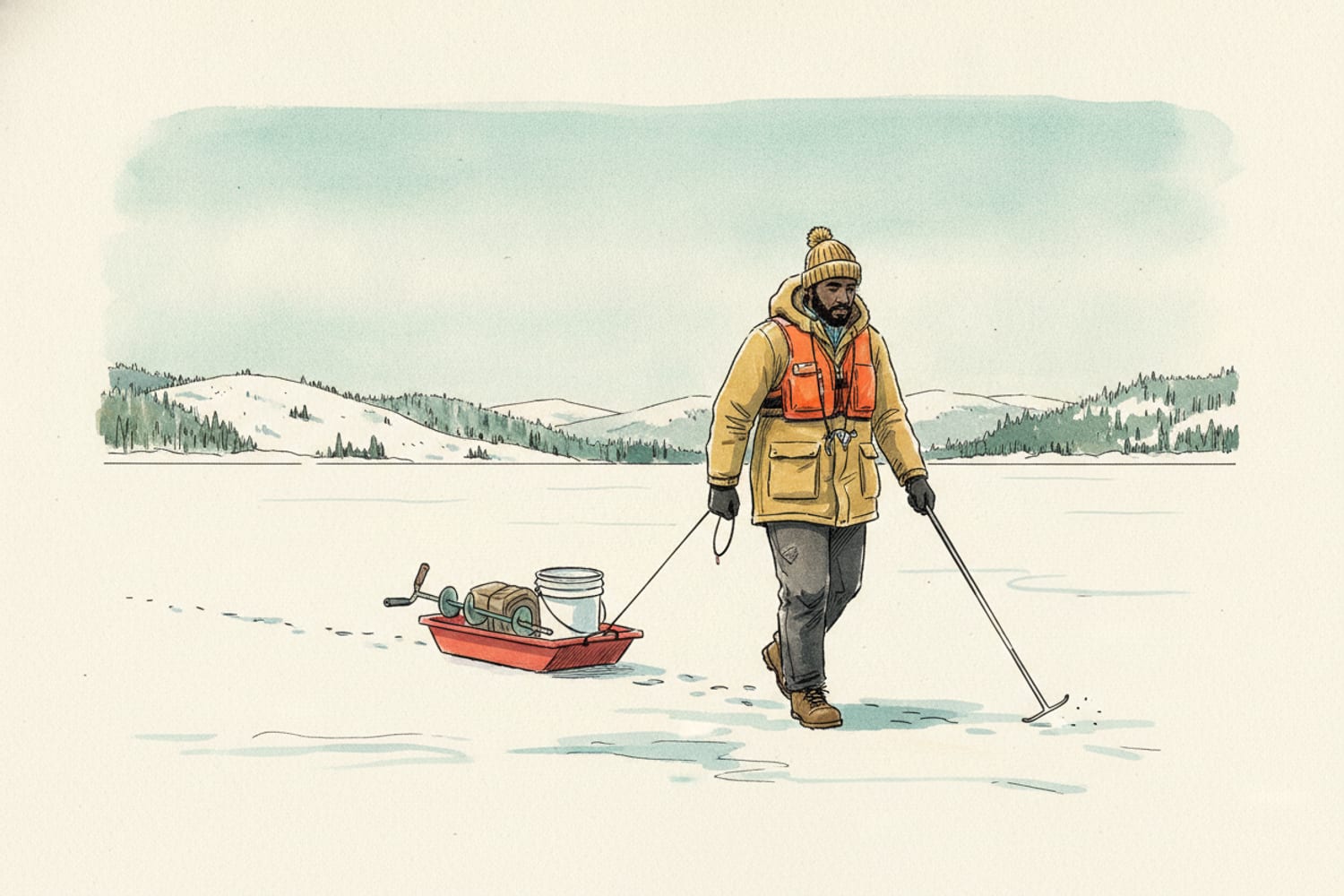
It’s fishing a lake from on top of it, after that lake freezes hard enough to stand on. You drill a hole through the ice with an auger, drop a baited jig down it, watch for fish on a sonar unit called a flasher, and lift the rod when one bites. The fish are the same trout, kokanee, pike, and perch that live there all summer — they just slow down, school up, and hold at predictable depths once the water gets cold. No casting, no wading, no fly line freezing to your guides every third drift. You sit (or stand) over a hole the size of a dinner plate and the fish come to you.
The mental adjustment for a fly angler is that you’re fishing down, not across. Your whole world is a vertical column of water under one hole, and a little screen telling you what’s in it. It sounds boring written down. It is not boring when a red mark rises off the bottom toward your jig and you’re trying not to set the hook too early.
Why Colorado is genuinely good for it
Most people picture Minnesota or Wisconsin when they think hard water, but Colorado quietly has one of the better setups in the country. The high-country reservoirs freeze thick and reliably, the water is full of stocked and wild trout, and a handful of South Park lakes hold things you can’t catch through the ice in many other states — kokanee salmon being the headliner. You can be standing on safe ice about an hour and a quarter from Colorado Springs.
The altitude is the catch, and it’s a real one. Eleven Mile sits at about 8,600 feet, and the South Park reservoirs around it are all in that 8,000–9,000-foot range. Cold up there isn’t the cold you feel in town — wind across open ice at 5 to 15 degrees will find every gap in your layers. Dress like you’re walking to the truck and your hands will quit long before the fish do. But the same exposure that makes it brutal is what keeps the crowds thin and the ice solid. Dress for it and the place is yours.
The other quiet advantage: a Colorado fishing license barely dents the budget, and the ice season runs from roughly December through March — when you’d otherwise be staring at fly-tying videos and lying to yourself about being productive.
The genuinely minimal starter kit
Here’s the part where most articles try to sell you a sled full of gear. You don’t need it to start. You need to cut a hole, get a jig down it, see what’s there, and not freeze. Four things:
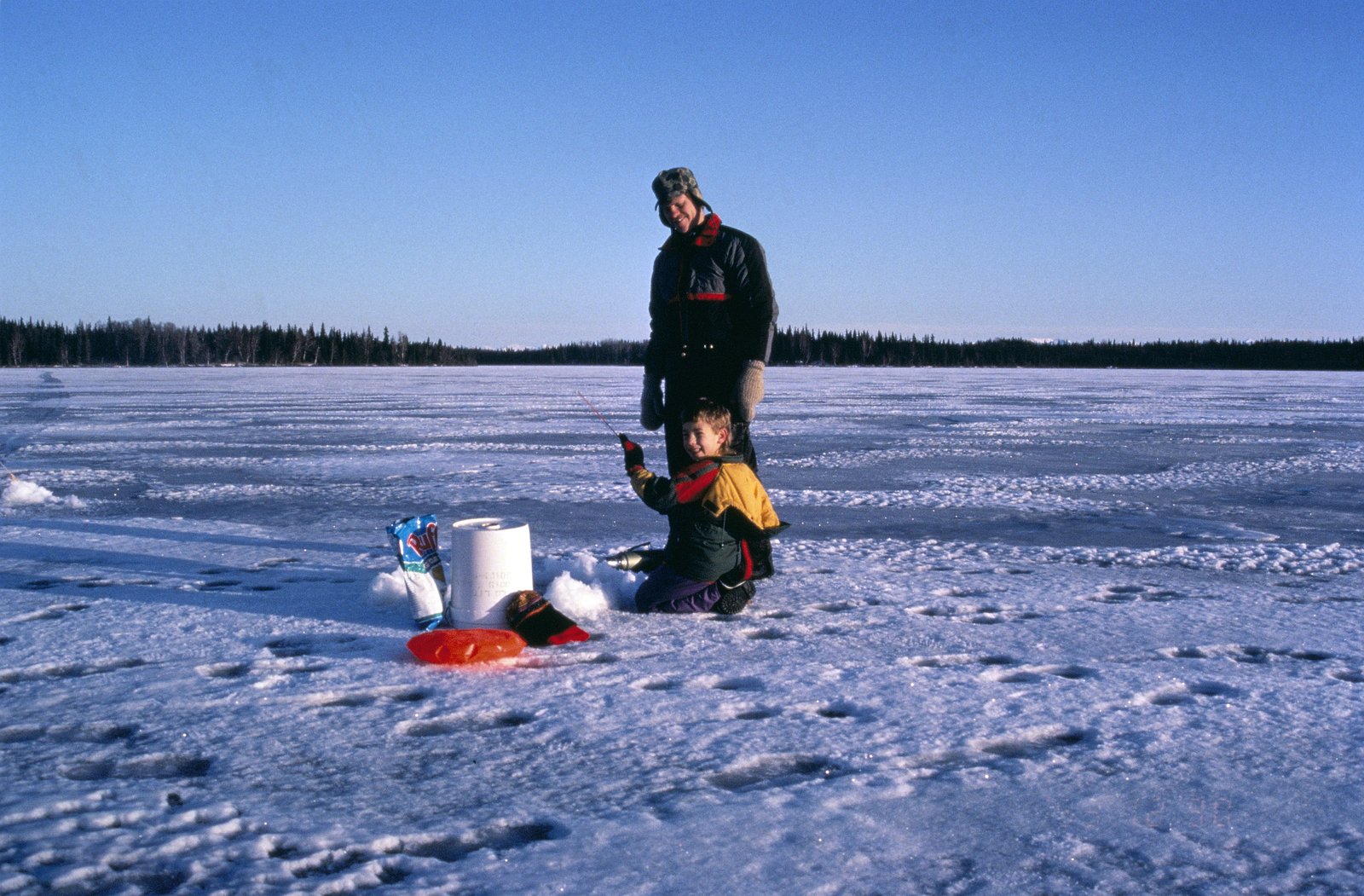
- A hand auger. A sharp 6-inch hand auger cuts through a foot of ice in under a minute and costs a fraction of a powered one. Beginners drilling a few holes a day do not need an electric auger yet — that’s a comfort upgrade for when you’re chasing fish across the lake all day. There’s a whole hand-versus-electric auger debate, but for trip one: borrow or buy a hand auger.
- A short ice rod and a small reel. A 24–28 inch rod is the standard. You can buy a perfectly good rod-and-reel combo for less than a single fly reel costs. There’s more to picking a rod and combo, but anything labeled light or medium-light for panfish and trout will catch your first fish.
- A flasher. This is the one piece that isn’t optional, and the one beginners skip to their own frustration. A flasher is a sonar unit that shows you, in real time, the bottom, your jig, and any fish — and exactly how the fish reacts to what you’re doing. Without it you’re dropping a hook into the dark and hoping. With it, ice fishing makes sense in about ten minutes. Learning to read one is simpler than it looks.
- Warm layers and boots. This is gear, but it’s survival gear, not luxury. A merino base layer, an insulated mid, a windproof shell, and boots rated well below zero. Getting the clothing right matters more than any other gear call, because at 9,000 feet it’s genuinely the difference between a great day and quitting at 9 a.m.
Add a five-gallon bucket to sit on and haul gear, a skimmer to clear ice shavings out of the hole, and a handful of hand warmers, and you are fishing. That’s it. No shelter, no power auger, no flip-over sled required to catch your first trout.
Resist the upgrade itch until you actually know you like this. The flip-over shelter market will survive one more winter without your money.
A quick word on jigs: don’t buy the whole wall. A few small tungsten jigs in pink, white, and chartreuse will cover a beginner’s first season. Tungsten is denser than lead, so a tiny jig still drops fast and fishes deep — exactly what you want through a hole. There’s more to jig selection later, but a couple of each color is plenty to start.
What license do I need to ice fish in Colorado?
The same fishing license you’d need any other time of year — there’s no separate ice-fishing license in Colorado. The fish don’t know it’s winter; neither does the licensing system. Anyone 16 and older needs a valid Colorado fishing license, and an annual resident license is one of the cheaper outdoor habits going — well under fifty bucks a year. If you’re only going out a few times, a one-day license is cheaper still. Buy it online from Colorado Parks & Wildlife (cpw.state.co.us), by phone, or at plenty of sporting-goods stores and fly shops. The full Colorado license walkthrough has the current pricing, day-pass, and stamp details.
One add-on worth knowing about as a beginner: the second-rod stamp. It’s cheap, and it lets you fish two lines at once — say, a jigging rod in your hand and a tip-up set in another hole nearby. It does not give you a second bag limit, and you don’t need it for your first trip, but it’s a common, low-cost way to cover more water once you’ve got the basics down.
As for regulations, the one thing I’ll say plainly: don’t take bag limits, size rules, or bait rules from a blog — including this one. They vary by water, they change, and individual reservoirs layer their own rules on top of the statewide ones. Before any trip, pull up the current CPW regulations for the specific lake you’re fishing at cpw.state.co.us; the lake-specific lines are listed clearly. Don’t fish off what some forum said three winters ago, and don’t fish off what I said either.
How to find safe early ice
This is the part I will not be casual about, so I’m going to be brief and then hand you off to the piece that does it properly: no fish is worth going through the ice, and no one can tell you a lake is safe from a keyboard. Early ice is the most dangerous ice of the year precisely because it’s the most exciting — the bite is hot and the crowds are gone, and that pull gets people onto water that isn’t ready.
The short version of what you need to internalize before your first trip:
- General guidelines call for at least 4 inches of new, clear, solid ice for a single angler on foot — and CPW’s own words on everything else are “White or gray ice is much weaker. You should only consider traveling on clear, blue ice.”
- Drill or chisel and check thickness as you go, starting near shore, and re-check any time the ice changes appearance.
- Stay well away from inlets, outlets, springs, and pressure ridges — moving water and buckled sheets mean thin or open ice. Colorado reservoirs also get drawn down through winter, which cracks and shelves the ice unpredictably.
- Carry ice picks around your neck (the single most important self-rescue tool), a throw rope, and cleats. Go with a buddy, spread out, and tell someone your plan.
That’s the orientation. The full decision framework — exactly how to judge thickness, what to carry, how to fish with a partner, and when to walk away — lives in the first-ice safety guide. Read it before you step on anything. I mean that.
The simplest way to actually catch a fish
Once you’re standing on safe ice with a hole drilled, the recipe that catches more beginner trout than anything else is almost stupidly simple: a flasher, a small tungsten jig, and a waxworm.
Drop the jig — tipped with a waxworm or a small piece of bait on the hook — to the bottom, then reel up a couple of feet. Watch your flasher: you’ll see your jig as a mark near the bottom. Work a slow lift-and-drop, raising the jig a foot or so and letting it settle. When a fish shows on the screen, it’ll appear as a separate mark moving toward yours. Most strikes come on the drop, as the jig falls — so the moment a fish closes the gap to your jig, get ready, and lift to set when you feel the weight. That’s the entire move. Trout, perch, and kokanee will all eat some version of it.
The flasher is what makes this work for a newcomer. It turns an act of faith into a video game: you can literally watch a fish decide. If they keep rising and refusing, jig smaller and slower. If nothing’s showing at all after fifteen minutes, drill a new hole somewhere else — in ice fishing, you move to the fish, the fish don’t come find you.
That single habit — drill-and-move instead of marrying a dead hole out of pure stubbornness — is what separates people who catch fish from people who get cold and blame the lake. Plenty of anglers manage to be both in the same morning.
My take
If I were starting over, I’d spend on exactly two things and cheap out on the rest: a flasher and warm boots. The rod, the auger, the jigs can all be the budget version and you’ll still catch fish. The flasher is what makes the whole thing click instead of feeling like dropping a string into a dark closet, and cold feet are what end every trip early. Borrow a buddy’s gear before you buy anything else, go with someone who’s done it, and pick a forgiving lake with thick, well-traveled ice. Do that and you’ll be hooked before lunch.
Where a Colorado beginner should start
Eleven Mile Reservoir. It’s the answer for most people in the Front Range, and it’s the easiest place to send a first-timer. It’s about an hour and a quarter from Colorado Springs, the parking lot stays plowed, the south-end flats are shallow and forgiving, and the lake holds rainbow trout, kokanee, pike, and perch — so even a slow trout day can turn into a bucket of perch. There’s enough foot traffic on the ice in a normal winter that you’re not pioneering safe routes alone, which matters a lot when you’re new.
I wrote a full destination breakdown — access, the best spots by depth, target species, and the lake-specific regs — in the complete Eleven Mile ice fishing guide. Start there for the where; this post is the how. Between the two you’ve got everything you need to plan an actual trip.
Your first-trip checklist
Before you leave the house:
- License squared away (and the second-rod stamp if you want two lines).
- Hand auger, sharp and assembled.
- Ice rod + reel, spooled, with a few small tungsten jigs (pink, white, chartreuse).
- Waxworms or bait — pick them up on the way.
- Flasher, charged the night before. Charge it. Do not skip this.
- Layers + sub-zero boots, hand warmers, and a hat that covers your ears.
- Safety kit: ice picks around your neck, a throw rope, cleats on your boots.
- Bucket (seat + gear hauler), skimmer, and a sled if you’ve got one for the walk in.
- A buddy, and someone onshore who knows where you’ll be and when you’re back.
- Current CPW regs for your specific lake, pulled up on your phone.
Tick those boxes and you’re not guessing at anything once you’re out there. The first trip is the hardest because it’s all unfamiliar; by the third one you’ll be the person at the lot confidently telling a newcomer it’s easy.
Bottom line: ice fishing is the cheapest, most forgiving way to keep a rod in your hands while the rivers are locked up, and Colorado is a better place to learn it than most. Spend on a flasher and warm boots, borrow the rest, go with a buddy who’s done it, and pick thick, well-traveled ice. The fish do the cooperating. You mostly just have to show up dressed correctly.
Next: before you step on anything, read the first-ice safety guide — it’s the one piece in this cluster you can’t skip.