
In this guide
Look, I get it — nobody buys waders and a $700 rod dreaming about reading a regulation booklet. But before you drive to Cheesman Canyon, you need two boring things squared away: the right license and an understanding of the regulations. The South Platte has multiple management sections with different rules, and a $10 mistake in the wrong beat can turn a great day into a conversation with a warden you’d rather not have. Here’s the complete rundown so you can skip that part.
The short answer
To fish the South Platte you need two things: a Colorado fishing license (required at 16 and up — $44.87 resident / $124.01 non-resident annual for 2026) and the $12.76 Habitat Stamp, which CPW requires statewide of anglers 18–64 and which most people forget. Buy them together at cpw.state.co.us, and know that Cheesman Canyon and Deckers are artificial flies and lures only under their own special regulations — catch-and-release in Cheesman Canyon, and a two-fish, 16-inch-minimum limit from the lower Wigwam Club boundary down to Scraggy View.
Thirteen dollars for the stamp against a wrecked day is the cheapest insurance in this sport. Everything below is the section-by-section detail.
What You Need to Fish
Colorado Fishing License: Required for anyone 16 and older fishing Colorado waters. Available through Colorado Parks & Wildlife at cpw.state.co.us, by phone, or at sporting goods retailers and some fly shops. For 2026, an annual resident license runs $44.87; non-resident annual is $124.01. Day licenses are available if you’re not planning multiple trips. (Worth noting: Colorado Free Fishing Days are June 6–7, 2026 — you can fish without a license those two days, though all other regulations still apply.)
Habitat Stamp: This is the one people miss. It isn’t a South Platte permit: CPW requires one Habitat Stamp per year of every angler aged 18–64 who buys a license, wherever in Colorado they fish. The stamp costs $12.76 annually and funds CPW’s wildlife habitat program. (One-day and additional-day license buyers are exempt on their first two of those licenses.)
Buy both when you buy the license — CPW bundles them together in the online purchase flow. Don’t assume the license includes the stamp; they’re separate line items.
Gold Medal Designation and What It Means
The Gold Medal designation on Colorado trout water is a fisheries-quality standard, not a set of rules: CPW reserves it for water that holds at least 60 pounds of trout and at least 12 trout of 14 inches or longer per acre. The South Platte’s Gold Medal sections include portions of the Cheesman Canyon and the Deckers stretch.
The fishing rules come from each section’s special regulations in CPW’s Chapter W-1, not from the Gold Medal label. On the Cheesman and Deckers stretches:
- Artificial lures and flies only — no bait, no scent attractants, no PowerBait
- Catch-and-release or a tight bag limit, depending on the section — every trout goes back in Cheesman Canyon; Deckers allows two trout, 16 inches minimum
- Check the regulations document for the specific section — the exact rules vary by subsection
The non-Gold Medal sections of the South Platte (including parts of the Deckers stretch below the Gold Medal boundary) allow harvest with a possession limit. If you’re keeping fish, confirm you’re on water where harvest is permitted. The boundary markers aren’t always obvious on the ground.
Cheesman Canyon Specific Rules
Cheesman Canyon has its own special regulations separate from general Gold Medal rules. The canyon is managed as artificial flies and lures only, catch-and-release only. These rules apply regardless of your license type.
The roughly 3-mile public access section between the canyon walls is well-marked at both ends. Within those markers, the canyon’s catch-and-release rules apply. Below the canyon boundary, regulations shift — check the CPW regulations for the exact boundary coordinates before fishing.
No wade-in access from private property on either side of the canyon. The public access is the canyon stretch itself; wade out of the canyon and you may cross into private water.
Deckers Regulations
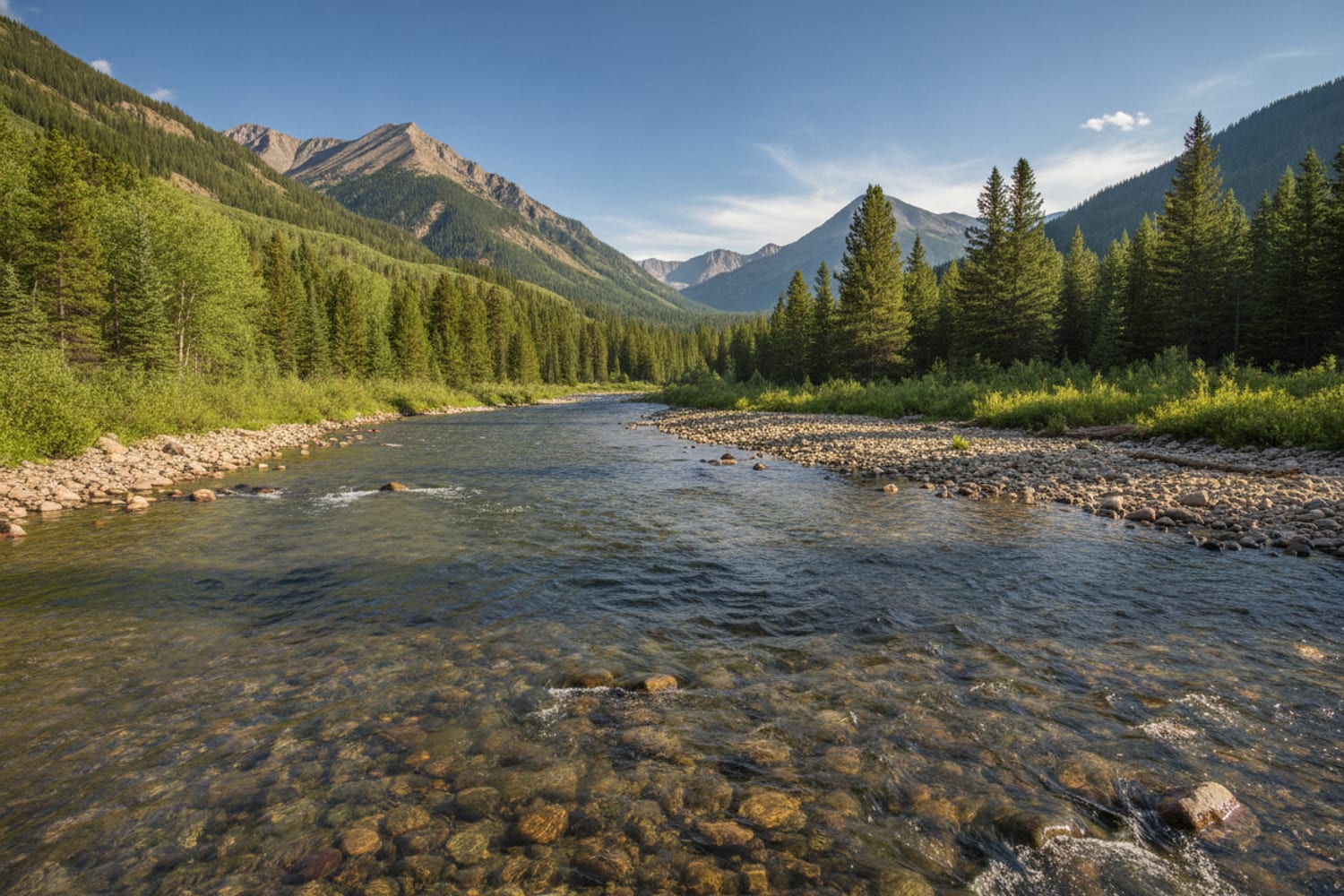
The Deckers section is more complex than Cheesman because harvest is permitted. CPW’s Chapter W-1 sets the reach from the lower boundary of the Wigwam Club downstream to Scraggy View Picnic Ground as artificial flies and lures only, with a bag and possession limit and minimum size for trout of two fish, 16 inches. The boundaries are marked on CPW’s regulation maps.
Generally: that special-regulation reach runs through the most productive water near the main access points. Below Scraggy View it ends, and the rules change again.
If you want to keep fish at Deckers, read the CPW regulation booklet for the specific section number (South Platte River, Park County) before your trip. The rules are clearly written; the mistake people make is not reading them before they’re standing in the river.
My take
My system is one boring errand a year: license and Habitat Stamp together, bought before the first trip, so the question never comes up again until next season. The stamp is the piece I’d bet most anglers standing in a Colorado river don’t realize they need — thirteen dollars against a wrecked day is the cheapest insurance in this sport. Beyond that, I’ve simplified my life by releasing everything no matter which side of a boundary I’m standing on. The markers aren’t always obvious on the ground, and a fish in the net has never once asked to come home with me.
Dream Stream (South Park)
The Dream Stream section (Spinney Mountain Reservoir to Eleven Mile Reservoir) has its own special regulations that are among the most restrictive on the South Platte system. See the south-platte-hatch-calendar for season timing on each section, which helps you plan which stretch to target and which regulations will apply. It’s catch-and-release only for most of the fishable water, flies and lures only, with a winter closure section near the inlet.
The Dream Stream section is managed for trophy fish — this is where the South Platte’s heaviest rainbows and browns live. The catch-and-release management is what keeps those fish in the river.
Check CPW’s current regulations annually — the Dream Stream regulations have changed in recent years and will likely continue to be refined as CPW manages the population.
The Arkansas River at Pueblo
Different river, different regulations entirely. The Pueblo tailwater below Pueblo Reservoir is a special-regulation tailwater — not Gold Medal (the Arkansas Gold Medal water ends far upstream at Parkdale, above the Royal Gorge). From the Valco Ponds bridge down to Pueblo Boulevard it’s artificial flies and lures only, with all trout over 16 inches released; below that reach, standard harvest rules apply. If you’re making the drive from Colorado Springs to Pueblo specifically for the tailwater, check the CPW regulations for the current season — the possession limits and size limits change.

Where to Check Current Regulations
CPW publishes regulations annually and updates them online throughout the year for emergency closures or regulation changes. Before any South Platte trip, check:
CPW Regulations Online: cpw.state.co.us → Fishing → Regulations — the current year’s regulation booklet in PDF, searchable by river name and section.
Local fly shop: The shops near the water post regulation summaries for their section. Flies & Lies at Deckers, for example, keeps current Gold Medal boundary information posted at the counter. If you’re unsure about a specific beat, ask.
USGS Flow Data: Not a regulation source, but flows affect access. Some sections are unfishable or inaccessible at high flows in late spring. Check before you go.
The licensing and regulation process isn’t complicated once you’ve done it once. Buy the license, buy the stamp, know your section’s rules, and fish confidently. That first time, read the actual regulations rather than relying on secondhand summaries — yes, including this one. CPW’s booklet is clear and the rules for the South Platte sections are specific. Twenty minutes with the PDF beats explaining yourself to a warden while the hatch goes off without you. For a breakdown of exactly what to expect at Deckers versus the canyon sections, both river guides include the current regulation details for each stretch.