
In this review
I own a small fortune in tailwater rods, and the one that makes me happiest is a slow little glass 3-weight I had no practical reason to buy. I told myself it was a “small-stream rod.” What I meant was that I wanted recess. The South Platte is a chess match — twelve-foot leaders, 7X tippet, fish that have been to graduate school. A blue line is the playground at the end of the dirt road, where the fish are wild, eager, and have never once judged my drift.
I’ve already written about why I started chasing those creeks and how to find them on a map. This one’s the missing piece: what I carry, why it’s short and soft and dumb-simple, and how I fish it once I’ve made the hike. Fair warning — the whole “setup” is mostly an exercise in leaving things in the truck.
The whole setup in one breath:
- Rod: a short, slow glass 3-weight (mine’s the Scott F Series 7’2”)
- Reel: a click-pawl that does nothing but hold line and hum
- Leader: 7.5 to 9 feet, 4X or 5X — short and on the heavy side
- Flies: one box, mostly attractor dries, a few nymph droppers
- The move: dry-dropper rig, fished low, slow, and hidden

What a blue-line setup actually is
A blue-line setup is a short, soft rod; a short leader; one box of attractor dries with a few droppers; and the discipline to move slowly and stay hidden. Everything past that is subtraction — every item you talk yourself out of bringing is one less thing snagging on willows while you scramble over a boulder.
The tailwater mindset actively works against you up here. On big technical water you solve problems by reaching farther, mending across conflicting currents, and going finer with tippet. On a creek almost none of that applies: the casts shrink to fifteen feet or less, the fish aren’t picky, and the whole game becomes getting close without being seen. Small water rewards the opposite of everything a tailwater teaches you.
The rod: short, soft, and a little bit silly
This is where my Scott F Series 7’2” 3-weight finally earns its keep. It’s E-glass — fiberglass — with a genuinely slow action, and on a creek that matters enormously for two reasons.
First, glass loads at close range when graphite won’t. Under twenty feet, a soft glass rod bends off just the weight of the line, so you can form an accurate fifteen-foot cast a stiff, tip-fast graphite rod simply can’t — a fast rod needs line out past the tip to load, and on a creek you almost never have it. Second, a short rod fits the water. Seven-foot-two clears branches that eat a 9-foot rod alive, and it lets you roll cast, sidearm-flip, and bow-and-arrow into pockets inside a tunnel of brush. The full theory is in how rod action works: slow rods load deep, protect light tippet, and turn a small fish into a real fight.
And that last part is the quiet argument for glass: an eight-inch wild brookie on a slow 3-weight fights like something twice its size. Fun is a legitimate design goal up here. There’s no trophy to be efficient about.
If your creeks run wide and open, or it’s windy country, a crisp graphite 7’6” 3-weight is the smarter call — more reach, more backbone, less playful. For tight, brushy blue-line water, short and soft wins. I put eight small-stream rods side by side in my best fly rods for blue lines roundup if you’re actually shopping.
What weight rod is best for small creeks?
A 3-weight in the six-to-seven-and-a-half-foot range is the do-it-all small-stream rod. Drop to a 1- or 2-weight for maximum delicacy, or stretch to a 4-weight for bigger fish or steady wind, but a short 3 is the natural center of that range. Glass for fun and forgiveness; graphite if you need more reach.
The reel, line, and leader (keep it dumb-simple)
The reel barely matters here, and that’s the point. I run a Ross Colorado click-pawl, whose entire job is to hold line and make a pleasant ticking sound when a fish runs. On a creek a reel is line storage with a nice voice. Buy the simple one.
The honest tradeoff: no sealed drag means a dunked reel can flood and grit up, and it gives you next to nothing to fight a fish with. Neither costs you much against eight-inch trout — but if your “small water” holds the odd two-pound surprise, a sealed reel earns its weight.
For line, go true-to-weight and stop there. Scott doesn’t name a taper for the F Series — its published chart lists a grain window, and the 7’2” 3-weight (model FS 7235) asks for 94–106 grains, which is simply a true-to-weight 3. Match that and the taper is your call. Mine’s a double taper, because a DT rolls and mends beautifully at the short range that’s most of what you’re doing up here.
The leader is where people overthink it. Keep it short. I fish a 7.5- to 9-foot leader in 4X or 5X and almost never go finer. A long, fine tailwater leader is a liability on a creek — harder to turn over in tight quarters, less control when you’re dropping a fly into a pocket the size of a dinner plate. Short leader, heavier tippet than you’d dare on the Platte. Nobody up there is going to inspect your tippet diameter and file a complaint.
The fly box: one box, mostly attractors
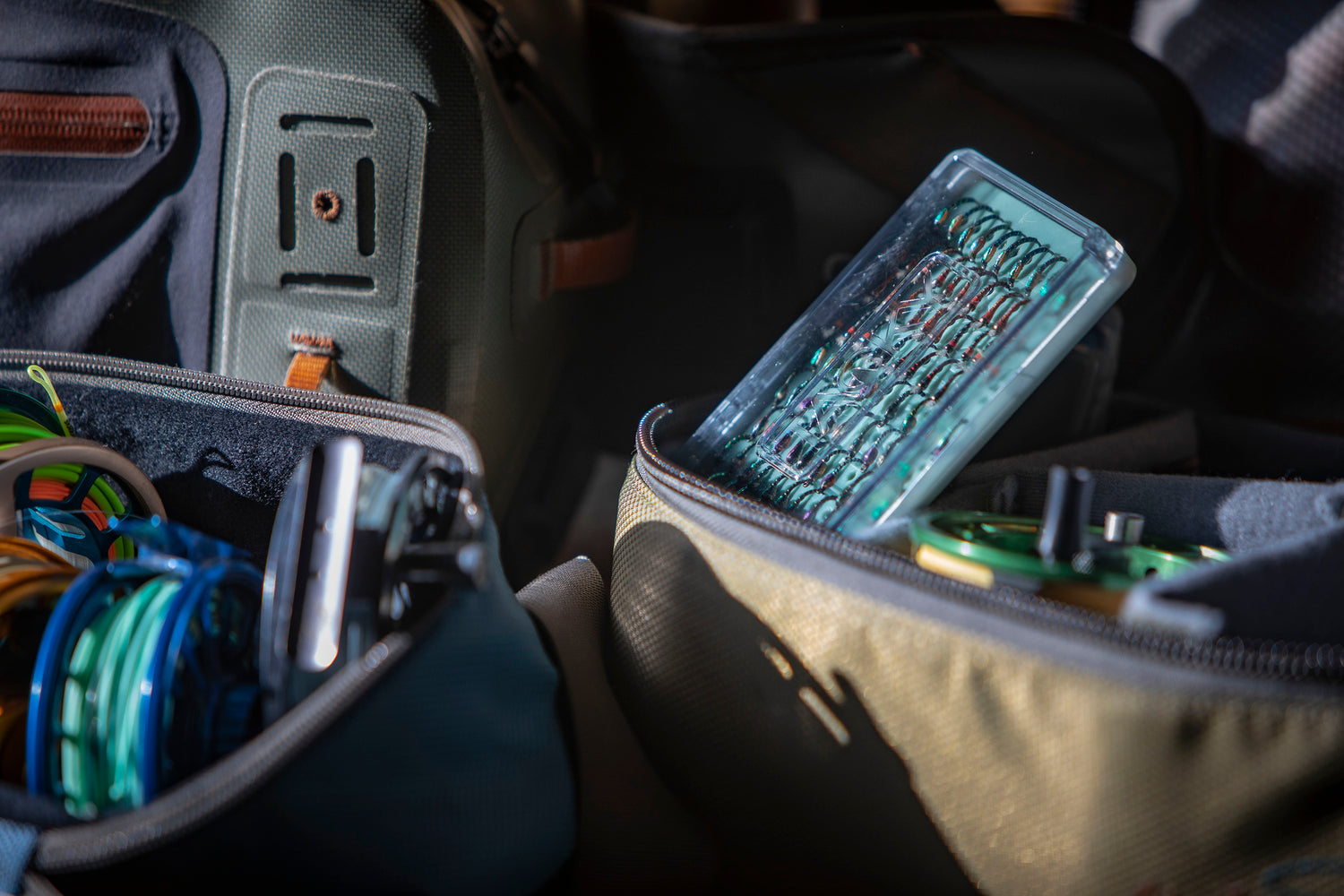
One box. That’s the rule, and breaking it just means more weight and more decisions. Wild creek trout are opportunists, not critics — short feeding window, lots of competition, so they eat a plausible bug fast before a neighbor beats them to it.
- Attractor dries do most of the work: a Royal Wulff, an Elk Hair Caddis, a Stimulator, a parachute hopper, a foam beetle or ant. Big enough to see, buggy enough to eat.
- A few small nymphs for droppers: a Perdigon or a Pheasant Tail in size 16–18 for the deeper pockets.
- The Olsen’s Blowtorch — my confidence fly everywhere, and small water is no exception. I tie it with an orange tag for stained water and a green tag when it’s running clear, and it’s the first thing I reach for on the dropper.
What’s not in the box is the whole philosophy: no 7X tippet, no strike indicators, no split-shot tray, no twelve midge variations in three colors. If you’re carrying your tailwater nymph rig up a mountain, you brought the wrong kit.
My take
The blue-line setup is the cheapest, simplest kit I own, and it makes me happier than anything on my tailwater shelf. A slow glass 3-weight, a click-pawl reel that just hums, a short leader, and a single box of bugs I refuse to overthink. The “system” is really just a decision to leave most of my gear in the truck and trust the fish to be eager and the water to be enough. It usually is. Buy the rod that makes you want to make the hike, and stop shopping.
The rig: dry-dropper does almost everything
My default on a creek is a dry-dropper: a buoyant attractor dry up top, a small beadhead nymph hung 12 to 18 inches below. The dry is both fly and indicator — when the nymph gets eaten the dry dips, and when a fish wants the surface it just eats the dry. One cast covers two water columns, which is about the only place in my life where the math comes out ahead.
When fish are visibly looking up — and on an eager creek they often are — I’ll cut off the dropper and fish a single dry: easier to keep floating, easier to see bobbing through fast pocket water. Start dry-dropper, simplify when they tell you to.
Stealth is the whole game
On small water, stealth beats every piece of gear you own. In thin, clear, low-volume water a trout has nowhere to hide and every reason to be nervous. It lives its whole life one heron-shadow from death, so it bolts at the first wrong signal — a tall silhouette against the sky, a line shadow swinging across a pool, the whoosh of false casting, footsteps drumming through the streambed.
The countermeasures are all about being smaller and slower:
- Approach from downstream. Trout face into the current, so coming from below keeps you out of their window and carries your disturbance away.
- Stay low. Crouch, kneel, use boulders and streamside brush. Break up your outline against the sky.
- Move absurdly slowly. If you feel like you’re being theatrical about it, you’re probably going the right speed.
- Minimize false casting. Every stroke over the water is a chance to spook the pool. Measure once and deliver.
- Mind your shadow. Cast so your shadow and the line’s fall away from the lie, never across it.
None of this is fussy purism. On a creek it’s the entire difference between a productive morning and watching wakes scatter all day. When a pool goes quiet, my first assumption is that the fish saw me — not that I tied on the wrong bug. I have changed flies over and over on a pool I had already ruined, which is a very thorough way of being wrong.
What do you do when a creek pool goes dead?
Leave it, and come back later. Don’t stand there cycling through patterns — a spooked pocket wants twenty or thirty minutes of nobody standing over it, and you have a whole creek upstream that hasn’t seen you yet. Fish up, hit the burned pools again on the walk back down, and in the meantime ask yourself what you did in the ten seconds before it went quiet: stood up, waved a rod, dropped a line shadow across the head of it. That’s the mistake not to repeat in the next pocket.
Reading tiny pocket water
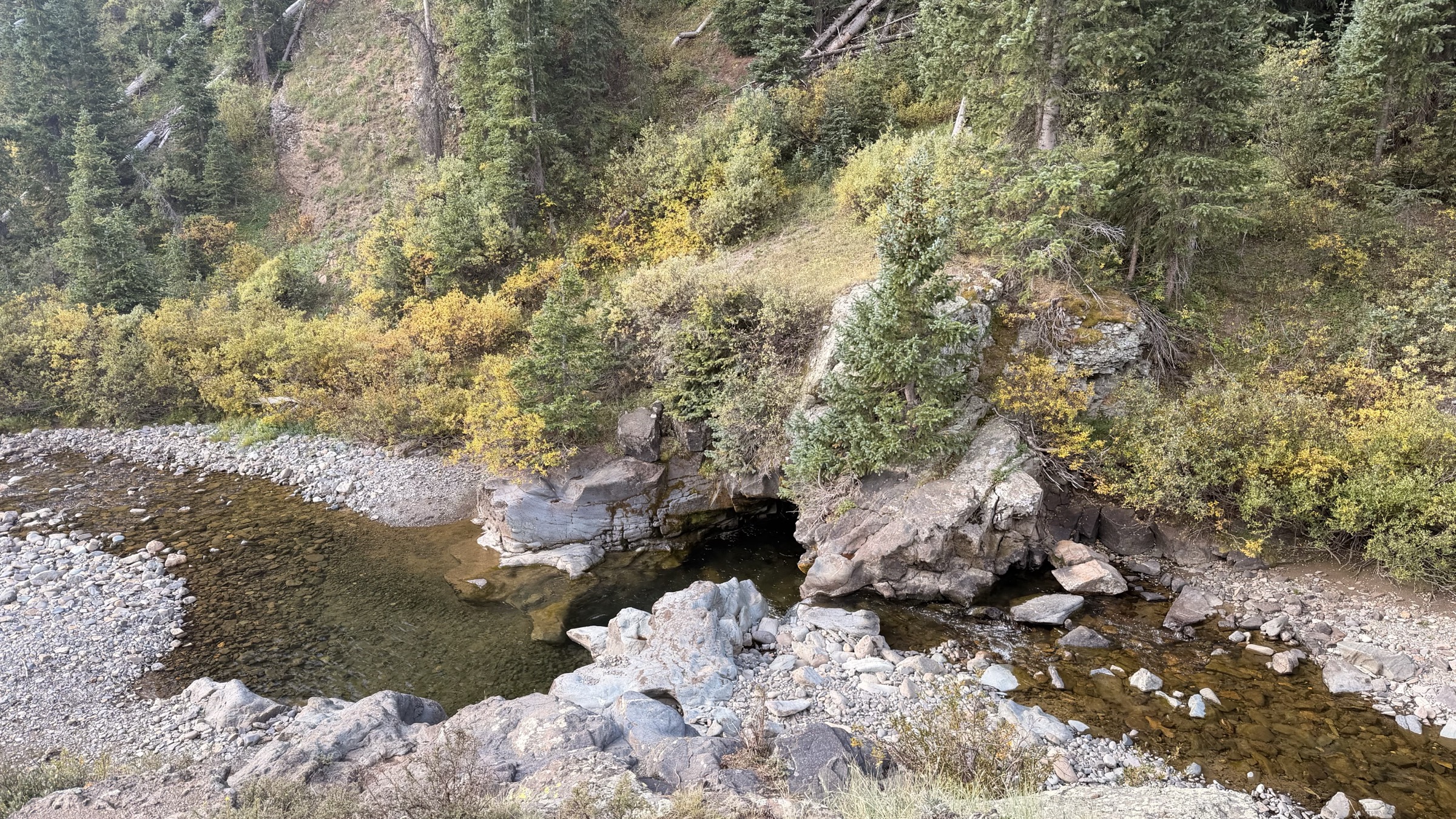
The flip side of all that spookiness is that small streams are absurdly fishy once you learn to read them. On a tailwater you hunt for a handful of prime runs. On a creek, the whole stream is structure. Every rock builds a cushion of soft water on its upstream face and a calm pocket behind it. Every plunge digs a scour hole. Every seam where fast meets slow is a feeding lane, and every undercut bank, submerged log, and foam line can hold a fish — often the best fish, since the heaviest trout claim the prime lies. The pocket-water reads I use at Deckers scale straight down to a creek: same seams, same cushions, just smaller.
The skill is seeing a mosaic of dozens of tiny holding spots instead of a few obvious pools, then giving each one a cast or two and moving on. Drop the fly at the head of the pocket so it gets a clean, drag-free drift before the conflicting currents grab it — on tight water that’s often a matter of a foot and a single second. Distance is irrelevant. Placement is everything. Then step upstream and keep going: a good blue-line day covers a mile of water rather than camping on one run.
In the tightest brush, where you can’t make any backcast at all, dapping outfishes any cast you could attempt: reach the rod out and lower the fly straight down onto the surface with little or no line. It looks like cheating. It works like a charm.
Wet-wade and travel light
In warm months I leave the waders in the truck and wet-wade — quick-drying pants, good wading shoes, hands free for scrambling over rocks and ducking under deadfall. Mobility is the tactic up here, and waders fight that.
One caveat, straight: this is a summer move only. Cold high-country water in the shoulder seasons means full waders. Immersion in genuinely cold water costs you dexterity and judgment fast, and hypothermia is a real risk at altitude even on a mild day.
The rest of the safety picture deserves to be blunt, because what makes this water appealing is what makes it unforgiving. You are usually alone and often out of cell coverage, and the walking is the hazard more than the water — loose rock, wet deadfall, talus, streambed cobble that rolls under a boot. Take a wading staff and use it on the crossings. Tell somebody your drainage and your turnaround time before you leave the truck, and carry an offline or paper map. Watch the sky: high country builds afternoon thunderstorms fast, and you do not want to be on an exposed slope holding a rod. If a crossing looks marginal, walk upstream and find a better one — nothing up there is worth a fall with nobody around to notice.
Here’s roughly what’s on me for a creek day:
- The short glass rod, reel, and one box of flies
- Tippet in 4X and 5X (maybe a spool of 6X for the rare technical pool)
- Nippers, floatant, and a small net I can clip and forget
- Polarized glasses — you’ll be sight-reading shallow pockets all day
- A wading staff. I carry one everywhere, and loose creek cobble is exactly why
- Water, a layer, and a map with public-land boundaries downloaded for offline
How I carry it: a lanyard, not a vest
The carry system is the part I’m quietly proud of, mostly because it’s barely a system at all. I’ve owned a vest, I’ve owned a vest and more slings than a grown man needs, and on most water my everyday carry now is a Fishpond Stormshadow chest pack. But when the creek’s close — a short scramble down from a pullout — I leave even the sling behind. The rig is built around C&F’s Universal System: a magnetic fly patch carrying the handful of bugs I’m actually fishing, with clip points for nippers, floatant, forceps, and a couple of tippet spools. That’s it. That’s the kit. (Long version in my C&F Universal System review.)
A plain neck cord works, but it hangs everything off the back of your neck, and after a day of leaning over pockets you feel it. So I upgraded to a 54 Dean Street Universal Strap — a padded two-shoulder harness with a light chest belt, extra tool loops down both straps, rear net attachments, and G-buckles that take the C&F patch. (If you’ve ever fished a creek hunched like a heron, that detail is the entire ballgame.) It’s the comfiest way I’ve found to carry almost nothing.
There’s a middle gear I fish too: C&F’s Universal System Chest Storage — the CFA-830, a compact box that rides flat on your sternum and weighs all of about nine and a half ounces. The foam is the reason it works — the same inserts swap straight from the lanyard patch into the box, and the box clips onto the very same 54 Dean Street harness. No new system to learn, just a bigger box on the strap I’m already wearing, plus three tippet spools on the back, and the weight rides high and dry when I’m wet-wading. Which, yes, does make me a guy in a chest pack on a creek — but there’s a wide gap between one slim chest box and the version of me that used to bring an entire garage to eight-inch fish.
Honest limits: the harness is about a hundred dollars and the box a good bit more, which is absurd money if you fish a creek twice a summer — a $15 neck cord genuinely does the job. And the box is the wrong buy if minimal is the point for you. The lanyard patch alone is the purer answer, and it’s where I’d start.
When the creek’s a real hike, though — a couple of miles back, or a full day where I want water, a layer, and lunch — the kit goes into a small backpack. That’s the only time a full pack earns its keep up here. It took me an embarrassing number of seasons to work out that the gear I missed most on a creek was the gear I’d left in the truck approximately never.
Get the kit dialed, then fish it the way the water wants — low, slow, hidden, picking the creek apart pocket by pocket. The trout up there will forgive a clumsy cast. They will not forgive being seen.
Next: you’ve got the setup — now go find the water. Here’s how I find blue lines in Colorado without anyone handing me a single GPS pin.