
In this review
Nobody sets out to buy a whole bench of one brand. It happens the way most gear habits happen — one tool at a time, each one quietly better than the thing it replaced. On my bench, a fair number of the tools that stuck carry the same duck: the whip finisher, the wax, the mat the whole setup sits on.
So let me be upfront before we start: Loon doesn’t pay me, and there’s no affiliate link in this post. This is the Loon gear worth knowing about, the pieces on my own bench among it, with the honest version of what’s great and what isn’t. If you tie — or you’re shopping for someone who does — here’s what’s worth the money, what I’d buy first, and the couple of things worth knowing before you spend it.
The one that changes how you tie: UV Clear Fly Finish
If you buy only one Loon product, make it the UV Clear Fly Finish. It’s a UV-cure resin that hardens in about 15 seconds under a UV light — no waiting on head cement to dry, no tacky overnight messes, no little jar of lacquer thinner-smelling cement evaporating on you between sessions.
It comes in three viscosities, and the difference genuinely matters once you’ve fished them:
- Flow — water-thin. It wicks into thread wraps and locks them, and it works as a head-cement replacement on small stuff. If you buy one, buy Flow. It’s the bottle you’ll reach for ten times a session.
- Thin — for building clean heads and wing cases without a bulky profile. The middle ground.
- Thick — big heads, bodies, hot-spot collars, anything where you want to build up shape fast.
Here’s where it pays off: a hot-spot collar like the one on the Blowtorch I can’t stop tying. A drop of resin over the thread collar, two seconds of light, and that hot spot is bombproof — it survives a season of trout teeth and rock instead of unraveling by the third fish. The pitch for UV resin is simple: durability you can see. Flies last longer, and the ones with a resin-locked thread base don’t come apart at the head when a fish chews them.
There’s also a Fluorescing version that absorbs available UV light underwater and re-emits it as visible color — a subtle trigger on tailwater fish that have seen everything. It isn’t for every pattern, but on a stubborn winter midge it’s a card worth having.
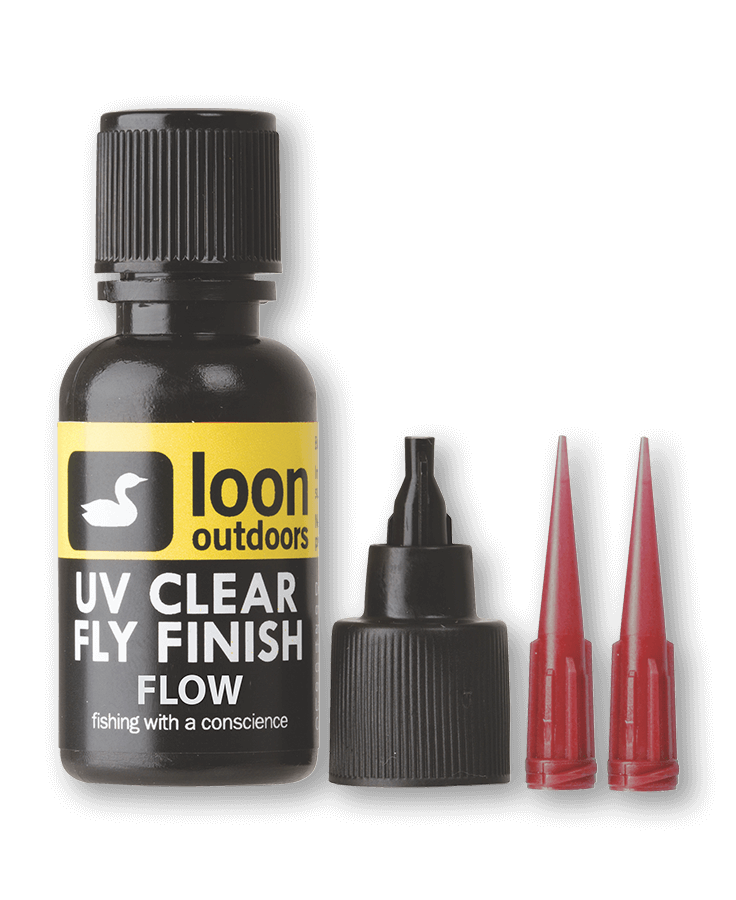
Two honest gripes. First, older UV resins (Loon’s included, years back) used to leave a tacky surface you had to wipe down — the current Clear Fly Finish cures tack-free under a proper light, but if you cheap out on the light, you’ll still feel it. Second, you have to use the little applicator tips and not flood the fly; a glob of resin looks like a glob of resin on the water. Apply less than you think.
Do I really need a UV light, or will any cheap one do?
You need a real one. Sunlight and keychain UV lights technically cure resin, but slowly and unevenly, and they leave the tacky finish everyone blames on the resin. A dedicated bench light cures a head tack-free in about 15 seconds. If you buy the resin, buy the light with it.
A resin is only as fast as the light curing it, and this is the half of the system nobody tells you about. Loon’s UV Bench Light is a bright, focused beam that cures a head in about 15 seconds and runs off a single AA. It’s small enough to ride in a pack for streamside repairs, which can save a fly on the water. (On my own bench, Loon’s UV Torch does the curing.)
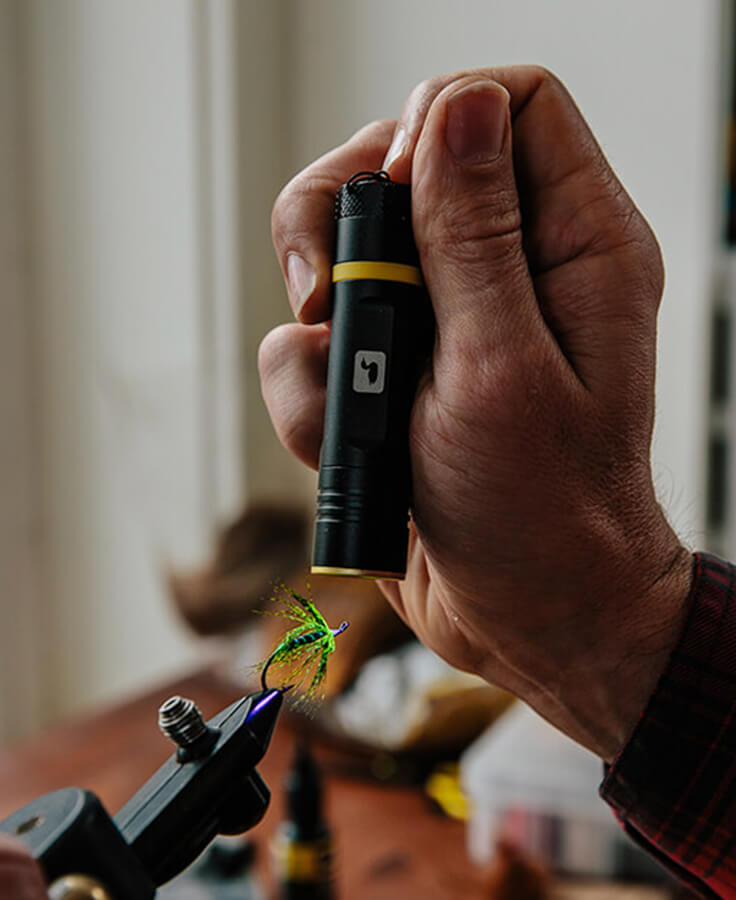
Loon makes a whole range of lights — smaller Nano and Plasma options, bigger ones — but the Bench Light is the do-it-all for most tyers. The cheap-light lesson usually gets learned the expensive way: buy a keychain UV light to “save money,” fight tacky heads for a season, and blame the resin. It’s not the resin. It’s the light.
The whip finisher I actually reach for
The whip finisher in my hand at the end of every fly is Loon’s Ergo Whip Finisher, for two reasons. First, the fat ergonomic handle doesn’t cramp your hand over a long tying session — when you’re tying two dozen flies, the skinny wire-handled tools start to bite. Second, the part most people don’t know they need: the base of the handle is sharpened, so you can finish the fly and clip the thread with the same tool. One fewer thing to set down, lose, and hunt for under the desk.
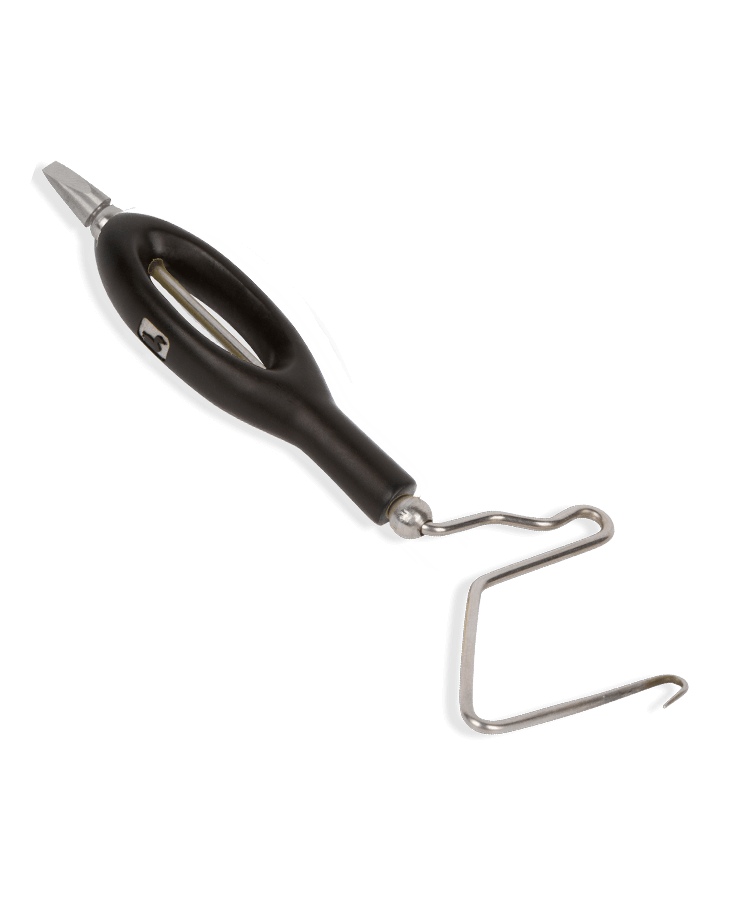
If the whip finish itself is the move you fumble — and everyone does at first — I broke it down with the tool and by hand here. The tool doesn’t fix bad technique, but a comfortable one makes the reps a lot less miserable while you’re learning.
The Loon bench at a glance
Here’s the whole bench in one place — every piece, what it does, and the one-line verdict. Prices vary by retailer, so check the current listing before you buy; I’m not going to quote you a number that’s stale by the time you read this.
| Piece | What it does | One-line verdict |
|---|---|---|
| UV Clear Fly Finish (Flow) | Water-thin UV resin; head-cement replacement | The one to buy if you buy only one |
| UV Bench Light | Compact torch; cures a head in ~15 sec | Buy it with the resin — it’s half the system |
| Ergo Whip Finisher | Fat handle, sharpened thread-cutting base | In my hand at the end of every fly |
| Rogue Nippers | Stainless line nipper with an eye-cleaning needle | The everyday tool I’d replace first if I lost it |
| Swax | Tacky dubbing wax that doesn’t gum up | Unsexy, constantly used, lasts forever |
| Tying mat | Non-slip silicone bench mat | Saves the bead from a one-way trip to the carpet |
| Core Tool Kit | Whip finisher, bobbin, scissors, bodkin, hackle plier in a case | The smart way to start from zero |
Category picks, the short version:
- Best first buy: UV Clear Fly Finish (Flow). It changes how durable your flies are.
- Best for beginners: the Core Tool Kit — one case, no piecemeal regret.
- Best everyday tool: the Rogue Nippers. Boring, perfect, never thought about them twice.
- Best thing you’ll forget you own: Swax. You only notice it when it’s gone.
The rest of the Loon kit on my bench
The marquee pieces get the attention, but the small stuff is what makes a brand sticky — these are the unglamorous ones that get used without a second thought:
- The Rogue Nippers. Loon’s simple line nipper — stainless blades, a double-dipped comfy grip, and an eye-cleaning needle tucked in the end for the head cement I inevitably get in the eye. They cut tippet and fine wire without complaint and haven’t dulled on me. The everyday tool I’d replace first if I lost it. Loon sells a Rogue Zinger to hang them on, which is the obvious pairing.
- Swax. Dubbing wax that’s tacky enough to grab dubbing onto the thread but not so gummy it builds up and fouls everything. Unsexy, constantly used, lasts forever. The kind of product you only notice when you’re out of it.
- The tying mat. A non-slip silicone mat that catches the bead I’d otherwise donate to the carpet forever. If you’ve ever spent ten minutes on your hands and knees with a flashlight looking for a tungsten bead, you understand why this is on the list.
- The Core Tool Kit. If you’re starting from zero, Loon’s Core Fly Tying Tool Kit bundles the tools in one case — and it’s honestly a smarter way to start than buying piecemeal the way I did, one “I’ll just grab one more thing” at a time.
Building a Loon bench from scratch — what I’d buy first
If a friend told me they were getting into tying and wanted to do it once, this is the order I’d hand them:
- The Core Tool Kit — whip finisher, bobbin, scissors, bodkin, hackle plier, in a case. Covers the tools in one buy.
- UV Clear Fly Finish (Flow) + the UV Bench Light — bought together, as a system. This is the upgrade that makes your flies last.
- Swax and a tying mat — cheap, daily-use, and essential.
That’s a complete, genuinely good bench for less than the cost of one nice rod, and you won’t be replacing any of it next year. For the bigger picture — the vise, materials, and first flies that actually catch — start with my getting-started-in-fly-tying guide, and the full tour of my own setup is in the bench tour.
Fishing with a conscience — the part I respect
There’s a line on every Loon bottle: fishing with a conscience. It’s not just marketing fluff. Their floatants and treatments lean non-toxic, and the brand has built its whole identity around gear that doesn’t poison the water you’re standing in. When you spend as many days as I do with my hands in a river, and my son comes along too, that matters more than it used to. It’s a small thing, but it’s the kind of small thing that makes me reach for their bottle over a cheaper one.
What rides in my pack, not just on the bench
Loon isn’t only a tying brand for me — it follows me to the water. A bottle of Aquel floatant lives in my pack year-round; it keeps a dry fly riding high through a hundred drifts, which matters most on a flat, technical BWO morning when the fish get a long, suspicious look at every bug. It’s the same non-toxic, conscience-first formula, which I appreciate given how much floatant inevitably ends up in the river one way or another. It’s a small bottle that saves a lot of fly changes.
Is Loon worth it? An honest take
No, Loon isn’t the cheapest. You can buy a no-name whip finisher for a few bucks and a generic UV resin for less. Here’s the calculus I keep landing on: tying tools are worth buying once. Cheap nippers rust, cheap resin stays tacky no matter what, and a cheap UV light can die in a season. Good tools don’t come back up on the shopping list. Spread over the years and the thousands of flies, the premium rounds to nothing per fly.
Who should skip it: if you tie a dozen flies a year, the budget kit is genuinely fine — don’t overthink it. Who it’s for: anyone tying in real volume who’s tired of fighting their tools instead of the fly, and who’d rather buy once than re-buy every season.
My take
A brand quietly takes over a bench one tool at a time for one reason: each piece works better than the one it replaced. The test of good gear is exactly that — you stop thinking about it and just tie. If I were starting from an empty desk, the resin and a real light would be my first Loon buy, because that pair is the genuine upgrade; the rest are just the most comfortable, most reliable versions of tools you’ll use forever.
FAQ
Which Loon UV resin should I buy first — Flow, Thin, or Thick? Flow. It’s water-thin, locks thread wraps, and doubles as a head-cement replacement, which covers the most situations. Add Thick later if you tie big heads or hot-spot collars.
Is Loon UV resin still tacky after curing? The current UV Clear Fly Finish cures tack-free under a proper UV light. Tackiness almost always means an underpowered light or sunlight curing — not the resin itself. Use enough light, and use less resin than you think.
What’s the one Loon tool to start with? The Ergo Whip Finisher if you tie by hand — the sharpened base means it finishes and clips the thread in one tool. If you’re building a whole bench from scratch, the Core Tool Kit is the cheaper path to the same set of tools.
Is Loon Outdoors gear worth the money? For anyone tying in volume, yes — the tools last for years and the resin-plus-light system genuinely makes flies last longer. Casual tyers who tie a handful of flies a year can get by with a budget kit.
This isn’t sponsored and there’s no commission here — just Loon gear worth a look, some of it on my bench and in my pack. The pieces that stick around do it for the same reason: they work, then get out of the way.
Next: Getting started in fly tying — the bench, the tools, and the first flies that actually catch.