
In this guide
September and October on the South Platte are the best-kept secret in Colorado fly fishing — and I’m a little annoyed at myself for telling you, because the parking lots are finally empty and now look what I’m doing. The summer crowds are gone. The PMDs are done. The caddis have mostly finished. What remains — for six to eight weeks of reliable surface fishing — is the fall Blue-Winged Olive hatch, and it’s better than the spring version in almost every way. The South Platte hatch calendar shows exactly where the fall BWO window falls relative to the rest of the season.
This is the guide to fishing it correctly — so you don’t spend a perfectly good gray October morning doing what I did for years: throwing a #18 at fish that wanted a #22, then blaming the fish.
The short answer
Fall BWO fishing on the South Platte peaks in late September and October, and it’s best on overcast, 45–60°F gray days — the miserable-looking ones. Start with a #22 dry (the Vis-A-Dun is my top producer, with an RS2 as the emerger before fish commit up top) on a 12-foot 5X leader tipped with 24 inches of 7X, and fish Cheesman Canyon, Deckers, or Eleven Mile Canyon. Everything below is the why and the how — hatch timing, the full fly box, rigging, and reading the rise.
Bring smaller flies and finer tippet than feels reasonable. That’s the whole trick.
Why fall BWOs beat spring
Most South Platte anglers know about the spring BWO hatch. Fewer pay proper attention to the fall one. Here’s why the fall is actually the better season:
Calmer water. Spring on the South Platte means runoff pressure, fluctuating flows, and cold, fast water that makes flat-water dry-fly presentations a fight. By September and October, flows have settled into their fall baseline — typically lower and more stable than spring — and the flat sections at Cheesman and Deckers fish with the gin clarity and slow current that produces the best dry-fly conditions of the year.
Longer hatch windows. Spring BWO hatches here tend to be compressed — 30 to 45 minutes triggered by a brief overcast break. Fall hatches, particularly in late September and early October, can run two to three hours on the right day. Lower water temperatures and the stability of Colorado’s fall weather create extended emergence windows.
Fewer anglers. The crowd that stacked Cheesman in May is not there in October. A Thursday morning mid-October gives you access to water that had twenty anglers on it in June. The fish have had months to recover from summer pressure and they’re feeding hard ahead of winter.
Active fish. Brown trout begin pre-spawn behavior in October. They’re more aggressive, more territorial, and more willing to commit to a surface fly. The biggest browns of the year become visible and active in fall in ways they simply aren’t in summer.
When it happens
Season: Late August through mid-November, with the best fishing in late September and October.
Daily timing: BWOs hatch in response to overcast skies, dropping barometric pressure, and cooler air. The fall hatch is less of a clockwork event than the spring one — instead of a reliable 10 a.m. window, fall Baetis can come off anywhere from 9 a.m. to 3 p.m. depending on cloud cover and temperature. Don’t show up at first light expecting bugs; show up, fish nymphs, and watch the sky.
Best day type: Overcast, 45–60°F air, ideally with a chance of rain. Bluebird fall days in Colorado produce minimal BWO activity — the bugs want gloom. If you’re planning an October South Platte trip around the hatch, hope for gray skies and dress for the cold instead of the postcard.

What size BWO fly works best in the fall on the South Platte?
Start with a #22. Fall BWO duns here run on the smaller end of the range — #22 beats #20 on most days, and #24 can be the difference on fish that are clearly rising but refusing everything. Pair it with 7X tippet for the low, clear October water.
The key transition: When overnight lows drop into the 30s and daytime air struggles to reach 50°F — usually mid-October into early November — the hatch window compresses and fish slide from surface feeding back to deeper holding. That’s the end of the fall dry-fly season, and the start of winter midge fishing.
Best sections
Cheesman Canyon — the premium fall BWO destination. The canyon walls throw shade and shelter that concentrate emergence even when the valley above is in partial sun. Deep, clear pools hold large trout in visible feeding lanes. October weekday mornings at Cheesman are some of the most technical and satisfying dry-fly fishing in Colorado. The run below the Gill Trail junction and the deep slot well upstream of the junction are the two most consistent fall beats — both demand the standard canyon approach: long leaders, slow feet, and shadows kept off the water.
Deckers — easier access and reliable fall BWO activity throughout the Gold Medal water. The flat above the Trumbull Road bridge stacks fall risers well. Less technical than Cheesman, a gentler approach, similar quality fish.
Eleven Mile Canyon — consistent cold water and shaded walls make the mid-canyon section (miles 2–5) one of the best fall BWO stretches in the whole system. On overcast days the morning activity here outlasts what you’ll find at Deckers, and you’ll share it with fewer people than either Cheesman or Deckers in October.
The flies
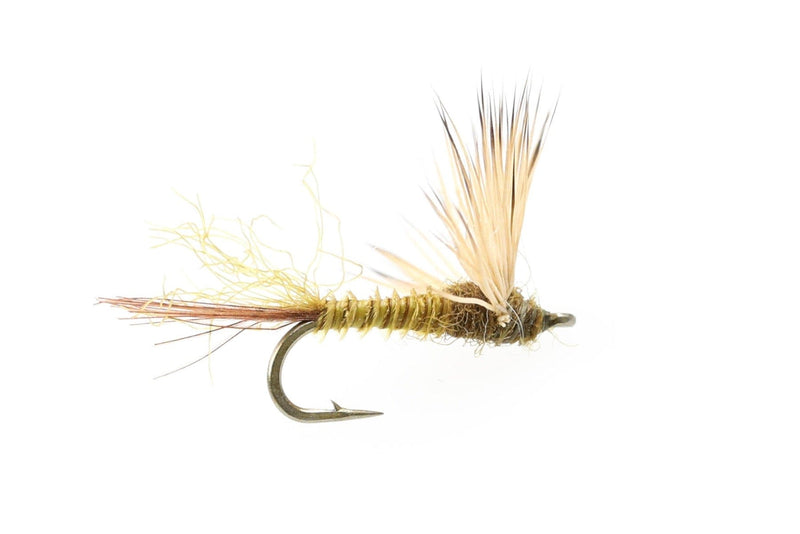
Dry flies
Vis-A-Dun (#20, 22) — the most effective fall BWO dry on the South Platte for me. A CDC-winged pattern with a dubbed olive or gray body. The CDC creates the right translucency and rides flush in the film in a way that fools selective fall fish. Start at #22.
CDC Comparadun BWO (#20, 22) — a comparadun with the CDC wing fanned in a semicircle. My change-up when fish refuse the Vis-A-Dun; the different silhouette occasionally unlocks a fish that’s locked onto one profile.
Parachute BWO (#20, 22) — the visibility option for bad light. White post, olive body. Reach for it when you need to track your fly from a distance — flat morning glare, rippled water, or a riser sitting 40 feet out.
Sparkle Dun BWO (#20, 22) — tied with a trailing Antron shuck. Deadly in the transition moment when duns are still climbing out of their shucks, usually the first twenty minutes of the hatch. As it matures and fish key on the fully-formed adult, switch to the Vis-A-Dun or Parachute.
Subsurface
RS2 (#20, 22) — the most versatile BWO emerger on this river. Gray or olive, fished as a dropper below your dry during the approach phase, before fish commit on top. It’s also the answer on days when the rises are subtle sips — fish eating in the film rather than the adult on the surface.
Soft Hackle BWO (#18, 20) — partridge and olive, or partridge and hare’s ear. Swing it through current seams during the hatch, especially in Eleven Mile’s riffles where trout intercept emergers in the current instead of rising to duns.
All of the above are at The Fly Fishing Place — including the Parachute BWO #20, Parachute BWO #18, and a Soft Hackle. Our link gets you 15% off everything.
Rigging
Standard fall BWO dry rig:
- 12-foot 5X leader (longer than spring — the lower, clearer fall flows demand it)
- 24 inches of 7X fluorocarbon tippet
- Single dry fly
7X is the standard, not the exception, for fall BWO fishing here. Low, clear October water plus #22 flies means fine tippet. 6X will catch fish, but refusal rates climb noticeably. If that math is new to you, the leaders explained guide walks through length and X.
Before the hatch (or on a slow one):
- 9-foot 5X leader, 24 inches of 6X
- RS2 or Soft Hackle BWO as a dropper
- Switch to dry-only as surface feeding kicks in
Reading the rise: duns vs emergers
Half of fall BWO fishing is figuring out what stage the fish are eating, and the rise tells you. A confident, splashy rise where you see the fish’s back or a clean ring around a taken dun means they’re up on adults — fish the Vis-A-Dun or Parachute. A soft, barely-there sip that leaves a bubble or just a dimple usually means they’re eating emergers stuck in the film, not duns riding on top. That’s when you stop forcing the dry, drop an RS2 in the surface film, and watch the refusals turn into eats. The fish aren’t being difficult on purpose. They’re eating a stage you haven’t matched yet.
Approach and tactics
Fall fish on the South Platte are wary in a specific way — they’ve been fed on and caught for five or six months. By October they have a PhD in tippet and they know exactly what drag looks like. Practically, that means:
- Position beats pattern. A clean, drag-free drift through the feeding lane matters more than which BWO you tied on.
- Don’t false cast over rising fish. Set up so your false casts go away from the lane. A flash of line overhead puts fish down.
- Time the cadence. Most BWO-feeding trout settle into a rhythm — a rise every 8–12 seconds. Land your fly so it arrives during the active beat, not in the lull between.
- Drift longer than feels necessary. Fall fish are slow and deliberate. Let the fly ride well past where you’d normally pick up.
Common mistakes
A few easy ways to blow a good fall morning, all of which I’ve personally donated to the river:
- Fishing too big. When in doubt, go smaller and finer, not bigger and stronger. #22 on 7X out-fishes #18 on 6X almost every gray day.
- Showing up at dawn and leaving at noon. The fall hatch often peaks right when the spring one would be over. Be there at 11 a.m. and 1 p.m., not just at sunrise.
- Praying for sun. A bluebird forecast is a bad BWO forecast. The miserable-looking days are the good ones.
- Lining the pool. Wading to the middle and casting to the far bank drags your line over every close fish first. Work the near water before you ever step in deep.
October access notes
Cheesman Canyon access is via the Gill Trail. The trail’s in good shape through October; after the first hard freeze, check the shaded sections for morning ice — occasional microspike conditions show up in late October. Deckers road access is straightforward year-round, and parking that fills by 6:30 a.m. in summer is rarely full before 9 a.m. in fall. The Dream Stream requires checking Charlie Meyers SWA regulations — some access points have seasonal closures tied to waterfowl hunting in October. Verify before you go.
One pairing worth knowing: those same cold, gray mornings are prime fall streamer time. I’ll throw streamers early while the water’s coldest and the fish are holding deep, then switch to BWO dries around 11 a.m. when the Baetis start coming off. Best of both worlds in one trip.
My take
So pick a gray, drizzly, miserable-looking day — the kind your non-fishing friends think you’re crazy for chasing — and go. The crowds won’t, the fish will be up, and you’ll have the best dry-fly water in Colorado mostly to yourself. Bring smaller flies and finer tippet than feels reasonable, fish the seam closest to you first, and let the fly drift longer than your instincts want. That trade — a little discomfort for the best surface fishing of the year — has never once felt like a bad one to me.
Some links in this article are affiliate links. Read our full disclosure.