
In this review
Floatant is the dullest thing in the pack. Nobody argues about it online, nobody posts a picture of it, and no one has ever been talked out of a rod purchase by a $10 bottle of goo. It also quietly decides whether the fly you just spent four minutes tying on is a dry fly or a very slow nymph.
For a lot of anglers the answer to all of this is one bottle of gel, applied by feel, topped up when they remember. That works, in the way that eating the same lunch every day works.
Then you actually look at the shelf, which is where the confusion starts. Gel, liquid, spray, paste, powder, desiccant, pre-treatment. Six or seven products, near-identical bottles, all promising a fly that floats. They are not competing with each other. They’re doing four different jobs, and most people buy two products that do the same one.
So which one should you use?
If you buy one: a liquid floatant, because it’s the most forgiving across the most situations. If you buy two: add a desiccant powder for after a fish. If you buy three: add a pre-treatment and use it at home. That’s the short answer, and the rest of this post is why.
The four jobs, which is the only sorting that matters
Here is what actually has to happen to a dry fly over a day.
| The job | When | What does it |
|---|---|---|
| Waterproof it | At the vise or the night before | Pre-treatment |
| Dress it | Before the first cast | Gel, liquid, or spray |
| Refresh it | Every dozen drifts, fly still dry | Powder, or a touch more liquid |
| Revive it | After a fish, or after it goes under | Desiccant powder |
| Sink the tippet | Whenever the last foot pulls the fly’s nose down | Paste, rubbed on the tippet — not the fly |
The most common mistake is using a dress it product to do a revive it job — squeezing gel onto a fly that was already soaked, which is roughly like drying a towel with lotion.
What each product is actually for
Pre-treatment is the one most people have never used and the one that changes the most. It’s applied at home, before the fly ever sees water, and it soaks into the fibres rather than coating the outside. A fly treated at the vise starts the day genuinely waterproof instead of merely greasy. The downside is obvious: it requires you to think about tomorrow’s fishing tonight, which is a big ask for a hobby built on avoiding responsibility.
Gel is the default and the one everybody owns. It’s precise — you can put it exactly where you want — and it’s the easiest to overdo by a factor of about ten. More on that below, because it’s where the real damage happens.
Liquid comes as a dip bottle, drops, or a spray. You’re coating the whole fly quickly and letting it soak in rather than sit on top. It’s faster than gel and much harder to overapply — dip it, false-cast once to throw the excess, fish it. The trade is precision: you’re treating the whole fly whether you wanted to or not.
Paste is thicker and mostly useful on leaders and tippet rather than flies — the part of the system nobody treats and which drags your fly under from twelve inches away.
Powder traps air in the fibres. It’s a refresher rather than a treatment, and it works on a fly that’s damp, not one that’s drowned.
Desiccant pulls the water out first and then leaves the fly buoyant. This is the one that resurrects a fly a fish just chewed on. ⚠️ Worth knowing the two often come in one bottle — most “powder floatant and desiccant” products do both jobs, so you’re buying one thing, not two.
⛔ The gel-on-CDC problem
This is the rule worth the whole post.
CDC floats mainly because of structure. Those barbules trap tiny pockets of air, and while preen oil gets some of the credit in the older literature, the air held in that structure is doing most of the work. A thick, greasy gel mats them flat and fills the gaps — and a matted CDC fly doesn’t float badly, it floats wrong, sitting lower and looking like nothing in particular.
So on CDC: desiccant powder, and otherwise leave it alone. High N Dry say their gel is thin enough for fine fibres; an independent long-run test says the opposite. I’m not refereeing that one, because I don’t need to — powder does the job, and there is nothing to be gained by finding out who’s right on a fly I actually like. A thick gel on a CDC wing is a fly you’ve just retired.
The same logic applies more gently to any hackle-heavy dry. My Elk Hair Caddis guide makes the point in passing and it’s worth repeating here: dress the wing and the hackle, never the body. Goop the body and you mat the hackle and kill the high float that was the entire reason you tied it on.
What I actually carry now
I ran a bottle of Loon Aquel for years. It lived in my pack, it worked, and — to be exact about it — it’s still in there. I just don’t reach for it first any more, which is a different thing from replacing it.
What changed is that I stopped thinking of floatant as one product and started thinking of it as the four jobs above. Once you do that, a single gel is obviously covering one job and leaving three unattended. So what’s in my pack now is three things, none of them gel:
Pre-treatment — about $10, used at home. It’s the one I’d have dismissed fastest and the piece I’d now defend hardest, because a fly that starts waterproof needs far less attention all day.
Liquid floatant — around $12, on the water. Fast, even, hard to overdo, and it soaks in rather than sitting on the surface. It replaced my gel.
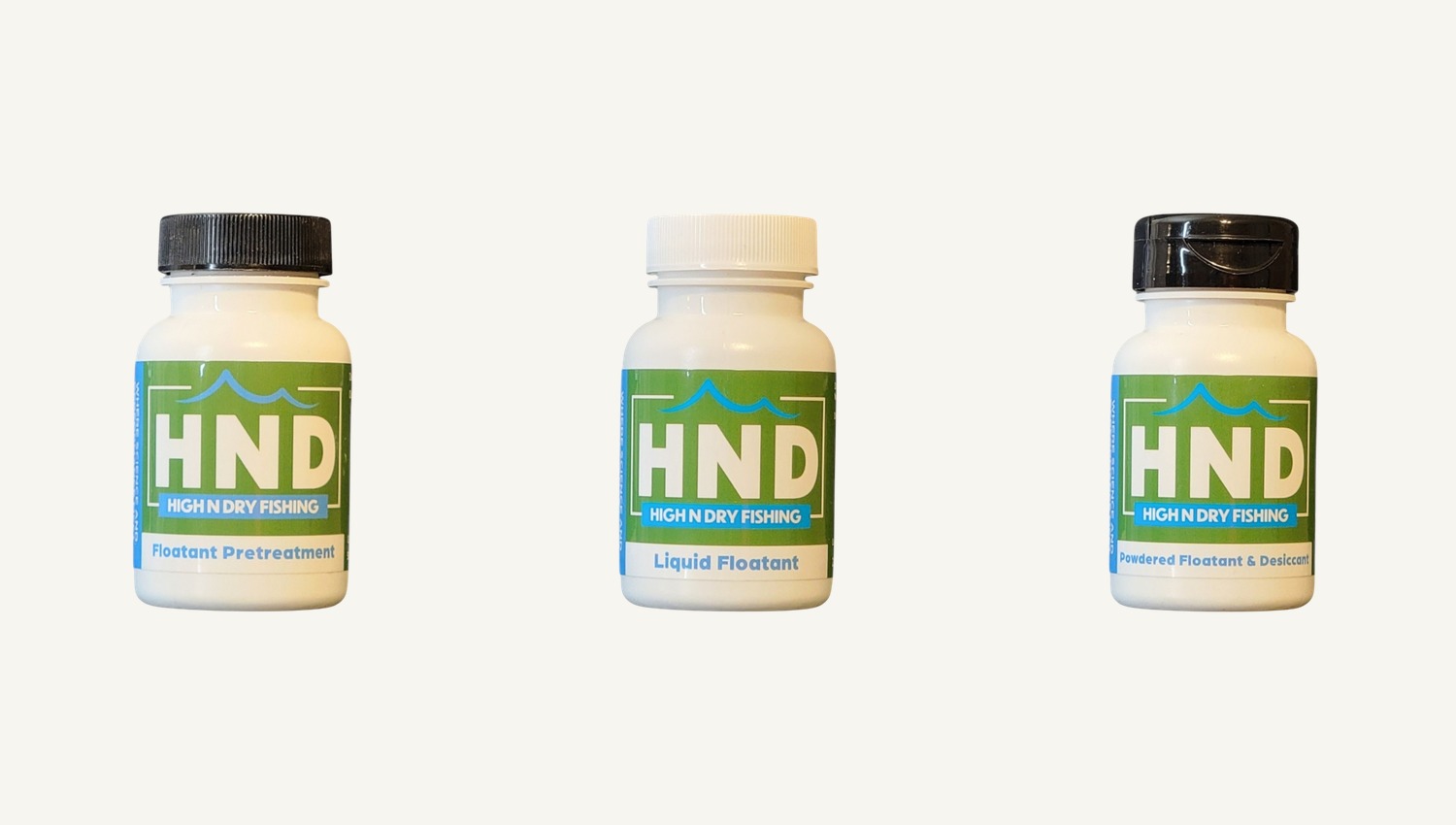
Powder floatant and desiccant — about $10, for after a fish. Drop the fly in, shake, blow off the excess. A fly that looked finished comes back.
All three are High N Dry, which I didn’t set out to do and which I’d flag rather than gloss over — one brand covering three slots in a post is worth your scepticism, so weigh the reasoning above rather than the logo. It’s a Colorado-registered company, though as far as I can tell the actual manufacturing happens out of state — so “Colorado brand” is more a paperwork fact than a factory one, and I’d rather tell you that than let the label do work it hasn’t earned. What I do care about is that they’re solvent-free, which matters more than it sounds when you’re squeezing something into water you’d like to keep fishing.
What actually sinks your fly
Almost none of it is the floatant.
Fish slime. A fish is the fastest way to drown a dry fly. Slime is the problem, not water — rinse the fly, then dry it, then treat it, because treating a slimy fly just seals the slime in. Do all of that after the fish is off and away: it stays in the net, in the water, and none of this happens while it’s waiting on you.
False casting to dry it. This mostly works, and it also puts your fly over the fish twenty extra times and takes it away from the water it should be drifting. Use the desiccant instead and make one cast.
Untreated tippet. The last twelve inches of tippet sinking pulls the fly’s nose under. This is the invisible one, and it’s what paste is for — a smear on the tippet, not the fly.
A fly that’s simply finished. Hackle mats permanently and elk hair splays. At some point a fly is done, and no product on the shelf brings it back. Cut it off.
How often should you reapply floatant?
Stop counting and watch how the fly sits. A well-treated fly can ride high for a long stretch — a good gel or liquid will go hours on easy water — while a fly that’s taken a fish is finished in one drift. The only reliable signal is the fly itself: when it starts riding in the film rather than on it, it’s already been sunk for several drifts and you didn’t notice. Treat after every fish, and otherwise let the fly tell you.
⚠️ One thing to get right: reaching for the wrong product here is worse than doing nothing, because you’ve sealed water into the fibres rather than removing it.
What about cold weather?
This is the part nobody writes about and the one that catches people out on a Colorado tailwater, where the good fall BWO fishing happens in temperatures that change how these products behave.
Gel stiffens. Below about forty degrees a gel goes from honey to toothpaste, and you end up squeezing far too hard and dumping a blob on the fly. Keep the bottle in an inside pocket rather than a chest pocket — body heat is the whole fix.
Liquid is worse, not better. The solvent that makes it flow also flashes off slower in the cold, so the drying step actually matters in winter when it barely does in July.
Powder is the winter workhorse. It doesn’t care about temperature at all, which is exactly why it belongs in the pack from October onward even for people who ignore it all summer.
And the real winter enemy isn’t water, it’s ice. A fly that’s been in a trout’s mouth at 35°F freezes in the guides and on the hackle. Powder first, then false-cast — reversing that order welds the powder into a lump.
How long does a bottle last, and what does this cost?
A season, comfortably, for all three. These are small bottles that get used in drops, not glugs — the pre-treatment goes further than anything because you’re treating a dozen flies at a time at the vise, not one at a time on the water.
Call it thirty-two dollars for the three-bottle setup and expect to replace one of them a year rather than all three. Compared with a fly line at a hundred dollars or a leader habit at six to nine dollars a leader, floatant is the cheapest line in the kit and the one most likely to change a day.
⚠️ One caveat worth knowing before a trip: liquids and solvent-based floatants are subject to the usual carry-on liquid rules, and anything flammable is a bad idea in a checked bag. Powders travel without argument — another quiet point in their favour.
Does floatant work differently on different materials?
Yes, and this is where most one-size advice falls apart.
CDC — covered above. Powder only.
Deer and elk hair is hollow and floats on its own. It wants a light dressing on the fibres and nothing worked into the base, which is the same rule as the Elk Hair Caddis: dress the wing, never the body.
Foam doesn’t need floatant at all. What sinks a foam fly is the hackle, the legs and the tippet — treat those and leave the foam alone.
Parachute posts and synthetic wings are mostly there so you can see the fly. Treat them for visibility, not buoyancy — a soaked post is invisible long before the fly is actually sinking.
Quill and biot bodies absorb, so they’re the one place a pre-treatment genuinely outperforms anything you can do streamside.
How to actually use a pre-treatment
Since it’s the one I’d defend hardest and also the one nobody explains:
Do a whole box at once, the night before. Dip or brush each fly, stand them somewhere they can drip, and leave them overnight to dry properly — that drying time is the entire point, and it’s why this cannot be done on the water. A treated box stays treated until the flies get fished.
Then on the river you’re only ever doing the other three jobs. That’s the difference between a system and a bottle.
What if you don’t want to buy High N Dry?
Fair, and I’d rather name alternatives than pretend the shelf has one brand on it.
Gel: Loon Aquel is what I ran for years and it’s still a good product; Gink is the old standard and still works. Powder and desiccant: Frog’s Fanny at around $7 is the classic, and Shimazaki Dry Shake is the other name you’ll see. Pre-treatment is the thinnest field — it’s a newer category and there genuinely aren’t many options. Part of why I ended up where I did.
I’ve also told you to carry two types before now, back when I thought of this as gel plus a powder. The four-job sorting above is that same advice, worked out properly.
Frequently asked questions
Does floatant spook fish? Not in any way that’s easy to detect, but a slick on the surface film is real if you’re heavy-handed, and it’s more visible on flat water than broken. Blow off the excess. That’s mostly a reason to stop over-applying, which you should be doing anyway.
Is there an environmental difference between brands? Yes. Some floatants are solvent-based — petroleum-derived, flammable, and going into the water you’re standing in. Solvent-free is the alternative and it’s what I buy. Two things can be true at once here: that’s also the founding story of the brands selling solvent-free, and independent tests still rate some conventional gels top on pure float. I’m not choosing on float. I’m choosing on what I’m squeezing into a river I’d like to fish again.
Can I use one product for everything? You can, and if you’re going to, make it a liquid rather than a gel — it’s the most forgiving across jobs. You’ll still be stuck when a fish soaks a fly — that’s the moment you’ll wish you’d packed the desiccant.
What about floatant for nymphs and streamers? Different problem entirely — you want those to sink, and the answer is a sinkant or plain mud on the tippet. Don’t let floatant migrate onto a leader you’re trying to get down.
Does floatant go off? Gels thicken and separate over a couple of seasons, and powders cake if they’ve been open in humidity. It’s a $10 consumable; if the bottle predates the rod, replace it.
My take
Stop buying one bottle and start covering the four jobs. Pre-treat at home, dress it on the water, and carry a desiccant for after a fish — three products, about thirty dollars, and it will do more for your dry-fly day than any single upgrade at that price. It is also the cheapest thing on this website that will visibly change your fishing, which is either encouraging or a little deflating depending on what you spent on your rod.
Next: once the fly floats, the rest is the drift — leaders and tippet for tailwater trout covers the twelve inches that pull it under.