
In this review
Here’s the sentence that should be printed inside every beginner fly box: you cast the line, not the lure. The fly weighs essentially nothing. In every other kind of fishing, the lure’s weight loads the rod and carries the cast. In fly fishing, the line is the weight — it’s the projectile, and the rod is just a lever that stores and releases energy into it. Which means the line is at least as important as the rod, and probably more so, and a genuinely shocking number of anglers fish the wrong one for years and quietly blame their casting stroke.
This is the most common misdiagnosis in the sport, and it is expensive in the wrong direction: people replace a four-hundred-dollar rod to fix an eighty-dollar line. A rod that feels lifeless close in, or that has quietly got worse over two seasons, is far more often carrying a dead line than a dead blank. The fix costs less than a fifth of what the wrong fix costs, so it is worth ruling out first.
What does a fly line’s “weight” actually mean?
A fly line’s weight is a real, physical number: the mass in grains of its first 30 feet, minus the level tip. Not the diameter, not the length — the weight of the front 30 feet, measured in grains (one grain = 64.8 milligrams), under a standard set by AFFTA, the American Fly Fishing Trade Association, which inherited it from the old AFTMA standard, proposed in 1959 and published as a table in 1961. The rule everyone learns first — match the line weight to the rod weight — exists because the rod was designed to load with that specific amount of mass. A 5-weight rod wants 5-weight mass to bend it properly.
Here’s the actual table, with the tolerance band, because this is the spec the whole sport quietly runs on:
| Line wt | Target (grains) | Range (grains) |
|---|---|---|
| 2 | 80 | 74–86 |
| 3 | 100 | 94–106 |
| 4 | 120 | 114–126 |
| 5 | 140 | 134–146 |
| 6 | 160 | 152–168 |
| 7 | 185 | 177–193 |
| 8 | 210 | 202–218 |
Simple enough on paper. But there are two wrinkles that account for most of the confusion around fly lines, and the second one is genuinely useful.
Wrinkle 1: the rating only measures the first 30 feet — so two “5-weights” can feel nothing alike
Read that table again and notice what it does not say. It rates the front 30 feet and nothing else. So a line with a long, gradual head and a line with a short, front-loaded head can carry the exact same printed number and feel completely different in your hand — because the mass is distributed differently past that 30-foot mark. Head lengths on trout lines vary enormously — Scientific Anglers’ Creek Trout runs a 21.5–25 foot head, their Infinity 47–52 feet, and their Trout Expert 65–73 — while RIO’s Gold carries a 47-foot head. Two lines can agree perfectly for thirty feet and then behave nothing alike beyond it.
The number is a starting point, not a fingerprint. It’s a bit like judging a rod by its length: true, useful, and nowhere near the whole story.
Wrinkle 2: many modern lines run a half-size heavy — but not all, and you should know which
This is the one that saves rods from being sold. The AFFTA standard was written for slow, deep-flexing bamboo and fiberglass rods. Modern graphite is stiffer and faster, and a stiff fast rod needs more mass to bend at the short range where most of us fish. So a lot of manufacturers build their lines a half-size to a full size heavy — a line labeled “5-weight” might weigh 155 or 160 grains, which is inside the true 6-weight band of 152–168 (5-weight is 134–146). It’s not deception; it’s compensation, built so an average caster can load a stiff rod at normal fishing distance.
But — and this matters — not every line does this, and the good news is that the honest makers tell you outright. Take three lines from one manufacturer, Scientific Anglers, all in the Amplitude Smooth family, all around a hundred dollars, all stamped the same number on the box:
- Infinity — “made a half-size heavy to load fast-action rods.” The general-purpose pick, deliberately over-spec.
- Creek Trout — “built full size heavy,” on a very short 21.5–25 foot head. A whole line size over, built for waking a rod up at close range in tight water.
- Trout Expert — built true to line weight, with an elongated front taper for delicate presentations to wary risers.
Three lines, three different philosophies, one number on the label. That is the whole confusion in a nutshell, and it’s why a line you loved on one rod can feel wrong on another. Read the taper description, not the number. When a maker doesn’t say where their line sits against spec, that silence is itself information.
You don’t have to take my word for any of this, incidentally. Scientific Anglers prints “HALF-SIZE HEAVY LINE” across the bottom of the Infinity box, right under the feature icons. The information is not hidden. It’s just on a part of the packaging nobody reads, next to the barcode.
Should I overline or underline my rod?
Overline a stiff or fast rod that feels dead up close; underline a rod when you carry a lot of line in the air at distance. A rod casts a grain window, not a single magic number, and you can deliberately mismatch to tune how it feels:
- Overlining — say, a true 6-weight line on a 5-weight rod — loads the rod deeper at short range. It’s the cure for a stiff fast rod that won’t wake up under 30 feet, and it’s great for slow presentations and chucking heavier flies. If a rod feels lifeless close in, try a line a size heavier before you decide you hate the rod — and read what rod action actually means, because a fast blank and a slow one want different answers here.
- Underlining — a 4-weight line on a 5-weight rod — keeps loops tighter and crisper at distance for anglers who false-cast a lot of line. It’s a distance-and-wind move, not a beginner move.
The “right” line is whatever loads your rod at your typical fishing distance. For Colorado tailwater, where so much of the real work happens at 15 to 35 feet, that often means a touch more mass than the label suggests, not less.
Taper: the shape of the line
A fly line isn’t a uniform string — it’s tapered, thick in some zones and thin in others, and that shape decides how it casts and presents. A line has five sections: a short level tip, a front taper, the heavy belly, a rear taper, and the thin running line. How the mass is parceled out across those is the whole ballgame.
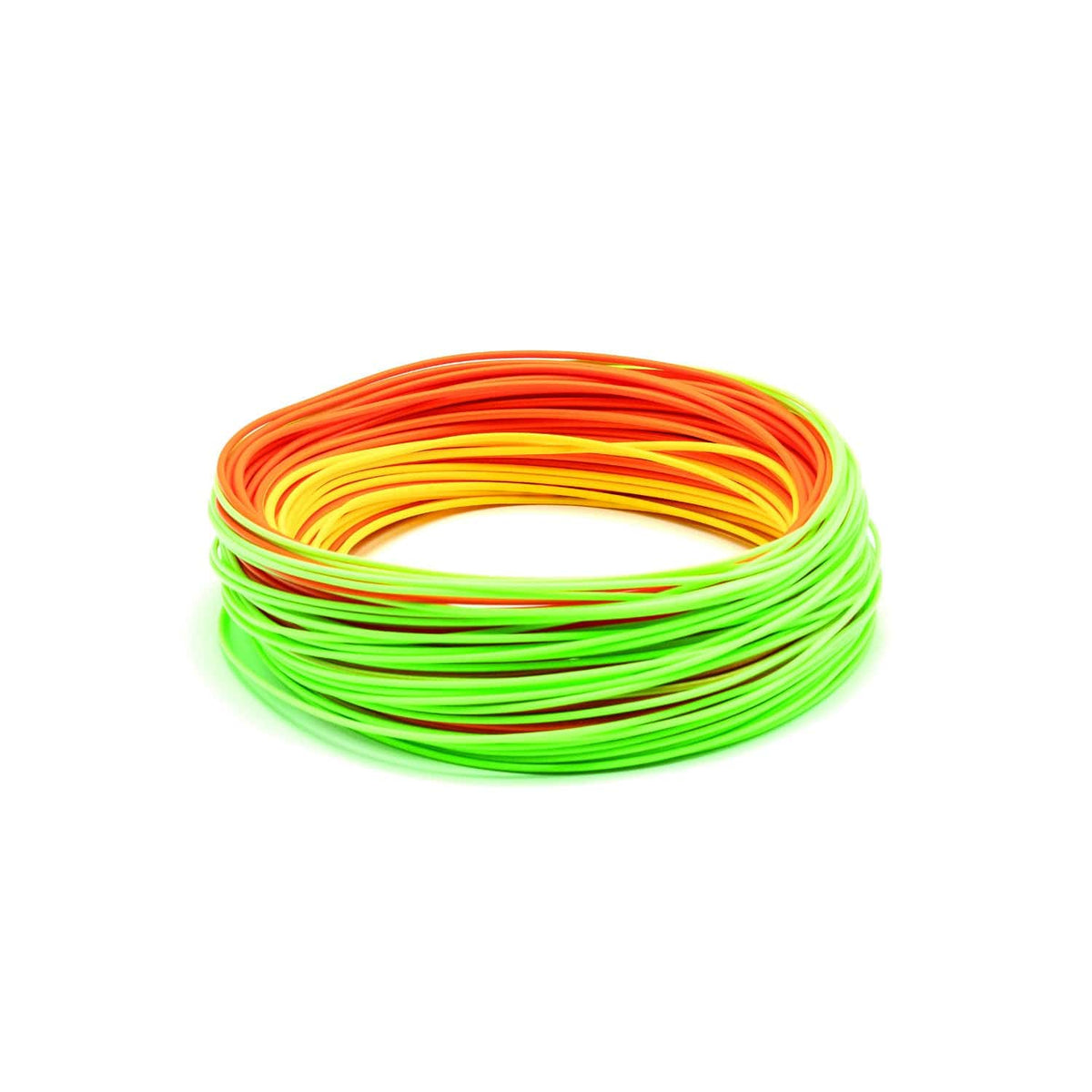
This is also why so many modern trout lines come in two or three colours. Those aren’t decoration — the colour change marks where one section ends and the next begins, so you can see at a glance how much head you have outside the tip top. Once you start using it, it’s genuinely hard to go back to a single-colour line and guess.
Two tapers you’ll actually choose between:
| Weight-forward (WF) | Double-taper (DT) | |
|---|---|---|
| Shape | Mass concentrated in a front head, then thin running line | Symmetrical, weight spread evenly, tapered both ends |
| Best at | Distance, wind, weighted rigs, all-around | Delicate presentation, roll casts, mending |
| Trade-off | Slightly less delicate at very short range | Won’t shoot distance |
| Bonus | Easiest to cast — the default | Reversible: flip it when one end wears out |
| Fish it for | ~90% of trout fishing | Small-water dries, glass and cane rods, spring creeks |
- Weight-forward (WF) front-loads the mass so it loads the rod quickly and punches distance and wind. This is what roughly 90% of anglers should fish — it’s the easiest to cast and the most versatile, and nearly every all-around trout line on the shelf is a WF. If you own one line, make it a WF floater.
- Double-taper (DT) is symmetrical, spreading the weight evenly with matching tapers at both ends. It lands more delicately, roll-casts and mends beautifully at short range, and you can flip it end-for-end when one side wears out — a nice frugality bonus. It’s the small-water dry-fly and bamboo/glass choice. It just won’t shoot line like a WF, so it’s a specialist, not a default.
There are aggressive short heads built for streamers and long fine heads built for spooky dry-fly work, but WF-versus-DT is the only taper decision most trout anglers ever actually need to make.
The detail that quietly matters most is the front taper: long and fine delivers a soft, accurate dry-fly turnover; short and steep delivers aggressive turnover for air-resistant or weighted flies. When a line “lands too hard” or “won’t turn over my dry,” the front taper is usually the culprit, not your stroke.
And the front taper doesn’t work alone — it hands off to the leader, which is its own tapered system doing the same job at a smaller scale. A fine front taper married to a leader with a butt section that’s too limp will still pile up, and you’ll blame the line. I’ve written the whole downstream half of that handoff up in leaders and tippet for tailwater trout; the short version is that the two tapers have to agree with each other. I spent years tuning only one of them and wondering why my dries landed in a heap.
Floating, sink-tip, or full-sink?
For trout, this is a short conversation. Density relative to water decides where your line fishes, and sink rate gets measured in inches per second (IPS):
- Floating line — the default, and what you’ll fish the overwhelming majority of the time for trout: dries, nymphs, indicators, dry-dropper. It floats because the PVC coating is loaded with millions of hollow glass or polymer microspheres, which drop the whole line’s density below water’s. A floating line is, functionally, a very long piece of foam. If you own exactly one line, it is this one.
- Sink-tip — the front 10–15 feet sinks while the rest floats. It gets a streamer down in current without surrendering all your line control. This is the streamer angler’s workhorse.
- Full-sink / intermediate — the whole line sinks at a graded rate (intermediate is just barely sub-surface). Stillwater and committed deep streamer work.
For tailwater and most river trout fishing, a quality weight-forward floating line covers very nearly everything. The sink-tip comes off the bench when I’m committed to swinging or stripping streamers — which happens, but it’s the exception, not the rule.
Worth being clear about why any of this matters to me personally, since a lot of Colorado tailwater writing lately reads as though tight-line nymphing had won outright. My season splits roughly evenly. Half of it is a tight-line euro rig on the South Platte, where a mono leader does the casting and the fly line never leaves the reel — and on those days everything in this post is irrelevant. The other half is a 5-weight with an actual weight-forward floating line on it: dry-dropper water, rising fish, wind, distance, anywhere I need to reach across a seam or put a dry on a riser forty feet away. For that half, the line is the tackle. A euro rig can’t do it, and no amount of sighter technique substitutes for a taper that turns over.
Does an expensive fly line actually matter?
Yes — more than almost anything, and it’s the single best value upgrade in fly fishing. This is the one place I’ll tell you to spend without much hand-wringing, and it’s the opposite of my advice on rods.
What you’re actually buying is three things. First, a slickness additive built into the coating rather than sprayed on top — Scientific Anglers calls theirs AST Plus and describes the slickening agents as living throughout the coating and migrating to the surface as the outer layer wears, so the line stays slick well past the first few outings instead of scuffing off; RIO’s SlickCast is the same category of technology, though RIO doesn’t describe the mechanism in those terms. Second, a taper engineered to turn over cleanly rather than extruded to a generic profile. Third, a supple core that doesn’t fight you with memory coils, which you’ll appreciate in February. A cheap or worn line cracks, gets sticky, holds coils like a Slinky, and casts like a rope — and the angler dutifully blames the rod or the stroke.
Here’s the rule worth tattooing on your stripping hand: if your casting suddenly got worse, check the line before you buy a new rod. A fresh premium line on a mid-priced rod will out-cast a tired old line on a flagship, every single time. A line at around a hundred dollars is the highest return-on-dollar purchase in the entire sport, and it’s roughly a tenth of what a flagship blank costs. A $1,000 rod with a dead line is a very expensive way to cast badly — which is also most of my answer to whether an expensive rod is worth it: buy the line first, then ask the question again.
How long does a fly line last?
A season or two of regular use before the coating starts cracking and the line loses its slickness — though it varies a lot with care, sun, and grit. The enemies are UV, heat, and dirt. Clean it occasionally with a damp cloth, keep it off hot truck dashboards (a fly line cooking on a black dash in a Colorado parking lot ages a year in an afternoon), give it a stretch before you fish to pull out the spool memory, and replace it the moment it stops shooting smoothly. It’s the cheapest meaningful performance upgrade you’ll ever make, so don’t nurse a dead one out of stubbornness.
My take
If you want a single answer: buy Scientific Anglers Amplitude Smooth Infinity in your rod’s line weight, floating, around $100. It’s half-size heavy, which suits nearly every modern graphite trout rod at real fishing distance, and it is the line I’d hand someone who doesn’t want to think about this again for two seasons. Go to the Trout Expert instead only if you fish long flat presentations to spooky fish, and to Creek Trout only if your water is genuinely tight and close. Budget about fifty dollars a season for line, replaced on a schedule rather than when it fails.
Next up: now that the line’s sorted, dial in what’s past it — my South Platte nymph rigging and building a euro rig from scratch — and if you’re still rod-shopping, here’s whether an expensive rod is actually worth it.