
In this guide
May on the South Platte means PMDs. The Pale Morning Dun hatch runs through most of June on Deckers, starts showing up earlier on warmer years, and when it fires, the fish stop eating everything else and lock onto emergers in the film. Dries won’t cut it. Fully sunken nymphs miss the window. Trout are feeding at the surface, but they’re taking bugs that haven’t fully broken through the shuck yet. I’ve stood there mid-hatch swapping dries for twenty minutes while trout sipped six feet away, ignoring me with what I can only describe as contempt.
That’s exactly what the Barr Emerger was built for — and exactly the fly I should’ve tied on first.
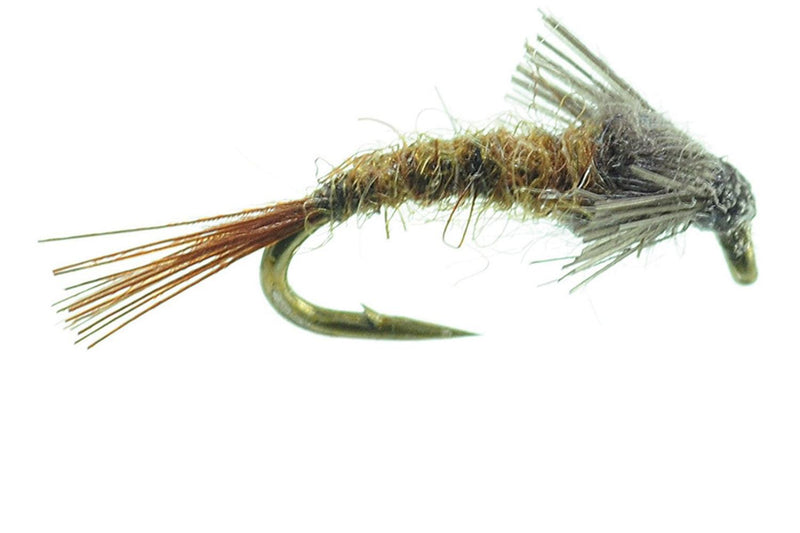
John Barr developed this pattern in the 1970s on Colorado’s South Platte, chasing selective trout keyed on emerging Baetis (BWOs). He needed something that imitated a mayfly stuck mid-emergence — body half in the nymphal shuck, unable to fully escape. That’s the most vulnerable point in a mayfly’s life, and trout know it. The Barr Emerger nails that silhouette with a minimal number of materials.
It’s been a South Platte staple ever since. You’ll find it in every serious box on Deckers.
The short answer
The Barr Emerger is John Barr’s South Platte pattern for trout keyed on mayflies stuck mid-hatch — tie the PMD version (Pale Yellow) in #16–18 and the BWO version (Olive) in #18–22, and fish it dead-drift 10–14 inches off the bend of a #16–18 Copper John at Deckers. PMD season runs late May through June; overcast BWO days go March–May and again in September–October. If I could carry one, it’s the PMD in #18 — that late-May-through-June window is where it earns its slot.
The Recipe
There are two primary versions — PMD and BWO. The recipe is identical except for color.
Hook: TMC 2487 or 2488, sizes #16–18 for PMD / #18–22 for BWO
Thread: 8/0 Iron Dun or Tan
Shuck/Tail: Brown spade hackle fibers (10–12 strands, half a shank length)
Abdomen: SuperFine dubbing — Pale Yellow or Cream for PMD / Olive for BWO
Wingcase: Dark Dun spade hackle fibers, tied at the front of the abdomen
Thorax: Grey muskrat or beaver dubbing, formed into a slightly wider ball
Legs: Tips of the wingcase fibers, pulled back along the hook sides
The curved hook (TMC 2487 or 2488) is important. It puts the shuck at the correct angle — bent slightly downward as if the body is still partially trapped. A straight hook doesn’t give you the same profile.
The abdomen should taper from the shuck base to about 75% of the shank. The thorax fills out the front quarter. Keep both sections sparse. This fly is not supposed to look bulky.

When It Matters on the South Platte
PMD hatches on Deckers typically start showing around late May and run through late June, with the best activity in the 10am–2pm window. The fish get dialed in to emergers fast. Once you see rises and the fish aren’t taking a parachute Adams or a Sparkle Dun off the top, switch to the Barr Emerger.
The Dream Stream runs hot with PMDs too, usually a couple weeks behind Deckers due to elevation. Eleven Mile Canyon gets them later in the summer.
BWO hatches are a different story. They run March through May and then again in September–October. On overcast days at Deckers — especially after a cold front — BWOs come off and the emerger pattern outperforms any dry. The olive version in #18–20 is the one to have for those days.
Cheesman Canyon fishes BWOs well in spring, but the canyon gets pressured quickly during hatches. If I’m there, I’ll fish the Barr Emerger on a straight 6X or 7X tippet as a single fly — no indicator, no dropper. Just dead drift through the slots. The South Platte hatch calendar shows the full seasonal overlap between BWO and PMD windows across the system.
Rigging Options
Dropper off a Copper John — This is how I fish it most on Deckers. Tie a Copper John in #16 or #18 as your point fly, then drop the Barr Emerger 10–14 inches off the hook bend. The Copper John sinks, the Barr Emerger suspends just below or at the surface. Use a small thingamabobber if the water is faster; go indicator-free on slower tailout water.
The Hopper-Copper-Dropper (HCD) — Also John Barr’s system. A large foam hopper as the indicator, Copper John as the point fly, Barr Emerger as the dropper. This works well in faster pocket water on Deckers when the fish are holding behind boulders and you want to cover water quickly. In May, the hopper doesn’t need to match anything — it’s just serving as a floating indicator.
Single dry emerger on 7X — When fish are sipping in slow, clear water and you can see the rises, go light. Single fly, long leader, fine tippet. Drop the Barr Emerger flush in the film and focus on drag-free drift. This is harder to pull off but when it works, it’s satisfying.

My take
The Copper John rig is the one I actually fish, and not because it’s clever — because it removes a decision. When PMDs start popping at Deckers I have a documented habit of standing mid-hatch, swapping dries while trout sip six feet away; the fix is having the emerger already rigged behind the point fly before the hatch finds me. I carry both colors, but if I had to keep one it’s the PMD in #18 — that late-May-through-June window at Deckers is where this fly earns its slot for the whole season.
Presentation Notes
Dead drift is the baseline. Most of the time that’s all you need. The fly is designed to look like something stuck — not something swimming.
That said, a slight twitch on the swing at the end of the drift can trigger fish that followed the fly but didn’t commit. Don’t overdo it. One small lift of the rod tip as the fly starts to drag is usually enough.
Depth matters more than anglers think. The PMD Barr Emerger should be riding at or just below the surface film. If it’s sinking too deep — more than a few inches — you’re missing the window. Dress your tippet with floatant, or use a floating version of the pattern if you’re tying your own. On slower water, you can fish it as a dry emerger by applying CDC dust or Shimazaki Dry Shake to the fly itself.
On the BWO, I’ll sometimes fish it slightly deeper — 6 to 8 inches below the surface — during a slow morning hatch when fish are feeding subsurface before the bugs start popping. That usually changes around 10am when the hatch intensity picks up and the fish move into the film.
What It Doesn’t Replace
The Barr Emerger is a hatch-specific tool. It’s not a searching pattern and it’s not going to do much when nothing is hatching. I carry the PMD version in #16 and #18, the BWO version in #18 and #20, and I keep them for the windows when fish are clearly targeting emergers.
If you’re fishing Deckers in late May and the fish are showing in the film but refusing your dries, tie on the Barr Emerger before you start changing everything else. Ninety percent of the time, that’s the fix — and it’ll save you the twenty minutes of fly-box archaeology I keep insisting on relearning the hard way.

Build Your Box Now
May is here. PMD season is opening. If you don’t have Barr Emergers in your box — PMD Pale Yellow in #16 and #18, and BWO Olive in #18 and #20 — go tie or buy some — The Fly Fishing Place carries the BWO version (15% off through our link) — before your next trip to Deckers. They’re simple to tie, cheap to buy, and when the fish lock onto emergers during a PMD hatch, nothing else on the river works as well. For a complete picture of the PMD emergence timing and what else is hatching alongside it, the PMD hatch guide for the South Platte is worth a read before the season opens.
Tie on a couple, tuck the box where you can actually find it, and you’ll be the one sipping coffee while the angler downstream cycles through his fly wallet. Don’t gloat too hard. That was you last week.