
In this guide
The South Platte didn’t invent Walt’s Worm, and Walt Young didn’t design it for tailwaters. He tied it in 1984 for Spring Creek in central Pennsylvania while looking for a lead nymph that worked everywhere. In its first serious test, it caught 23 fish against 3 for the pattern he’d been confident in. Word spread through the Fly Fisher’s Paradise shop where he worked, and eventually the fly made it out of Pennsylvania.
On Deckers, with its dense scud population in the aquatic vegetation along every bank, this fly gets inspected and eaten regularly. Its buggy hare’s ear body is close enough to a Gammarus scud, a cased caddis, or a crane fly larva that fish commit to it. You don’t always know which one they think it is. Neither does the fish, probably. It looks like food, and after enough fishless mornings second-guessing my fly choice, I’ve made my peace with “looks like food” being the whole strategy.
The short answer
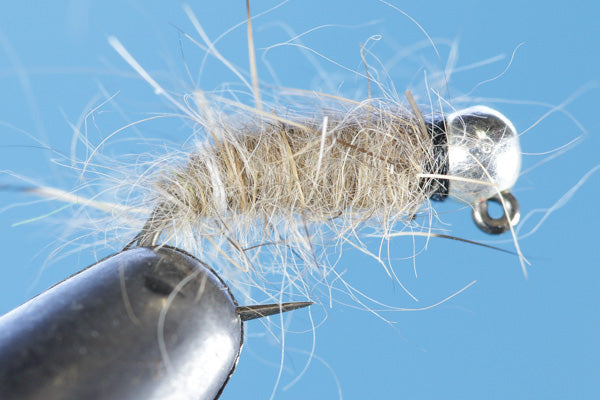
Walt’s Worm is a scruffy natural hare’s ear nymph — a fat cigar-shaped body of Hareline Hare’s Ear Plus #1 on a jig hook with a slotted tungsten bead, tied #14–18 for the South Platte and picked out hard so it pulses in current. Fish it as the heavy point fly (bottom anchor) with a smaller RS2, Zebra Midge, or Juju Baetis 18–20 inches above on a tag — natural tan year-round, olive with a chartreuse hotspot in summer, and it shines on Deckers where the scuds live.
Tie it ugly, fish it without a second thought — that’s the whole trick.
The Recipe
The original Walt’s Worm is Hare’s Ear Plus and not much else. Modern versions add a jig hook and occasionally a fluorescent hotspot, but the core material is unchanged — natural hare’s ear with clear Antron mixed in, picked out aggressively to create movement.
Hook: Standard curved nymph or jig hook — Tiemco 5262, Firehole 551, or Umpqua C450, sizes #8–18 (South Platte: #14–18)
Bead: Slotted tungsten, gold, 3.3mm / 1/8” for size 14
Weight: Lead wire, .015” for sizes 12–16, .010” for size 18
Thread: Uni 6/0 or Veevus 6/0, olive or tan
Body: Hareline Hare’s Ear Plus #1 (natural) — fat cigar shape from bend to bead, picked out hard
Rib: UTC Ultra Wire Copper, small — for durability
Optional hotspot: Fluorescent pink or chartreuse thread, 2–3 wraps behind bead
The body shape matters. It should be a cigar — fat in the middle, tapering at both ends. Don’t make it skinny. I know the instinct is to tie everything slim and tidy; fight it here. The bulk is part of the silhouette. Pick out the dubbing aggressively after you rib it — those loose fibers create the pulsing movement that makes this thing work in current.
For the South Platte, the olive variant with a chartreuse hotspot is worth having in summer. Natural tan covers the rest of the year.
My take
Tying this fly cured a bad habit of mine. I used to treat every pattern as a canvas — add a hotspot, slim the body, one more clever improvement — and the Worm punishes exactly that instinct. The versions I prettied up got inspected; the rough ones got eaten. So now I tie them a dozen at a time, deliberately scruffy, picked out until they look half-destroyed, and I fish them without a second thought. A fly that asks nothing of you on the water is worth more than a brilliant one you have to keep talking yourself into.

When It Matters on the South Platte
Deckers is where this pattern makes the most sense on Colorado tailwaters. The South Platte below Cheesman Reservoir has significant scud populations, especially in the bank vegetation between Deckers and Trumbull. In natural tan, sizes 14–16, the Worm passes easily as a Gammarus scud tumbling through the drift. Flies & Lies mentions it specifically in December and March reports for Deckers conditions. It produces year-round, but fall and winter are its strongest window.
Dream Stream responds well to it in the slower flats where scuds are equally abundant in the Spinney Mountain reservoir influence. Sizes 14–16 in both natural and olive. Fish it as a lead fly through the deeper seams between weed beds — it’s heavy enough to reach bottom in the deeper runs without requiring a full euro rig.
Cheesman Canyon takes it well in the transitional water between fast runs and slower pools — not in the fastest pocket water where a heavier Perdigon is more useful, but in the tailouts and slower canyon pools.
How to Fish It
Walt’s Worm is the heaviest fly in the rig. Point fly, lead nymph, bottom anchor — however you want to describe it. Run a smaller RS2, Zebra Midge, or Juju Baetis 18–20 inches above it on a tag.
It works under an indicator in standard nymphing (weight to bottom, let it tick through structure), and it works equally well euro-rigged with no indicator. On Deckers in flows under 200 cfs, I’ll usually fish it on a euro setup — my Diamondback with 5X fluorocarbon. Above 200 cfs, an indicator on the Centric helps keep track of it.
The fly drifts best when it’s bouncing. Let it tick the bottom — that’s where the scuds actually are. Fish that refuse the exact same fly drifted a foot off the bottom will eat it when it’s dragging through the gravel.
There’s a reason this pattern survived forty years without changing. Some flies get refined into obsolescence. Walt’s Worm got the proportions right in 1984 and nothing has improved on it since. I’ve got drawers full of clever modern nymphs that were going to be the answer. The ugly hare’s ear cigar keeps out-fishing most of them, and at this point I’ve stopped being insulted by it.