
In this guide
Russell Blessing tied the first Wooly Bugger in 1967 in Reading, Pennsylvania. He was a smallmouth bass guy chasing something that imitated hellgrammites. What he ended up with is probably the most-tied fly pattern in fly fishing history — not bad for a guy who was just trying to catch a few bass. Every fly box in every country, on every river, has at least one of these in some color. Including mine, in about six colors, because apparently “if you carry one color” advice is for other people.
On the South Platte, the Wooly Bugger isn’t your first fly during a winter midge rig. But when fall browns are pre-spawn and aggressive in October, when high spring runoff washes meat into the system, when you’re prospecting through deep pools where no nymph has gotten a look — the Bugger earns its place. The marabou tail moves like everything fish eat: leeches, baitfish, sculpins, crayfish. The fish doesn’t have to decide what it is. It looks alive. It gets eaten.
The pattern has been refined, articulated, beadheaded, conehead, rubber-legged, flash-tailed, and stacked into every possible variation. Fifty-plus years of tiers trying to improve it. The original three-material recipe — marabou tail, chenille body, palmered hackle — still catches everything anyway.
The short answer
The Wooly Bugger is a three-material streamer — marabou tail, chenille body, palmered hackle — and on the South Platte you fish it in black or olive, sizes 6–10, swung across-and-down at a 45-degree angle on 2X or 3X fluorocarbon. It earns its place for fall pre-spawn browns (October–November at Deckers, Cheesman’s deep pools, and the Dream Stream) and for high spring runoff when nymph rigs blow out. If you carry one color, black covers the most situations on this river.
Not bad for a fifty-year-old bass fly. Everything below is the recipe, the rivers, and how to fish it.
The Recipe
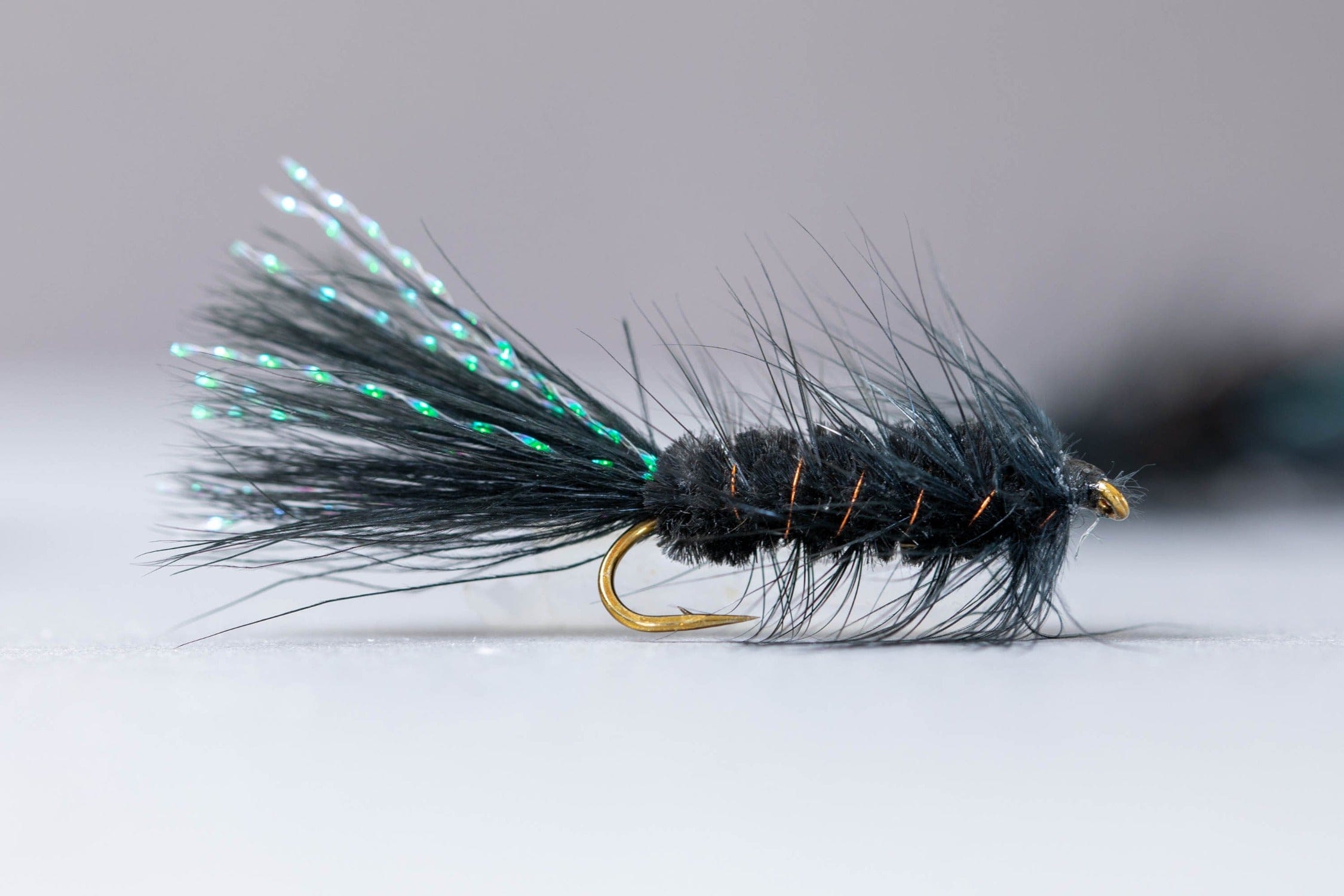
The Bugger is forgiving, which is good news for the way I tie. Tie it ugly, tie it pretty, weight it heavy or light, fish it any color — they all work. The recipe below is the standard tungsten beadhead version that fishes well on the South Platte in moderate flows.
Hook: TMC 5263 (3XL streamer) or TMC 9395, sizes #4–12 (South Platte: #6–10)
Bead: Tungsten cone or slotted bead, 3/16” for #6–8 — black or gold
Weight: Lead wire, .020”, 10–15 wraps under bead for body weight
Thread: UTC 70 Denier or 6/0 Uni, color matching body (black, olive, brown)
Tail: Marabou plume, hook gap length — black, olive, or brown
Flash (optional): Krystal Flash, 4–6 strands inside marabou tail
Body: Crystal chenille (UV variant) or standard chenille, palmered tight
Hackle: Webby saddle hackle, palmered through body in even spirals
Color rotation for the South Platte: Black for low light and fall browns. Olive for daytime, year-round generalist use. Brown for sculpin imitations in rocky water. White-and-olive (Thin Mint variation) when fish are keying on baitfish. If you carry one color, black covers the most situations on this river.
The marabou is the trigger. Length matters. A tail roughly equal to the hook shank gives the right action — too long and it tangles around the hook bend on the cast; too short and it kills the movement. Strip the bottom fibers off the marabou stem before tying in; the soft, webby barbules above the strip do the work.
Palmer the hackle in even spirals — five or six turns through the body, secured with the wire rib. The hackle is what gives the body its pulsing volume in current.
My take
For all my tinkering instincts, the Bugger is the one fly I refuse to complicate. I own it in six colors and fish two — black and olive cover everything I actually need on this river, and the rest ride along for moral support. But the honest reason it never leaves the box: swinging one through a deep pool in October is the most fun I have all fall, the kind of take that snaps you out of three months of indicator-watching. Results keep a fly in the rotation. Fun keeps it tied on a little longer than the results strictly justify.

When It Matters on the South Platte
Deckers in the lower section pocket water — the broken water below the bridge that doesn’t get the same nymph pressure as the upper Cheesman side. Fall is prime, October and November, when brown trout aggression peaks before spawning. Fish black or olive Buggers in sizes 6–8 with a downstream swing or short strip through deep pockets. Spring runoff fishes the Bugger well too, when flows blow out the standard nymph rigs and pushes fish to bank structure.
Cheesman Canyon in the deep canyon pools, swung through the slower water at the tail of major pools. Not your first choice in the canyon’s broken pocket water — too snaggy and too crowded for streamers. But in the deep pools that hold the largest fish in the canyon, a slow swung Bugger draws strikes that nymphs miss entirely.
Dream Stream during the brown trout pre-spawn run in October and November, and again during the rainbow run in March. Larger fish push through the Dream Stream during these windows, and they’ll eat streamer-presented Buggers more aggressively than they’ll eat anything dead-drifted. Olive or black in size 6, swung across-and-down through the deeper seams between weed beds.
How to Fish It
Streamer presentation. This is not a nymph rig — leave the indicator at home, and resist the urge to overthink it. Cast across-and-down at a 45-degree angle, mend once if needed to set the swing depth, then let the fly sweep through the run. The strike usually comes at the bottom of the swing when the fly is hanging directly downstream.
Strip retrieve is the alternative. Three to four-inch strips with brief pauses between. Fish often hit on the pause, not the strip — the marabou pulses when the fly stops, and that’s when an aggressive trout commits.
Tippet: 2X or 3X fluorocarbon. The Bugger isn’t a finesse fly. Heavy tippet works fine, and you’ll need it when a big brown takes deep in pool structure and tries to bury you in submerged wood.
Dead-drift the Bugger when fish refuse the swing. Run it under an indicator at depth like a nymph, through deep seams and along bank structure. Browns in pre-spawn aggression eat dead-drifted leeches all the time — they’re not always chasing.
A Bugger doesn’t replace your nymph rig on the South Platte. It complements it. Carry three sizes in two colors, fish them in the conditions where bigger food matters, and they’ll keep earning the second-most-valuable spot in your box behind the size 22 midge pupa that does most of the work. Not bad for a fifty-year-old bass fly that three materials and a bad haircut can produce. Russell Blessing knew exactly what he was doing — the rest of us are just still copying it.