
In this guide
The RS2 isn’t a Colorado fly. It’s THE Colorado fly. Rim Chung tied it in Denver in the early 1970s for one specific problem: South Platte trout that had stopped eating every standard mayfly emerger he was throwing at them. RS stood for “Rim’s Semblance.” The number two was the version that finally got everything right — which, if you’ve ever stared at a fly you tied at 11 p.m. and asked it why it isn’t working, is a humbling level of patience. Fifty years later, it’s still in every box on Cheesman, Deckers, and the Dream Stream. Mine included, in numbers I’d rather not count out loud.
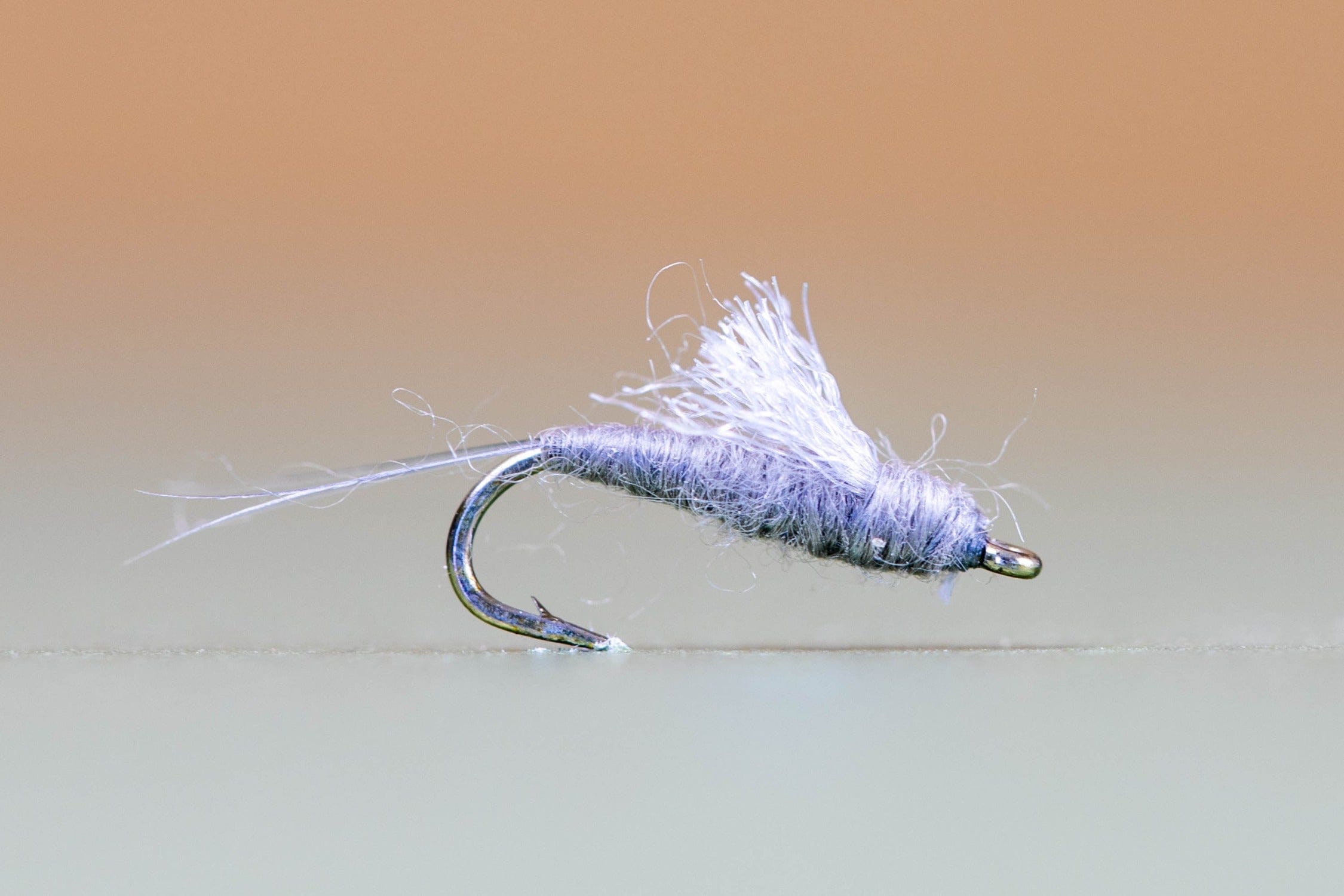
What Chung figured out is that South Platte fish — pressured, conditioned, selective — were rejecting the silhouette of every hard-bodied nymph in the standard rotation. They wanted something that looked like a mayfly halfway out of its nymphal shuck. Soft profile, sparse wing, suggesting movement rather than committing to anatomy. The RS2 doesn’t really look like one thing. It looks like emergence.
That’s the whole game on this river. Fish don’t always eat what’s most accurate — they eat what reads as alive in the drift. Took me a few too many fishless afternoons to believe that, but the fish were right and I was wrong, as usual.
The one-fly answer
The RS2 is Rim Chung’s South Platte emerger — a slim, sparse-winged mayfly-emergence pattern fished small (#20–24) on a tag dropper 16–20 inches behind a heavier anchor, up in the film, not on the bottom. If you carry one, make it Adams gray in a size 20; add olive if you carry two (olive for spring Baetis, rusty brown for fall, black for winter midge). Everything below is the recipe, the color rotation, and where it earns its tag spot on Deckers, the Dream Stream, and Cheesman.
The Recipe
The RS2 is a forgiving fly to tie if you stay disciplined about proportion — and “disciplined” is the operative word for those of us who treat dubbing the way I treat a buffet. The wing must be sparse. The body must be slim. Both should taper, not bulge.
Hook: TMC 101 or Daiichi 1130, sizes #18–24 (South Platte: #20–24)
Thread: Veevus 16/0 or Uni 8/0, color matching body (gray, olive, rusty, or black)
Tail: Microfibetts, dun, 2 fibers split into a “V”
Body: Superfine dubbing, tightly twisted on thread — tapered slim from hook bend
Wing: Snowshoe rabbit foot hair or natural CDC, white or dun, sparse — about 10–12 fibers
Color rotation for the South Platte: Adams gray for general BWO emergence, olive for spring Baetis, rusty brown for fall Baetis, black for winter midge emergence. If you carry one color, gray covers the most situations. If you carry two, add olive.
The wing is the trigger. Don’t overdo it. A sparse wing that lays low across the body suggests a wing partially out of the shuck — that’s what fish are responding to. Stack the fibers, trim them clean, set them at an angle that breaks the water tension. Overdressed wings turn an emerger into a dry fly.
When It Matters on the South Platte
Deckers runs the RS2 year-round. There isn’t a single hatch on this river that doesn’t have an RS2 dropper in the rig at some point. Spring BWO emergence (March–May), fall BWO emergence (September–November), and winter midge emergence (December–February) all key on emerger profiles. Gray and olive in sizes 20–22 cover spring. Rusty brown and gray in sizes 20–24 cover fall. Black or gray in sizes 22–24 cover winter midge.
Dream Stream during BWO emergence in March, April, and again in October. Fish hold in the slower flats between weed beds and lock onto emergers in the film. RS2 size 20 in gray or olive, fished as a dropper 16–20 inches behind a heavier anchor (a Pheasant Tail, Frenchie, or small midge pupa).
Cheesman Canyon during BWO emergence in slower pools and tailouts. Not your first choice in the canyon’s fast pocket water — fast water hides the emerger profile. But in the slower transitional water at the heads and tails of pools, it’s exactly the right tool when fish are eating in the film.
My take
Practical verdict: the RS2 is the closest thing my rig has to a permanent resident. Point flies rotate with the season; the gray RS2 on the dropper tag mostly just stays, because on this river, betting on emergence is rarely wrong. If you take one fly from this post, make it gray in a size 20 and fish it behind your heavier nymph. I’ve drifted into carrying more of them than any adult should admit to — but when a pattern keeps earning its tag spot through every hatch on the calendar, restocking it stops being a decision.
How to Fish It
Tag dropper. Always. The RS2 is too small and too light to fish as a point fly — it doesn’t carry weight and won’t reach depth on its own. Run it 16–20 inches behind a heavier nymph in either an indicator rig or under a sighter on a euro setup.
The right anchor depends on water. Perdigon for fast pocket water. Frenchie or Pheasant Tail for medium-paced runs. Small midge pupa for the slowest flats. The RS2 follows.
5X tippet from the anchor to the dropper tag, then 6X tippet between dropper and the RS2 itself. In low, clear conditions at Deckers below 150 cfs, go 6X straight through.
Fish it shallow. The whole point is the film. If your rig is dragging the RS2 along the bottom, you’ve put it in the wrong layer of water column. The fish are looking up — your fly should be up too.
When you see a sighter hesitate or your indicator move sideways in the film, set fast. Emergers get eaten subtly. The take is rarely violent. By the time you think “was that a strike,” the fish has spit it.
Fifty years on, a guy in Denver still out-fishes most of us with a hook, some thread, and a pinch of fluff that doesn’t look like much of anything. There’s a lesson in that, and it isn’t “buy more flies” — though if you’ve seen the state of my fly boxes, you know I’m the last person who should be preaching restraint.