
In this guide
The South Platte looks simple from the bank. Clear water, visible fish, defined structure. You stand there thinking this’ll be easy. It will not be easy. The fish in Cheesman Canyon have been educated by thousands of anglers and they sit exactly where they can eat efficiently with minimal energy expenditure — which means reading the right holding lies matters more here than almost anywhere else I’ve fished. These trout have seen more flies than I have, and I tie a lot of flies.
After a lot of days on the water, most of them on the South Platte, here’s how I read the river. I’ve earned plenty of this the hard way — by staring at the wrong piece of water for an hour while the fish ate three feet away.
The short answer
Reading water on the South Platte comes down to one rule — trout hold in the softest water next to the most productive current — and where that is changes by section and flow: in Cheesman Canyon it’s the pockets and deflection seams around granite boulders and the first 4–6 feet past a drop-pool lip; at Deckers it’s the subtle creases of flat-water feeding lanes and the undercut banks that hold the biggest fish; on the Dream Stream it’s the channel edges and the 2–3-foot gravel cuts. Below 100 CFS at Cheesman the fish stack tight behind individual boulders; at 200+ CFS those pockets wash out and fish move to bank structure, while the Dream Stream reads best at 100–150 CFS.
That’s the map. Everything below is how to actually see it once you’re standing in the river — because the fish vote with their positions, and the whole game is learning to count the votes.
The Basic Principle
Trout choose positions that maximize food intake while minimizing energy spent holding. On the South Platte, the food is drifting nymphs, emerging midges, and PMDs. The fish are looking for soft water adjacent to productive current — a place where they can see what’s coming without fighting the main flow.
That sounds simple. The complication is that “soft water” has fifty different definitions depending on flow rates, river structure, and the specific section. Reading the South Platte means reading each piece of water for its specific current dynamics.
The Cheesman Canyon Read
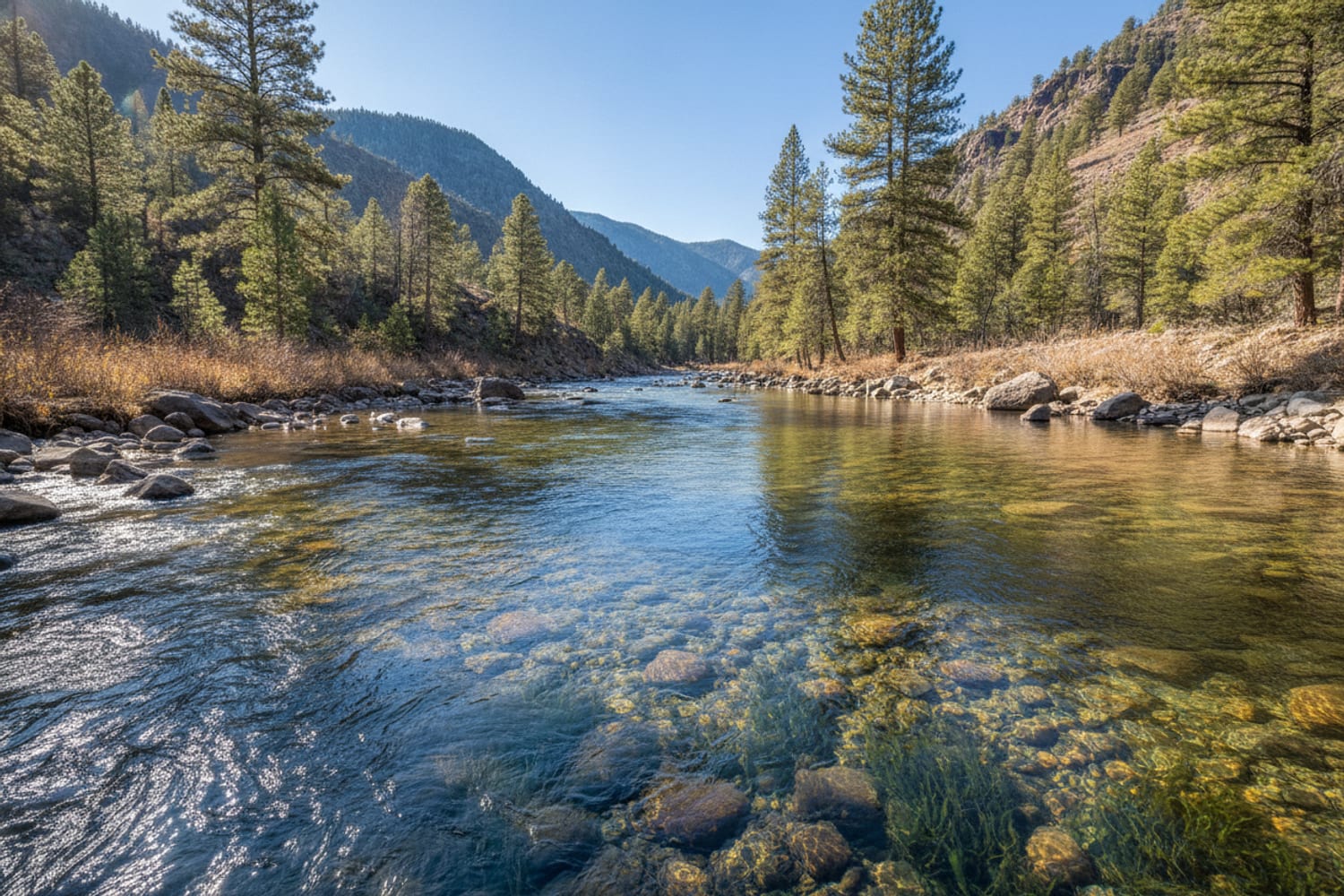
Cheesman is some of the most complex water I fish, and it’s a great teacher. The canyon is carved through Pikes Peak granite — irregular rock formations that create unpredictable hydraulics. You can’t assume the current behaves like a textbook diagram.
Boulder gardens: The main Cheesman runs have large granite boulders scattered through the riverbed. Behind each boulder is a soft hydraulic pocket. In front of each boulder is a deflection seam where current splits. Fish hold in both locations — the pocket behind for resting and ambushing, the front seam for feeding when a hatch is active.
The common mistake is assuming the fish are always in the pocket directly behind the boulder. When a PMD or midge hatch is happening, fish move to the seam in front because that’s where the food is concentrated by converging currents. I’ve fished an empty back pocket for 20 minutes and then walked three feet upstream to find fish stacked on the front seam.
Drop pools: Where a fast riffle drops into a slower pool, the transition zone is almost always productive. The riffle oxygenates the water and concentrates nymphs; the pool provides soft water to hold in. Fish stack just past the lip of the drop, in the first 4–6 feet of the pool where speed drops off.
In Cheesman, these transitions are often 2–3 feet wide. You’re presenting into a small target. The presentation angle matters — come from upstream, keep your shadow off the water, and get the fly to bottom quickly.
The Deckers Read
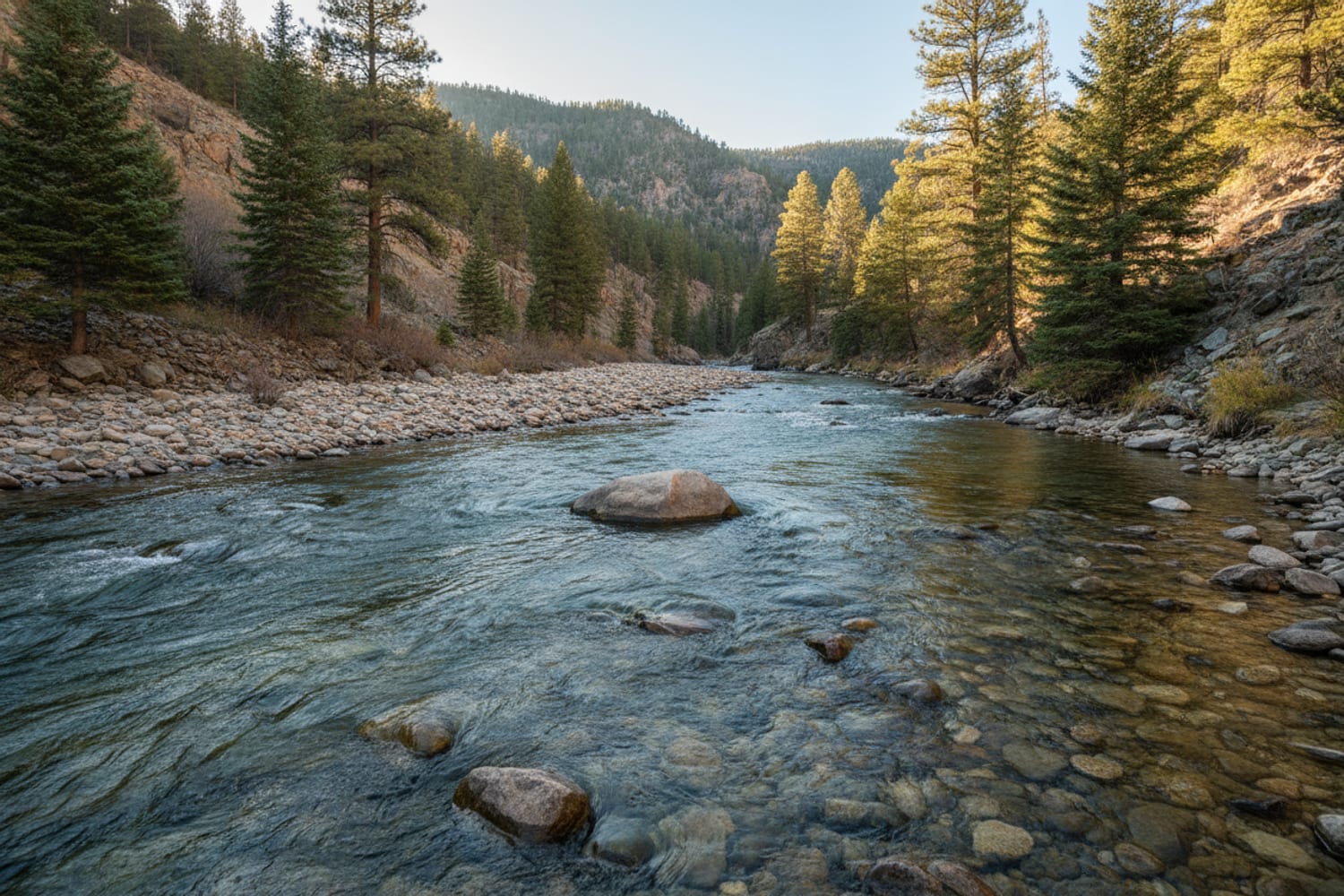
Deckers is a different river than Cheesman. It’s wider, more exposed, and has long flat runs that the Cheesman pocketwater doesn’t — I broke down reading Deckers pocket water versus pool tailouts in its own piece. The fish are visible in the flats and they’re feeding selectively in defined lanes.
Flat water feeding lanes: In flat Deckers runs, feeding fish hold in current lanes where food is concentrated. The key is identifying which lanes are productive at any given flow level. At 100 CFS, the lane might be the far seam along the bank. At 200 CFS, that seam moves as the hydraulics shift.
Look for subtle surface disturbances — a barely perceptible crease in the water’s surface where faster current meets slower. That crease is a feeding lane. In Deckers, I spend 10 minutes watching a run before fishing it. I look for rises or subtle position changes in fish I can see. A fish facing upstream at 45° angle and periodically tipping up is eating emergers — it’s feeding actively and a good target.
Bank structure: The Deckers stretch has sections with undercut banks, root systems, and overhanging willows. These hold the largest fish in the system. A 20-inch brown trout isn’t sitting in the middle of the flat exposed to eagles and ospreys — it’s tucked under a bank cutout in 18 inches of water with a clear view of the current lane.
These fish are difficult targets. The presentation must be precise and close to the bank. The risk of hanging up on vegetation is real. Most anglers walk past these fish. The willingness to get close to the bank and risk the snag is what separates consistent big-fish results from consistently catching average fish.
My take
The opinion that costs me the most pride: when I’m not catching fish on this river, it’s almost never the fly — it’s that I’m standing on the textbook lie instead of the one the fish actually chose that day. Twenty minutes drifting an empty pocket while the fish sat stacked three feet upstream cured me of trusting diagrams over evidence. Now I make myself watch before I wade in, even when my hands are itching to cast. The fish vote with their positions, every hour, at every flow. Reading water is just learning to count the votes.
The Dream Stream Read
The Dream Stream (the Spinney to Eleven Mile section) is unique. It’s a meadow spring creek — wide, slow, clear, and extremely difficult. The fish are in channels and cuts through the meadow substrate, not behind boulders.
Channel edges: The Dream Stream has defined channels carved through softer substrate. Fish hold along the edges of these channels where the bottom drops off and current slows. The edge is often visible — a color change from light to dark where the bottom depth changes. Fish that edge.
Exposed gravel beds: During low flow, gravel bars expose and the productive water narrows to deeper cuts. Fish concentrate. What looks like too little water often holds the most fish when flows are low. The cuts through the gravel bars are 2–3 feet wide and 18 inches deep — exactly what a tailwater brown is looking for.
Wind effect: The Dream Stream is wide open meadow country. Wind creates surface chop that gives fish overhead cover they don’t have in calm conditions. On windy days, fish that were hugging the bank in shadows move into more open water and become more aggressive. High wind at the Dream Stream isn’t a frustration — it’s often an opportunity.

Flow Levels Change Everything
The same run fishes completely differently at 80 CFS versus 250 CFS. This is the variable most people don’t account for when they read water advice written for a different flow level.
Before fishing the South Platte, check the Cheesman river page for live flow (DWR data) or USGS gauge 06701900 for Deckers. At flows below 100 CFS at Cheesman, the pocketwater concentration points are behind individual boulders and the fish stack tightly. At 200+ CFS, the hydraulics wash out those pockets and fish move to bank structure and softer edges.
The Dream Stream reads differently above 200 CFS — the channels blow out and fish scatter. Optimal Dream Stream fishing is often 100–150 CFS when the water is clear and the channels are defined.
Reading water isn’t a skill you develop from articles — it’s something you build by standing in the river and watching. Every hour I spend fishing Cheesman, I learn something I didn’t know from the previous hour, which is a polite way of saying the river still humbles me regularly. It’s always different. Once you can read the water, the next step is knowing which technique to apply — euro nymphing in the tight pockets and indicator nymphing on the longer flat runs at Deckers. Read it right and the canyon stops feeling like a puzzle and starts feeling like a fair fight. Most days.